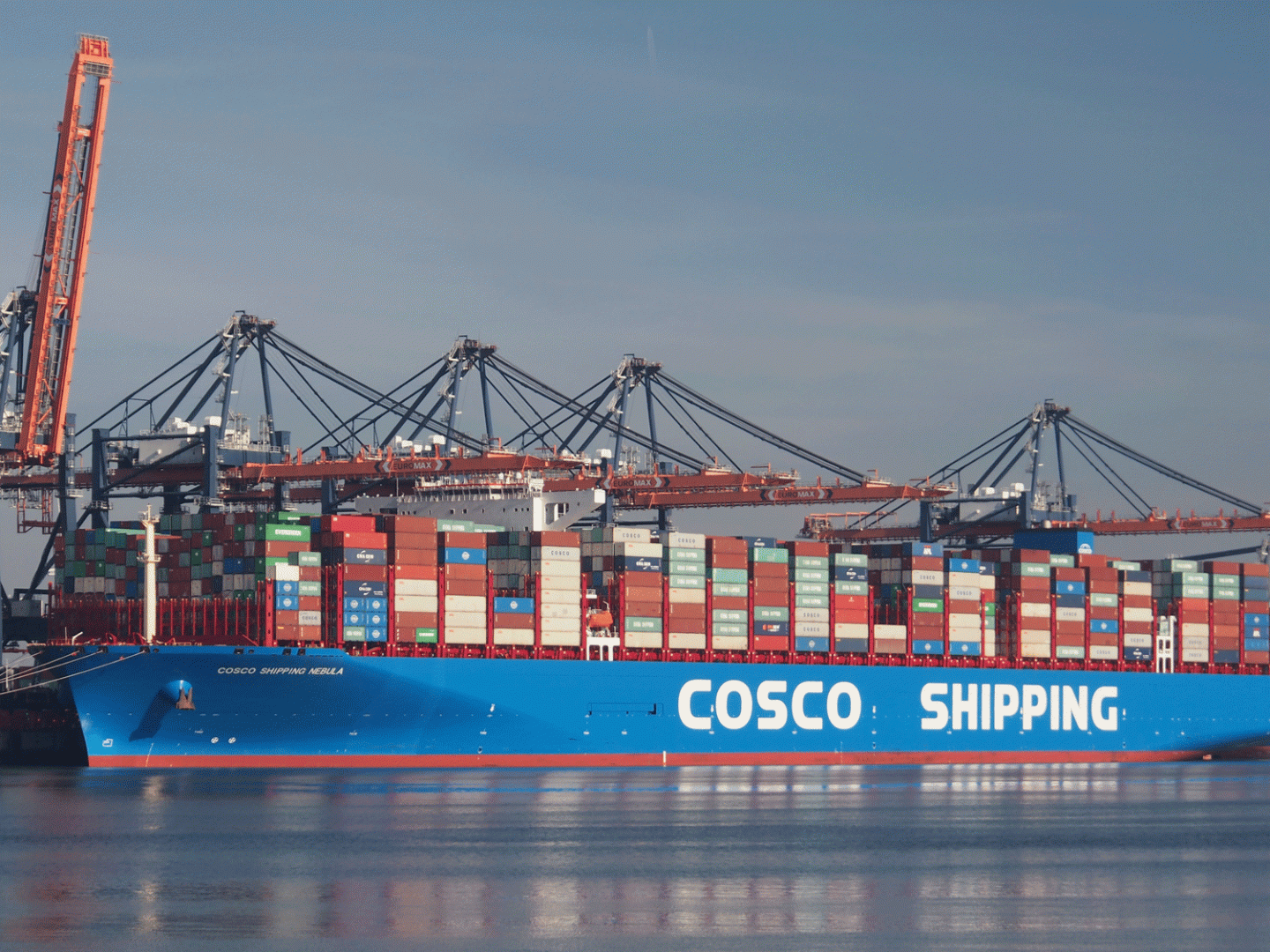
ships at anchor

Container Shipping Faces Prolonged Excess Capacity

The container shipping industry is set for several years of structural oversupply, which will put significant downward pressure on rates, with fleet growth consistently outpacing cargo demand until the end of the decade.

Analysts point to a combination of record vessel orders and limited scrapping as the primary drivers of the imbalance. By mid-2025, global carriers had ordered 2.3 million TEU of new capacity, only slightly below the record levels set in late 2024. The current order-book now totals 9.6 million TEU, equivalent to more than 30% of the active fleet. With 3.3 million TEU scheduled for delivery in 2028 alone, average fleet growth is forecast to remain above 6% per year.

The composition of new orders is also shifting. While demand for ultra-large ships of 14,000 TEU and above remains strong, the most striking increase has come in smaller units. Seventy-four feeder and regional vessels of up to 4,000 TEU were ordered in the first half of 2025, almost matching the entire 2024 total. This investment comes despite the fact that nearly a third of the world’s smaller ships are already over 20 years old, a share set to rise to around half by 2030.

Scrapping activity has stalled at the same time. Just ten ships totalling 5,454 TEU were demolished in the first six months of 2025, compared with nearly 49,000 TEU a year earlier. A strong charter market and resilient cargo flows, combined with continued diversions via the Cape of Good Hope, have encouraged carriers to hold on to older tonnage. Many remain wary of cutting capacity after recent shocks, including the pandemic and Red Sea disruptions, demonstrated the strategic value of surplus vessels.

On the demand side, global throughput is expected to rise 2.6% in 2025, supported by front-loading, fiscal stimulus, and lower effective tariff rates. But growth is forecast to slow to 1.7% in 2026 as inflationary pressures, higher costs, and weaker US job growth weigh on consumption. Asia–Europe routes, where the largest vessels are being deployed, are expected to feel the oversupply most acutely, while transpacific trades face uncertainty once front-loading unwinds.

The imbalance has clear financial and regulatory implications. Analysts expect profitability to bottom out in 2028, when the largest wave of deliveries coincides with a likely return of normalised Red Sea transits. At the same time, retaining older tonnage raises questions around emissions compliance and fuel efficiency as IMO decarbonisation rules tighten.

Industry projections suggest average overcapacity of around 27% through 2028. While unforeseen shocks may disrupt the outlook, the medium-term picture points firmly to a prolonged period of structural pressure on global container shipping.

With vessel supply set to outpace demand for years ahead, oversupply will continue to distort schedules and pressure rates. In this environment, booking space is no longer enough. You need visibility, agility, and the ability to adapt as conditions change, with blanked sailings and service adjustments likely without notice.

Metro’s MVT platform continuously tracks carrier KPIs and vessel position, comparing actual performance across alliances and adjusting supply chains in real time. This data-led approach maintain supply chain resilience, minimises disruption, optimises inventory planning, and safeguards service levels.

EMAIL Andrew Smith, Managing Director, to discuss how we can support your supply chain.

Six question marks 1440x1080 1

H1 2025: Six Developments Reshaping Global Trade

The first half of 2025 has been one of the most turbulent periods for supply chains in recent memory. From renewed tariff wars to fresh geopolitical flashpoints, logistics professionals have had to contend with a constantly shifting landscape.

At the same time, structural challenges around skills, safety, and sustainability have continued to grow. Here we review six developments that defined H1 2025.

1. Tariffs return to the fore
The pause in US tariff escalation ended in August, with the White House reintroducing “reciprocal” tariffs that apply baseline duties of 10% to all countries and higher rates of 10–41% depending on origin. The UK sit at the low end, while Syria faces the steepest levels. Brazil has been singled out further, hit by an additional 40% levy. Canada also saw tariffs raised from 25% to 35% on certain goods, justified by Washington’s claim that Ottawa has not done enough to curb fentanyl flows.

The executive order applies from 7 August 2025, with a grace period allowing cargo already loaded onto vessels before that date to arrive until 5 October 2025. To add complexity, US Customs will also impose new fees on Chinese-built or operated vessels from 14 October, potentially forcing alliances such as the Ocean Alliance into costly fleet reshuffles. Carriers are already working through how to redeploy capacity to avoid penalties, with COSCO and OOCL particularly exposed.

2. New shipping alliances reshape networks
The recomposition of global shipping alliances in Q1 has reshaped carrier strategies. The launch of the Gemini Cooperation between Maersk and Hapag-Lloyd marked one of the most significant realignments in recent years, focused on achieving 90%+ schedule reliability. Shippers are already seeing more dependable services, but questions remain about whether premium pricing will follow.

Other alliances, particularly Ocean and THE Alliance (now Premier Alliance), are recalibrating networks, with competition sharpening across Asia–Europe and transpacific trades. For shippers, the alliance changes mean rethinking service contracts and adapting to new network structures that could endure for much of the decade.

3. Houthi attacks deepen Red Sea crisis
The Red Sea crisis, triggered by Houthi rebel attacks, has now stretched on for nearly two years. In July 2025 the threat escalated further with the sinking of the Magic Seas, a Greek-operated vessel targeted for its links to companies calling at Israeli ports. Analysis suggests that one in six vessels globally could now be considered threatened under the Houthis’ broad definition of violators.

For container lines, this effectively rules out a return to Suez Canal routings before 2026 — and possibly not until 2027. Rerouting around the Cape of Good Hope adds up to two weeks to Asia–Europe journeys, pushing up costs and insurance premiums, and putting additional strain on fleet capacity. The Red Sea instability has been a reminder of how localised conflicts can have global consequences for supply chains.

4. Logistics skills shortages persist
The UK continues to face a significant shortfall in logistics skills, with the Road Haulage Association estimating a deficit of around 50,000 HGV drivers. The ONS also reports 6,000 fewer courier and delivery drivers than the previous year. With 55% of HGV drivers aged between 50 and 65, the demographic imbalance remains a long-term concern.

Factors include reduced access to EU workers post-Brexit, poor industry perception, and limited uptake of government training schemes. Although the crisis is not as acute as during the height of the pandemic, the ageing workforce and lack of young entrants mean structural shortages will continue. Rising wage costs, recruitment struggles, and bottlenecks in road transport all add to the burden on UK supply chains.

5. EV shipping challenges raise alarm
The growth of electric vehicle (EV) trade has created new safety risks at sea. Several high-profile fires on car carriers have been linked to lithium-ion batteries, sparking concern among insurers, regulators, and shipowners. Insurers are pushing for tougher loading protocols, enhanced crew training, and more advanced fire suppression systems.

For supply chains, this adds cost and complexity to automotive logistics, with carriers facing higher insurance premiums and the need to retrofit vessels. It is also slowing the momentum of EV exports, just as demand for cleaner vehicles accelerates globally.

6. Sustainability regulations tighten
Sustainability regulation is reshaping procurement strategies. The EU’s Carbon Border Adjustment Mechanism (CBAM) is beginning to impact trade in carbon-intensive products such as steel, aluminium, and cement, with importers required to report embedded emissions.

At the same time, sustainable aviation fuel (SAF) is moving toward a tipping point. UK and EU mandates are pushing airlines to integrate SAF into their fuel mix, with new investments underway to scale production.

While tariffs and geopolitics grab headlines, sustainability is quietly becoming a decisive factor in supplier choice, cost structures, and long-term resilience planning. For many organisations, compliance with emissions and ESG frameworks is no longer optional but critical.

Outlook
H1 2025 has exposed the vulnerability of supply chains to political shocks, armed conflict, safety risks, and structural labour shortages. Tariffs, alliances, and attacks have disrupted networks, while long-term challenges around sustainability and skills remain unresolved.

The message for supply chain leaders is clear: resilience, agility, and visibility will be critical in the second half of 2025, as disruption becomes the new normal.

H1 2025 has underlined how vulnerable global supply chains have become and staying ahead demands visibility, expertise, and a trusted partner by your side.

Metro’s account management team works proactively with customers to anticipate risks, share insights, and design solutions that are resilient and adaptable to change.

Our expertise encompasses dangerous goods and lithium battery shipping, customs, and multimodal freight, backed by a strong people strategy that includes apprenticeships, engagement programmes, and our Great Place to Work certification.

We are also leading the way on sustainability. Metro has been carbon neutral for five years, pioneering the use of Sustainable Aviation Fuel (SAF), while our MVT ECO platform helps businesses forecast, measure, and offset emissions across their global supply chains.

EMAIL Andrew Smith, Managing Director, to learn how Metro can build resilience into your supply chain.

US EU flags on desk 1440x1080 1

US–EU Trade Deal Signals New Trade Era

The US and EU have agreed a landmark trade framework taking effect 1 August, with a 15% baseline tariff, replacing many higher existing rates.

In addition to lowering tariffs the new trade deal opens markets, and pledges huge investment flows, with significant opportunities for UK traders able to leverage the EU’s expanded access to the U.S. market.

Headline tariff changes:

  • Cars & parts – Cut from 27.5% to 15%
  • Pharmaceuticals & semiconductors – 0% tariff until review; max. 15% after
  • Steel & aluminium – Stay at 50% pending quota deal
  • Zero‑for‑zero tariffs – On aircraft, some chemicals, generic drugs, semiconductor equipment, selected agri‑products, raw materials
  • Still under negotiation – Wine and spirits tariffs

Strategic commitments:

  • EU to buy $750bn in US oil, LNG and nuclear technology
  • EU firms to invest $600bn in the US over Trump’s second term
  • Defence procurement from US suppliers planned

Opportunities for US, EU & UK Traders

The agreement creates multiple areas of advantage for transatlantic trade:

For EU exporters to the U.S.:

  • Reduced tariffs on high-value sectors such as cars, pharmaceuticals, and technology components.
  • Greater certainty in supply chain planning with capped tariff rates post-investigation.

For U.S. exporters to the EU:

  • Immediate tariff elimination for priority goods, expanding competitiveness in aerospace, chemicals, and agri-products.
  • Increased market access supported by European government procurement in energy and defence.

For UK exporters and importers:

  • Ability to leverage EU supply chains for tariff-advantaged U.S. market access.
  • Opportunities to integrate into transatlantic supply networks in sectors such as automotive, chemicals, and renewable energy.

Leverage Metro’s EU network, in‑house customs brokerage, and on‑the‑ground teams in the United States to navigate this new trade landscape. Whether you’re reassessing sourcing strategies, managing new tariffs, or planning market entry, our experts can deliver compliant, cost‑effective solutions across every mode and market.

Email Managing Director, Andrew Smith, to explore how we can optimise your US/EU trade strategy.

Med satellite 1440x1080 1

UK Bid to Join Pan-Europe Trade Area Blocked

The UK government’s attempt to join the Pan-Euro-Mediterranean (PEM) Convention, a framework that simplifies supply chains and reduces tariffs across Europe, North Africa, and parts of the Middle East has been blocked by the EU.

Established in 2012 and modernised in 2025, the PEM Convention allows manufacturers in member countries to “cumulate” inputs, counting components sourced from any PEM country as local when determining a product’s origin for tariff purposes. 

So, if a Turkish manufacturer made a machine from EU-sourced parts, the item would be considered as “made in Turkey” when exported to France, benefiting from preferential trade agreements. This enables goods like cars, chemicals, and processed foods to move across borders with reduced  paperwork and lower tariffs.

The convention’s 25 members include the EU, Norway, Switzerland, Turkey, Ukraine, Egypt, Morocco, and Israel. The UK, notably, is one of the few European countries not included.

Joining PEM could ease post-Brexit trade friction, particularly for UK manufacturers relying on complex, multinational supply chains. It would:

– Reduce rules-of-origin paperwork
– Provide greater sourcing flexibility
– Support industries like automotive, chemicals, and food processing

While some experts say the impact would be moderate, others argue it’s a pragmatic step that offers clear benefits without requiring a return to the EU single market or customs union.

Why Is the UK Blocked?
Despite initially signalling openness, the European Commission has withheld support for UK accession, citing concerns that UK-made goods could unfairly qualify for low-tariff access to EU markets.

Technically, incorporating PEM provisions into the EU–UK Trade and Cooperation Agreement (TCA) would require reopening parts of the Brexit deal and EU officials have indicated they want to stick closely to the “common understanding” agreed at the May UK–EU summit, to avoid further complications.

This block has frustrated UK trade bodies, including the British Chambers of Commerce, which see PEM as a practical tool to improve trade flows.

The UK government has said it will continue to review the potential benefits of PEM and engage with the EU and other PEM members. However, with Brussels signalling little appetite to renegotiate TCA terms, short-term progress may be unlikely.

Metro’s customs specialists design tax-efficient supply chains using bonded warehousing, IPR/OPR, duty drawback, and other regimes to protect your cash flow, minimise duty exposure, and keep you fully compliant. EMAIL Managing Director, Andy Smith, to learn more