Sterling strength becomes a supply-chain variable

Sterling strength becomes a supply-chain variable

Sterling has strengthened meaningfully against the US dollar and held a relatively firm range against the euro, reshaping landed costs, sourcing decisions and margin dynamics for UK importers and exporters.

As of early February 2026, GBP/USD has traded near multi-year highs, fluctuating in a 1.36–1.38 range, while GBP/EUR has remained comparatively stable around 1.158–1.159. 

The contrast between a sharply weaker dollar and a steadier euro tells an important story for businesses trading across global and regional markets.

USD weakness drives sterling gains

The most pronounced FX movement in January came from the US dollar. The USD weakened by approximately 2.5% over the month, with GBP/USD moving between 1.3379 in mid-January and 1.3823 by the end of the month. In practical terms, this means the pound became more expensive in dollar terms, reducing the GBP cost of US-sourced goods.

Several forces converged to drive this shift. Geopolitical uncertainty played a central role, with renewed tariff rhetoric and trade threats from the US administration creating what markets increasingly describe as a “sell-America” bias. At the same time, expectations that the US Federal Reserve would hold rates steady reduced the yield advantage of dollar-denominated assets.

On the UK side, domestic data surprised to the upside. Retail sales rose 0.4% month-on-month in December, while the UK PMI reached 53.9, its strongest reading in nearly two years. These indicators reinforced the view that the UK economy is proving more resilient than previously expected, prompting markets to scale back expectations of near-term Bank of England rate cuts. That repricing has provided additional support to sterling.

For UK importers sourcing from the US, this has delivered immediate cost relief. For exporters selling into dollar markets, however, it may narrow margins unless mitigated through hedging or contract renegotiation.

GBP/EUR remains contained, but risks persist

Throughout January, GBP/EUR traded within a relatively narrow band, with highs around 1.155 and lows near 1.146. Over the past 90 days, the pair has fluctuated between roughly 1.13 and 1.16, reflecting relative balance between the UK and eurozone outlooks.

Eurozone inflation has stabilised, allowing the European Central Bank to maintain policy continuity. That stability has limited volatility in the single currency. At the same time, the UK’s stronger-than-expected economic prints have helped sterling remain toward the upper end of its recent range, even as longer-term growth concerns cap further upside.

Short-term forecasts suggest modest bullishness for GBP/EUR over the coming month, but longer-term models still point to potential sterling weakness over a one-year horizon. 

For businesses trading within Europe, this relative stability supports planning and budgeting, but it does not remove FX risk altogether.

Steadier GBP/EUR rates support predictability, but logistics costs, energy pricing and regulatory pressures still demand close monitoring. FX stability should not be mistaken for the absence of risk. Currency moves are now interacting with freight rates, inventory placement and sourcing strategies more directly than at any point in recent years.

Metro is well placed to support UK manufacturers, exporters and importers as finance and logistics decisions increasingly intersect. If you would like to discuss how these factors may affect your supply chain in 2026, please EMAIL our CFO, Laurence Burford.

Global trade powers towards a record 2025 with 2026 looking stronger

Global trade powers towards a record 2025 with 2026 looking stronger

With the flow of goods providing the real momentum, global trade closed 2025 at record levels, with the outlook for an even more robust 2026. 

Despite geopolitical tension, shifting trade policy and lingering supply-chain risk, the movement of physical goods continues to expand, reinforcing the central role of logistics, freight forwarding and international distribution in the global economy.

Latest analysis from UNCTAD shows that global trade values reached unprecedented highs in 2025, driven primarily by growth in merchandise trade rather than services. Manufacturing output, consumer goods and industrial products have all contributed to the uplift, underlining how resilient goods-led supply chains have become after years of disruption.

Strong demand for manufactured products and critical raw materials has supported higher trade volumes across Asia, Europe and North America. Supply chains have adapted to volatility, with shippers diversifying sourcing, rebalancing inventories and building more flexible transport strategies.

A more constructive outlook for 2026

Forecasts point to continued expansion in global goods trade, supported by easing inflationary pressure, stabilising interest rates and renewed confidence among manufacturers and retailers.

For shippers, this means planning for growth rather than contraction. For logistics providers, it reinforces the need to invest ahead of demand: in people, systems, networks and international coverage.

As trade volumes rise, so does the need for globally connected logistics partners. End-to-end visibility, local market expertise and seamless coordination across borders are becoming prerequisites rather than differentiators. Businesses need partners that can support expansion into new markets without adding complexity or risk.

This is where international network strength becomes critical. Not just in headline trade lanes, but across secondary markets and emerging corridors where growth is accelerating fastest.

Supporting growth through global expansion

Metro’s own international expansion reflects these structural shifts in global trade. As goods flows increase and supply chains become more geographically diverse, Metro continues to invest in new offices both nationally and internationally, strengthening its ability to support customers wherever their trade takes them.

By expanding its global footprint, Metro is aligning its services with the realities of modern goods trade: faster decision-making, stronger local execution and closer proximity to customers and suppliers.

Whether you are entering new markets, reshaping sourcing strategies or scaling established flows, our teams combine local expertise with global reach to keep your goods moving reliably and competitively.

EMAIL Andrew Smith our Managing Director today to see how our expanding international footprint can support your global trade ambitions.

Key finance factors shaping UK manufacturers and shippers in 2026

Key finance factors shaping UK manufacturers and shippers in 2026

As the UK enters 2026, there are early signs that the export and domestic economic environments are turning a corner. And while UK consumer sentiment is likely to remain cautious in Q1, recent PMI data shows UK exports returning to growth after a year-long slump.

However, while macroeconomic pressure is easing, finance-led decisions will remain a defining influence on supply-chain resilience, cost control and competitiveness. Freight markets may be normalising currently, but with operational volatility still present, finance, procurement and logistics teams must stay closely aligned.

We highlight below critical finance factors that UK manufacturers and shippers should be actively managing in 2026.

Cost of capital, balance-sheet resilience and working capital

Even with easing inflation and expected base‑rate reductions during 2026, the effective cost of capital for UK manufacturers remains structurally higher than the pre‑2020 period. 

This has direct consequences for logistics strategy and supplier choices.

Stronger balance sheets give shippers the ability to:

  • Position inventory more flexibly, including dual sourcing or buffer stock
  • Commit upfront to long-term logistics capacity or warehousing
  • Absorb short-term cost shocks across freight, storage or supplier disruption

By contrast, highly leveraged businesses remain more exposed to:

  • Short-notice capacity premiums
  • Supplier or carrier failures within extended logistics networks

Finance leaders increasingly need to assess logistics resilience not just through service KPIs, but through working‑capital intensity, cash tied up in transit and supplier dependency risk. In 2026, balance‑sheet strength directly influences supply‑chain choices and negotiating power.

Interest-rate easing and working-capital efficiency

Expected interest rate reductions in the UK during 2026 will provide some relief to manufacturers and shippers—particularly those managing inventory‑heavy or globally distributed supply chains.

However, the financial benefit will be uneven. Companies that optimise working capital will see the greatest upside, including:

  • Lower financing costs on inventory and goods in transit
  • Reduced costs for trade-finance instruments such as letters of credit or supply-chain finance

Manufacturers with inefficient logistics flows — excess stock, long lead times, or limited demand visibility — may see only marginal benefit from lower rates.

For finance and supply-chain teams, 2026 should be treated as a year to:

  • Re-evaluate inventory and safety-stock strategies
  • Renegotiate trade-finance and funding arrangements
  • Align logistics lead times more closely with cash-flow objectives

Interest-rate easing should be used to structurally improve working-capital efficiency, not simply as short-term relief.

FX volatility and total landed cost

Foreign exchange remains a critical, and often under‑appreciated, risk for manufacturers and shippers.

In 2026, continued sterling volatility means FX can materially impact:

  • Freight and fuel surcharges
  • Contract manufacturing and supplier costs
  • Total landed cost and margin predictability

A common challenge for exporters is misalignment:

  • Logistics and freight costs fluctuate with FX
  • Customer pricing is often fixed in GBP
  • Budgeting and reporting lag real currency movements

Finance teams will need to improve collaboration with procurement and logistics functions. For manufacturers competing on tight margins, FX‑aware logistics and sourcing strategies will increasingly differentiate strong performers from those reliant on short‑term margin recovery actions

Government support and export finance

UK Export Finance continues to play a critical role in supporting exporters through guarantees, insurance and financing solutions that can unlock working capital and de-risk international trade.

The Industry and Exports (Financial Assistance) Bill aims to increase UK Export Finance’s overall budget limit from £84bn to £160bn, with no fixed limit on future increases. This expansion will significantly strengthens the UK’s ability to support exporters as global competition, geopolitical risk and supply-chain complexity persist.

For manufacturers and shippers, government-backed finance can:

  • Support overseas contract wins
  • Improve access to funding for growth
  • Reduce balance-sheet pressure during periods of volatility

Looking ahead

Save for some notable exceptions many forecasters are predicting 2026 to be a less volatile market than 2025 with the general direction of interest rates, inflation and logistics clearer than at this stage in 2025. There is however the need, as always, for business to adapt to the new market conditions in order to thrive in 2026.

Metro is well placed to support UK manufacturers and exporters as finance and logistics decisions increasingly intersect. If you would like to discuss how these factors may affect your supply chain in 2026, please EMAIL our CFO, Laurence Burford.

When the Suez Canal Comes Back Online: Hidden Risks for Supply Chains

When the Suez Canal Comes Back Online: Hidden Risks for Supply Chains

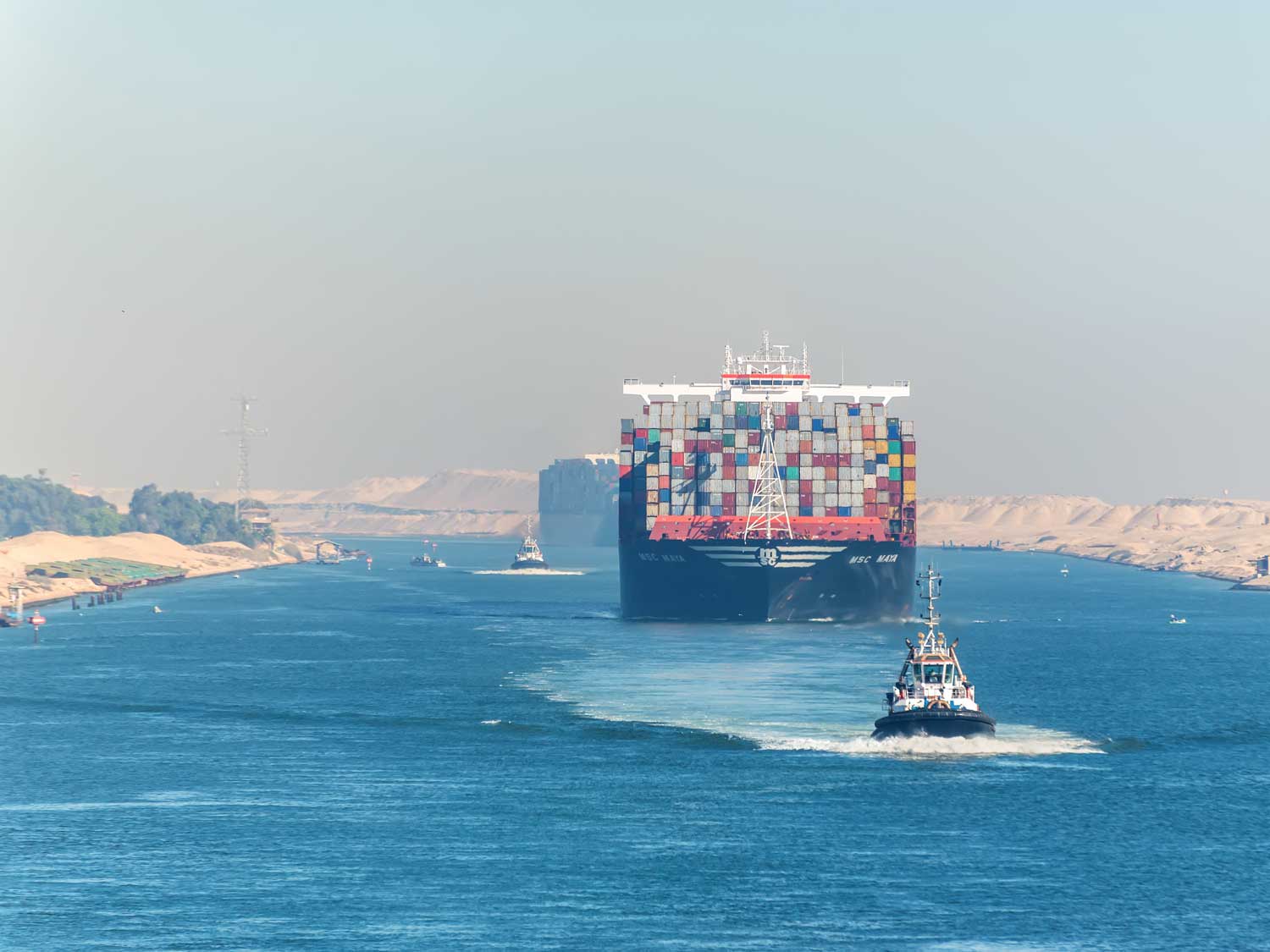
With hopes rising of stabilising conflict in the Red Sea region, analysts are increasingly considering what it would mean if shipping lines resume full use of the Suez Canal route, and it’s not all good news. 

While the shorter route from Asia to Europe might seem like a logistical boon, the modelling suggests there are several material pitfalls ahead that shippers need to be aware of.

Since late 2023, container shipping lines operating on Asia–Europe and Asia–North America routes have avoided the Suez Canal, opting instead to sail around the Cape of Good Hope. This detour has extended transit times and absorbed a significant amount of global container capacity. According to Sea-Intelligence, a full and immediate return to the Suez Canal could release up to 2.1 million TEU of capacity, equivalent to around 6.5 % of the global fleet, back into circulation.

However, this sudden release would create a powerful surge of imports into Europe. Modelling suggests that if all carriers reverted to Suez routing at once, inbound volumes from Asia could double for a period of up to two weeks, pushing overall port handling demand almost 40 % higher than previous peaks. 

Even if the transition were more gradual, spread over six to eight weeks, European ports would still face throughput levels around 10 % above historical highs, straining terminal operations, inland connections, and storage capacity.

Key Areas of Risk

  • European Port Congestion and Hinterland Strain
    European ports are already under pressure. A sudden import surge could stretch terminal capacity, yard space, and inland networks, leading to delays, higher handling costs, and increased demurrage.
  • Short-Term Disruption Despite Long-Term Gains
    While the Suez route offers shorter transits and lower fuel use, the transition back is complex. Network structures have been rebuilt around the Cape, and reverting will require major re-engineering, with temporary schedule changes and service disruption.
  • Lingering Risk and Insurance Costs
    The security issues that diverted ships from Suez persist. Even after reopening, residual war-risk premiums and contingency measures could keep operating costs elevated.
  • Capacity Overshoot and Rate Pressure
    Releasing 2.1 million TEU of capacity is likely to swing supply–demand balance, pushing rates down and while shippers may benefit in the short-term, it is likely that carriers would take drastic action to protect margins.
  • Timing and Readiness
    The timing of a full return remains uncertain. Analysts stress that rushing back before networks and ports are ready could trigger fresh disruption rather than restoring stability.

Metro’s sea freight team are already modelling reopening scenarios to ensure capacity, routing, and contingency plans are ready when trade flows shift back through the Suez Canal. 

EMAIL Managing Director, Andrew Smith to arrange a strategic review of your shipping patterns, risk exposure, and options to protect service continuity and cost efficiency when routes realign.