Pre-CNY sea freight reliability is breaking down at origin

Pre-CNY sea freight reliability is breaking down at origin

Chinese New Year 2026 falls on Tuesday, 17 February, marking the start of the Year of the Fire Horse. While the official public holiday in China runs from 17–23 February, the operational impact on global supply chains is far longer.

In practice, factories, trucking networks and export operations begin winding down weeks before the holiday. Full production and logistics capacity typically does not return until early March, meaning the effective disruption window stretches across six to eight weeks.

In the run-up to Chinese New Year, ocean carriers are releasing significantly more bookings than they can physically load. This reflects the need to honour minimum quantity commitments (MQCs) while simultaneously building vessel pools ahead of the holiday shutdown.

The consequence is a sharp rise in rolled cargo at ports of loading and transhipment hubs. Confirmed bookings are increasingly failing to convert into loaded containers, particularly where space has been secured on standard spot terms. Even services that previously offered a degree of loading assurance are now seeing rollovers as pressure builds.

“Guaranteed” loading is increasingly limited to premium, prepaid options, while some previously protected spot services are now also experiencing rollovers. For shippers, this means booking confirmation alone no longer equates to reliability during the pre-CNY window.

Congestion is building at key Chinese ports

The impact of overbooking is being felt most acutely at Chinese ports of loading, where inbound container volumes are exceeding what terminals can process or load onto vessels.

Ports such as Ningbo and Nansha are already experiencing severe congestion, with vessel delays compounding the problem. In some locations, terminals are restricting gate-in to containers with pre-booked slots only. Once a vessel’s allocation is reached, additional containers are rejected, forcing cargo to wait for later sailings and triggering extra storage, trucking and handling costs.

Even where shippers deliver cargo early, there is no guarantee it will be accepted or loaded as planned.

Alongside port congestion, a series of inland constraints are converging. Equipment shortages, delayed EIR release, limited truck availability and labour shortages are all becoming more pronounced as workers begin leaving ahead of the holiday.

Access to gate-in slots is tightening, CY cut-offs are less flexible, and minor delays can quickly cascade into missed sailings. These constraints mean that execution risk is now driven as much by inland logistics as by vessel capacity itself.

What this means for shippers

The key challenge for 2026 is that Chinese New Year disruption is not a single event, but a prolonged period of reduced reliability. In the Year of the Fire Horse — traditionally associated with speed, intensity and unpredictability — supply chains are feeling the effects in real time.

Some shipments will be rolled repeatedly. Others will ultimately miss the pre-holiday window altogether. As the holiday itself approaches, the focus shifts from optimisation to prioritisation: deciding which cargo must move and which can wait.

Planning beyond the holiday

Risk does not end on 23 February. Cargo that fails to ship before the holiday is likely to face a post-CNY gap of two to three weeks, as factories, terminals and trucking networks restart gradually. Many operations do not return to full capacity until early March, creating a temporary vacuum and renewed pressure on early post-holiday sailings.

If you are shipping from Asia ahead of Chinese New Year — or planning post-holiday restart volumes — now is the time to review priorities and timelines. EMAIL our Managing Director, Andrew Smith, to assess options and manage risk across your supply chain.

Carriers pause plans to restore Suez routes

Carriers pause plans to restore Suez routes

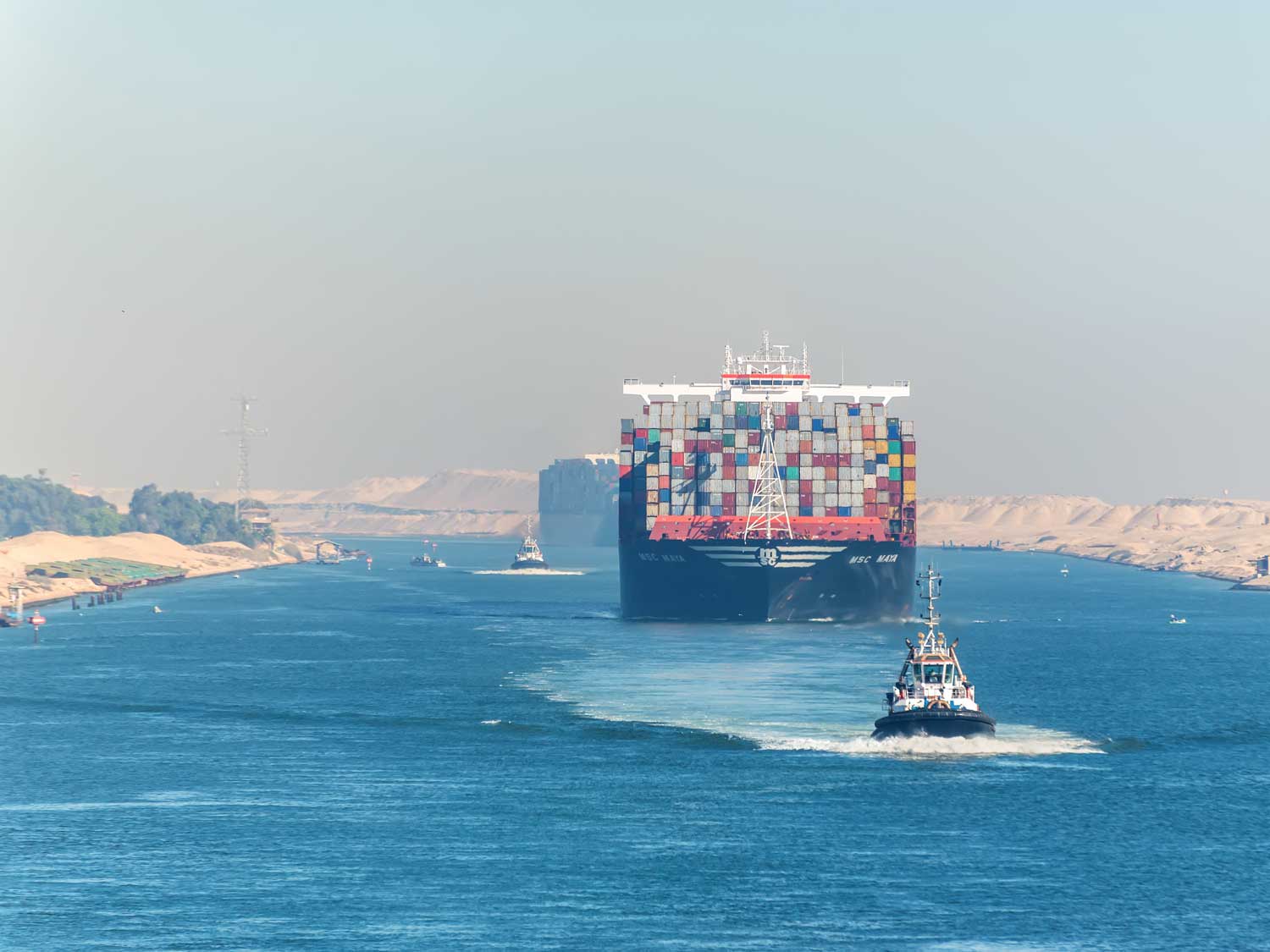
Hopes of a return to Red Sea and Suez Canal transits are fading again as renewed security threats from the potential resumption of Houthi attacks inject fresh uncertainty into global container shipping. 

While some carriers had begun cautiously testing the shorter route between Asia, Europe and the US East Coast, renewed threats from Yemen’s Iran-aligned Houthi group on 26 January — alongside the movement of a US aircraft carrier into the region — have raised tensions again, suggesting that any widespread reinstatement is likely to remain on hold.

Most commercial shipping diverted away from the Red Sea more than two years ago after attacks on merchant vessels made the route untenable. A ceasefire in Gaza late last year temporarily eased tensions, prompting limited transits through the Suez Canal and renewed discussion around normalising networks.

Several container lines had started to experiment with Red Sea transits, viewing the route as a way to reduce sailing times, fuel costs and schedule complexity. CMA CGM and Maersk both completed recent canal passages, signalling tentative confidence that conditions were improving.

That confidence has since weakened and escalating tensions have reintroduced risk at a time when carriers remain highly sensitive to crew safety, insurance exposure and service disruption. As a result, carriers will continue to favour longer routings around the Cape of Good Hope, prioritising predictability over speed.

Capacity management shapes carrier behaviour

The prolonged diversion around southern Africa has absorbed a meaningful share of global container capacity, helping carriers manage oversupply and support freight rates.

It is now looking extremely unlikely that we will see any sudden, full-scale return to the Suez. Instead, carriers will adopt a phased approach, selectively reinstating services while retaining contingency plans. This gradual reintroduction will allow their networks to stabilise while minimising rate volatility or widespread congestion across ports and inland infrastructure.

The Asia–Europe trade stands to feel the greatest impact from any shift. Before the Red Sea crisis, close to a third of global container volumes passed through the Suez Canal, compared with a smaller share of US-bound cargo. As a result, European importers and exporters remain most exposed to changes in routing strategy.

Market uncertainty around Red Sea access continues to influence pricing behaviour. Spot rates have already fluctuated ahead of the Lunar New Year slowdown, with carriers competing to secure volumes. While extended diversions can support rates by tightening effective capacity, that support may be critical if demand weakens seasonally.

For now, the Red Sea remains a route under review  and contingency planning remains central to carrier network design. Until the security environment stabilises decisively, most operators are expected to maintain flexible routing strategies, balancing risk, cost and capacity discipline until H2.

With ongoing uncertainty in the Red Sea, shippers need flexible routing options, up-to-date market insight and a logistics partner that can adapt quickly as conditions change.

Metro works closely with customers to assess risk, plan alternative routings and maintain supply-chain continuity, whether services transit the Suez or divert via the Cape of Good Hope.

EMAIL Managing Director, Andrew Smith, today to review your current routing strategy and ensure your supply chain remains resilient in a volatile operating environment.

Refrigerated container market update

Refrigerated container market update

While headline capacity and rate volatility have eased, equipment positioning, schedule reliability and geopolitical uncertainty continue to shape outcomes for temperature-controlled chemical cargo.

Reefer demand remains structurally resilient. Unlike typical consumer goods, temperature-sensitive chemicals, additives and intermediates move within mission-critical supply chains, where continuity and compliance matter more than short-term price movements. That dynamic has supported steadier reefer market conditions even as the wider container market remains under pressure.

Rates remain stable, but lane-specific

Reefer freight rates have largely decoupled from the sharp swings seen in dry cargo. Global indices show only marginal year-on-year decline of around 1% in Q4 2025, reflecting a market supported by high vessel and plug capacity and lower fuel costs. However, this stability should not be mistaken for softness.

For chemical shippers, pricing remains highly lane-specific and sensitive to local supply-demand balances, equipment availability and carrier allocation discipline. Seasonal tightening around key export regions can still trigger short-term pressure, particularly where chemicals compete with food or pharma cargo for limited reefer slots.

Equipment availability is the key constraint

The primary constraint in the reefer market is no longer vessel capacity, but equipment positioning. While global reefer plug capacity is ample, industry estimates suggest that up to 60–65% of reefer containers remain concentrated on East–West trades, while demand growth is increasingly driven by North–South flows. This imbalance continues to create shortages at origin in regions such as Latin America and parts of Africa.

For chemical shippers, this translates into longer lead times to secure suitable units and greater exposure to repositioning delays. Access to 40’ reefer units can be particularly challenging in export-heavy locations, reinforcing the need for early booking and flexible loading strategies.

Schedule reliability has improved but remains fragile

Carrier schedule reliability improved through early 2025 but has since plateaued. Missed connections, feeder delays, omitted port calls and weather-related disruption continue to reduce effective capacity, even where services are technically operating as scheduled.

Winter conditions in Europe and congestion at selected hubs increase dwell-time risk, which disproportionately affects temperature-sensitive chemical cargo with strict stability thresholds. As a result, operational resilience and contingency planning remain critical.

While hopes of a full return to Red Sea and Suez Canal routings have faded again, the 2026 chemical reefer market is stable, but unforgiving of poor planning. Rates are predictable, but equipment is unevenly distributed. Capacity exists, but reliability varies. And geopolitical risk remains an ever-present factor.

Resilient supply chains will increasingly depend on proactive booking strategies, strong carrier relationships, flexible routing options and clear visibility across the cold chain.

Metro’s dedicated chemical logistics team at subsidiary Elite Digital Logistics focus exclusively on the petrochemical and chemical sector.

Through a global network of specialised chemical hub operations they provide the control, visibility and risk management required for temperature-sensitive and regulated cargo — from equipment planning and routing strategy to contingency management and end-to-end execution.

Backed by Metro’s global freight forwarding network, Elite Digital Logistics helps chemical shippers protect cargo integrity, manage volatility and maintain continuity across international supply chains.

EMAIL Managing Director, Andrew Smith, to learn how Elite Digital Logistics can support your chemical reefer requirements and ensure your supply chain is prepared for the challenges of 2026 and beyond.

Cautious CNY trans-Pacific surge

Cautious CNY trans-Pacific surge

The trans-Pacific sea freight market is entering 2026 with pre-Chinese New Year volumes rising earlier than usual, spot rates climbing sharply and carriers leaning on capacity discipline to manage risk.

Despite Chinese New Year falling later than usual this year, shipment activity has moved forward, with volumes building three to four weeks earlier than the historical pattern. Import bookings from Asia to North America strengthened through December and into early January, marking the first month-on-month increase in six months.

According to the National Retail Federation, this uplift reflects a brief pre-holiday bump rather than a sustained restocking cycle. The organisation expects imports to soften again after Chinese New Year, in line with the usual post-holiday retail lull.

Forecasts for the US West Coast gateway show import volumes reaching a short-term high in early January, with weekly throughput at levels associated with a solid operating week. Volumes are then expected to ease back over the following weeks into a more typical seasonal lull, before recovering again from mid-February as cargo loaded just ahead of factory shutdowns arrives.

This pattern reinforces the view that the current lift is driven by timing rather than a fundamental demand shift.

Blank sailings shape the market response

Carrier behaviour has been decisive. In the five-week window from weeks 04 to 08, carriers have announced 68 blank sailings from approximately 698 scheduled departures from Asia, equating to around 10% of planned capacity being withdrawn.

Blankings are heavily concentrated on the trans-Pacific eastbound trade, which accounts for 47% of all announced cancellations. This targeted withdrawal has allowed carriers to manage utilisation closely, supporting pricing without widespread disruption to schedules.

Against this backdrop, spot rates from Asia to the US West Coast have increased by more than 40% over the past four weeks, with East Coast pricing up by around one-third over the same period. These gains follow a period of relatively muted demand and reflect a combination of seasonal lift and disciplined capacity management rather than space shortages.

Importantly, recent general rate increase attempts have shown limited staying power, indicating that while carriers have succeeded in lifting the rate floor, pricing remains sensitive to demand signals. The current rate environment is nevertheless viewed as sufficient to underpin upcoming service contract negotiations, with spot levels sitting comfortably above existing contract benchmarks.

Demand remains measured

Despite the visible rate movement, inventory indicators suggest a restrained demand environment. Importers are largely shipping against existing orders rather than aggressively pulling forward inventory. Inventory growth has slowed, and fourth-quarter volumes were slightly lower year on year, reflecting the unusually strong import levels seen in early 2025.

Looking ahead, expectations centre on a modest improvement rather than a repeat of last year’s surge. Trade growth forecasts for 2026 point to low single-digit expansion, consistent with a market returning to more traditional seasonal peaks and troughs.

With strategic capacity management and long-established ocean carrier relationships, Metro is helping customers secure space, optimise rates and keep high-priority cargo moving across key trans-Pacific lanes. As blank sailings and new rate initiatives reshape the market, proactive planning and flexible routing have never been more important.

Metro’s growing local presence in the United States further strengthens this approach, giving shippers on-the-ground support, closer carrier engagement and greater control across Asia–US supply chains.
https://metro.global/news/metro-global-usa-building-momentum-in-a-key-market/

If your business depends on reliable Asia–US trade flows, EMAIL Andrew Smith, Managing Director, to explore how expert guidance, tailored solutions and strong carrier partnerships can keep your supply chain agile and cost-effective—whatever the market brings.