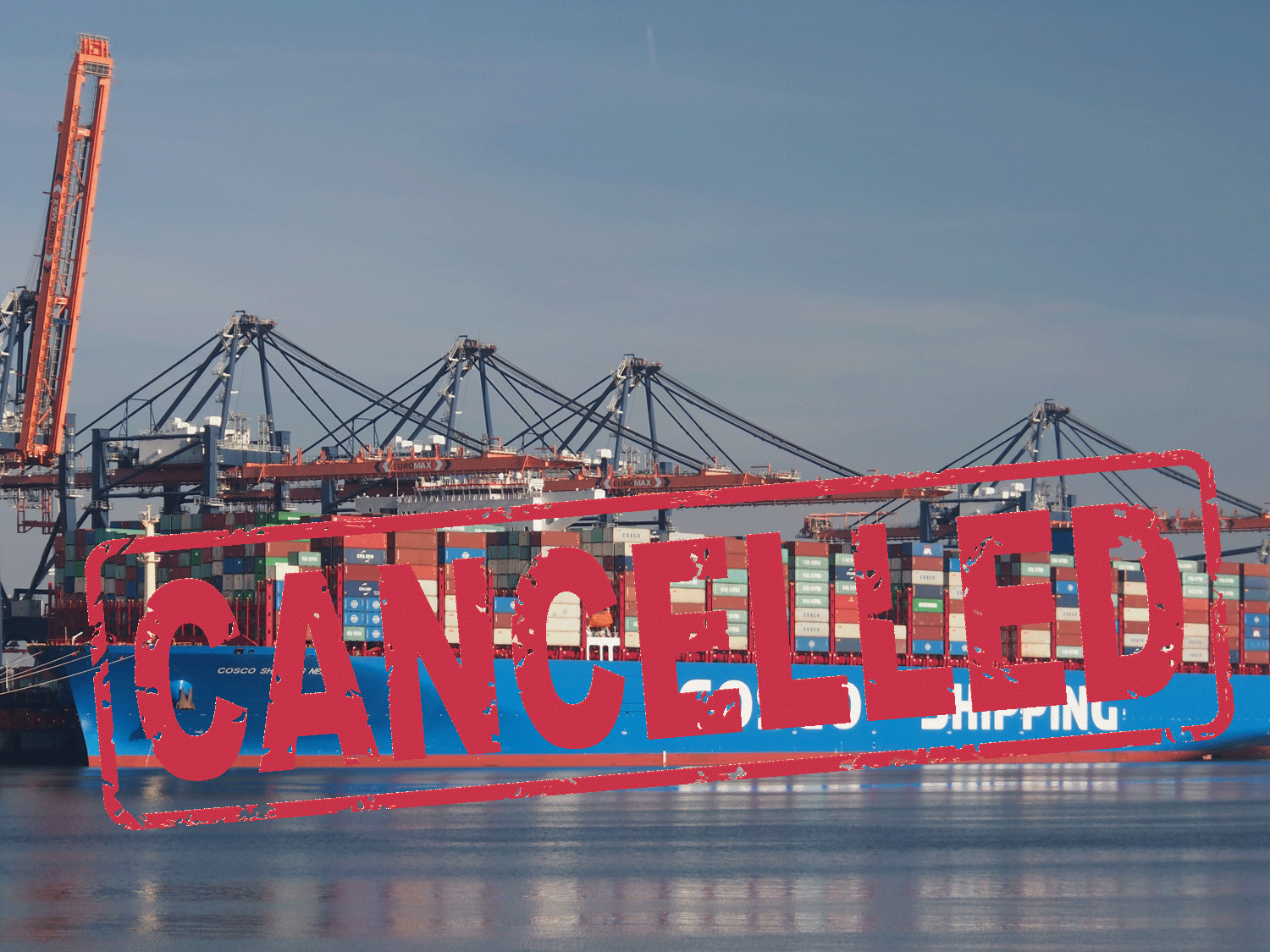
Carriers Pull Sailings and Add GRIs as US Port Fees Add New Cost Layer

Carriers Pull Sailings and Add GRIs as US Port Fees Add New Cost Layer

Container lines are tightening capacity to defend freight rates just as new U.S. port fees on China vessels start on 14 October—costs that carriers say will be passed through to shippers.

In the run-up to contracting season, the shipping alliances have stepped up blank sailings to support pricing. Between weeks 42–46, carriers withdrew 41 of 716 planned east–west sailings with the heaviest cuts on the transpacific and Asia–Europe corridors. It means that 6% of capacity, or 544,000 TEU have been stripped from transpacific and Asia–Europe trade-lanes over the past four weeks. 

Spot rates remain soft, with Drewry’s composite World Container Index dipping 1% in week 41, as carriers signal fresh GRIs of up to $2,300/teu and congestion/peak surcharges as they curb supply with voids and slow steaming.

USTR port fees are active

From 14 October, the United States is imposing USTR “special port service fees” on China-linked tonnage, with payment required in advance of arrival to avoid being denied lading, unlading or clearance.

For Chinese-owned/operated vessels, the fee starts at $50 per net ton, stepping up annually to 2028. For Chinese-built ships (not China-operated), the fee is the higher of $18 per net ton or $120 per discharged container, while foreign-built vehicle carriers face $46 per net ton from today.

What it means for shippers

  • The USTR regime adds a new fixed cost per container on top of base ocean rates and surcharges, and carriers are preparing pass-throughs.
  • With 6% of departures already pulled on main east–west trades and more voids likely, load factors are rising on the sailings that remain, which will add upward price pressure.
  • U.S. rules emphasise USTR pre-payment and proof on arrival, with non-compliance risks of port denial, cascading delays to inland supply chains and additional cost.

The container shipping lines are using their capacity and surcharge levers to prop up rates, while the USTR/China port fees, effective from last Tuesday, inject a non-market cost that will filter through to shippers. Expect more targeted blanks, GRIs with short notice, and more surcharges on Asia–Europe and transpacific flows into November.

At Metro, we work hand-in-hand with our network and carrier partners to keep cargo moving, even when the market is disrupted.

From time-sensitive shipments to sudden blankings, our sea freight team secure the right space to safeguard your supply chains and shield you from GRIs.

EMAIL Andrew Smith, Managing Director, today to explore how we can protect your US supply chains and insulate you from threatened GRIs.

Ex-China Airfreight: Turbulence and Transformation

Ex-China Airfreight: Turbulence and Transformation

For shippers moving goods by air into Europe and the US, the peak season has arrived with a complexity not seen in recent years. As flights are cancelled and rates trend sharply upward, a fundamental reshaping of the marketplace is underway.

In September, a powerful typhoon swept through southern China just as the annual Golden Week holiday loomed. Traditionally, Golden Week brings a slowdown as manufacturing pauses and workers take leave, creating ripples in cargo flow.

This year, the typhoon compounded the crisis: hundreds of flights were suspended and key export ports shuttered, abruptly tightening airfreight supply. Airport terminals saw mounting backlogs, with some shipments delayed by nearly a week before normal operations could resume.

The squeeze led to dramatic, double-digit percentage increases in airfreight rates for shipments from China to Europe, climbing between 30% and 50% compared to average off-season levels. Routes to the United States also saw significant jumps, though the impact was mitigated by shifting demand patterns and new import restrictions in the US.

Europe Bound: A Market in Flux

While every major trade lane felt the impact of these disruptions, the China-to-Europe corridor has emerged as both the most stressed and the most resilient. Demand for space surged as volumes, particularly of high-tech and eCommerce goods, outpaced declining US-bound shipments.

This pattern reflects a broader structural change: capacity typically serving transpacific markets is now being redirected to European routes, reinforcing the upward pressure on rates.

The European Union’s relative trade stability and ongoing restocking by retailers have kept import flows buoyant. In contrast, the US market is seeing smaller volume growth and increasingly complex customs checks, which have led to sporadic diversions of supply chains to alternative gateway countries and slower overall throughput.

US Adjustments and Alternative Strategies

The US airfreight market from China, though still sizeable, has shifted course under the weight of new regulatory developments. The end of duty-free de minimis rules has decreased the viability of direct eCommerce shipments for small parcels.

As a result, shippers have begun to favour indirect strategies, routing goods through third countries to manage duties, or utilising other North American hubs to avoid new tariff thresholds.

This has prompted a measurable contraction in direct air cargo volumes to the US from China, even as some businesses attempt to hedge risk by booking additional capacity in advance for the holiday season. Leading carriers report rates holding steady or growing only modestly compared to Europe-bound lanes.

The Road (Skies) Ahead

Looking through 2025’s peak season and into the coming year, the airfreight market faces continued unpredictability. Recovery from typhoon-related disruptions is expected to be gradual, with many factories extending their Golden Week closures and logistical bottlenecks possibly persisting into mid-October.

Industry analysts project that rates on China-Europe flights are likely to rise further by up to 10% before normalising, while transpacific pricing will remain highly sensitive to evolving US trade policy and inventory cycles.

At the same time, underlying trends, such as the shift of high-value tech goods via air and the migration of eCommerce flows through alternative channels, suggest that unpredictability will remain a defining feature.

Early communication is becoming indispensable for urgent shipments. We would encourage shippers to forecast and book well in advance, providing transparent communication about possible route or schedule changes, and retain contingency plans for the likely rolling pockets of disruption.

Metro gives you the visibility, agility, and expertise to overcome turbulence and transformation, strengthening your supply chain and securing your airfreight movements from China to the US and Europe.

With demand surging and carrier schedules in flux, securing space and certainty has never been more critical. Metro is actively monitoring capacity, adjusting routings, and working with trusted carrier partners to protect booking allocations.

Our latest innovation takes visibility and control to new levels, with real-time flight telemetry tracking to provide:

– Live aircraft position and route mapping
– Accurate departure and arrival confirmation
– Time-stamped milestone events, updated in real time

This level of transparency means you can plan confidently, optimise inventory, and protect service levels even in unpredictable conditions.

Partner with Metro for smarter, faster, and more resilient air freight solutions, powered by live data and long-standing carrier relationships.

EMAIL Andrew Smith, Managing Director, today to explore how we can support your success.

US Targets Tariff Evasion

US Targets Tariff Evasion

The White House has launched a revitalised Trade Fraud Task Force to clamp down on tariff evasion and customs violations. This coordinated cross-agency initiative is set to bring sharper enforcement tools and greater scrutiny to a trading environment already complicated by regulatory uncertainty and shifting tariffs.

The new Task Force brings together agents and specialists from Customs and Border Protection (CBP), DOJ, and Immigration and Customs Enforcement (ICE), with the explicit aim to aggressively pursue importers and affiliates who attempt to evade tariffs, duties, and import restrictions.

Exporters, as well as importers, should note that enforcement now targets not only mis-declaration of country of origin and tariff classification but also complex global fulfilment models and transhipment tactics commonly used to optimise duty payments.

Recent enforcement cases have involved importers penalised for inaccurately reporting the origin of goods or misrepresenting tariff categories, with multimillion-dollar fines levied under the False Claims Act.

As these measures ramp up, UK exporters must be prepared to demonstrate robust compliance processes, maintain meticulous records, and ensure transparency in customs documentation.

Civil and Criminal Measures

The launch builds on recent DOJ activity, where multiple settlements involving trade fraud have been reached since President Trump returned to office.

Recent cases include both failure to declare correct country of origin and deliberate misrepresentation of goods, with penalties reaching into the millions. The False Claims Act, traditionally used for government contractor and healthcare fraud, is now increasingly deployed to investigate and penalise customs violations, expanding the law’s scope within the trade sector.

A major element of this strategy is the expansion of whistleblower programmes, rewarding those who provide actionable leads on tariff, customs, and trade fraud. The DOJ has made clear that it intends to continue scaling these enforcement efforts and leverage whistleblower-driven intelligence to bolster the detection and prosecution of evasion schemes.

Uncertainty for Importers

Importers face growing compliance pressure as a direct consequence of these changes. The rapid rollout of enforcement comes as legal battles rage over tariff legitimacy and definitions, compounded by lingering ambiguity on what constitutes transshipment or qualifying country-of-origin. Shifting tariff rates by trading partner and category further complicates import cost management and supply chain transparency.

Companies manufacturing overseas, utilising complex fulfilment or multi-country storage, and those unfamiliar with recent regulatory changes risk exposure to sanctions and penalties.

With Customs and Border Protection continuing to flag difficulties in identifying and assessing duty on goods moved through indirect or deceptive routes, the new Task Force signals a more determined and well-resourced effort to close these enforcement gaps.

Takeaways for Global Traders

For businesses engaged in cross-border trade with the US, renewed vigilance is now essential. Meticulous record-keeping, robust compliance audits, and transparent reporting are key steps to minimise risk under the heightened enforcement regime.

As the Task Force expands its remit to cover a broad array of customs and tariff breaches, organisations must prepare to meet more demanding legal standards and guard against evolving investigation tactics.

In this fast-changing regulatory climate, proactive compliance and expert guidance offer the best defence, and securing a competitive foothold in US markets means staying one step ahead of enforcement trends.

For Metro clients, this trend creates new challenges in export planning and risk management. Those sending goods to the US must ensure their paperwork, origin declarations, and valuation methods strictly align with current customs codes.

Metro’s sector experience enables British exporters and US importers to navigate these requirements with confidence and reduce exposure to unexpected penalties.

EMAIL Andrew Smith, Managing Director, today to explore how we can support regulatory compliance and success in the United States.

EU Deforestation-Free Product Law Faces Further Delays

EU Deforestation-Free Product Law Faces Further Delays

The EU Regulation on Deforestation-Free Products (EUDR), which defines compliance obligations for businesses trading with the European market, is facing further implementation delays.

Designed to prevent the sale and export of goods linked to deforestation and forest degradation, EUDR applies to a wide range of commodities, including wood, paper, palm oil, rubber, coffee, cocoa, soy, and livestock.

On 23 September 2025, the European Commission announced it is considering another one-year delay to EUDR enforcement—postponing the application of the law from December 2025 for large companies to December 2026, and for smaller firms from June 2026 to June 2027.

This marks the second official delay as EU authorities struggle to roll out the IT infrastructure needed to handle due diligence statements and monitor supply chain transactions at scale.

Defining the EUDR

The EUDR is a core plank of the EU Green Deal, aiming to sever the link between Europe’s consumption and global forest loss. Companies placing relevant products on the EU market or exporting them from the bloc will be required to prove those goods are legal, traceable, and entirely deforestation-free.

To comply, businesses must maintain paperwork and geolocation data showing that commodities are sourced from land that has not been deforested after December 2020.

Due diligence statements will need to demonstrate negligible risk and trace every relevant batch from origin to final sale. Third-party certifications like FSC can help streamline compliance but do not serve as automatic proof; additional geolocation mapping and risk assessment remain mandatory for full EUDR compliance.

The latest delays are being linked with concerns over potential system “slowdowns” and disruptions that could stall trade and make compliance impossible for thousands of businesses.

The risk of further simplifications or legislative changes has also emerged, with some political groups pushing to amend the law’s benchmarking system and even introduce a “zero-risk” exemption for certain countries.

Implications for Metro Customers

  • The delay gives economic operators slightly more time to adapt their sourcing and compliance systems but increases uncertainty for businesses who have already invested in EUDR preparation.
  • Large and small companies alike must now track shifting requirements, especially as the regulation could change further in parliamentary negotiations.
  • Businesses sourcing affected commodities (timber, coffee, soy, cocoa, etc.) should continue mapping supply chains, aligning procurement strategies with deforestation-free criteria, and strengthening traceability processes, particularly around geolocation data and documentation.
  • If companies use FSC certification, extra steps are now needed: ensuring plot-level traceability and robust risk evaluation, not just certification documents.

What Comes Next?

The European Commission’s latest proposal is not yet final. Metro customers trading with or into the EU should stay up to date as legislative details and IT infrastructure roll out, and be ready to pivot quickly if further changes to EUDR emerge.

As enforcement eventually resumes, the EUDR is set to become a defining feature of UK–EU supply chain management and trade compliance, shaping how Metro supports customers in navigating new environmental obligations and regulatory risks.

EMAIL Andrew Smith, Managing Director, today to explore how we can support EUDR compliance and reporting.