Shipping at Risk from $1.5M Port Charge

Shipping at Risk from $1.5M Port Charge

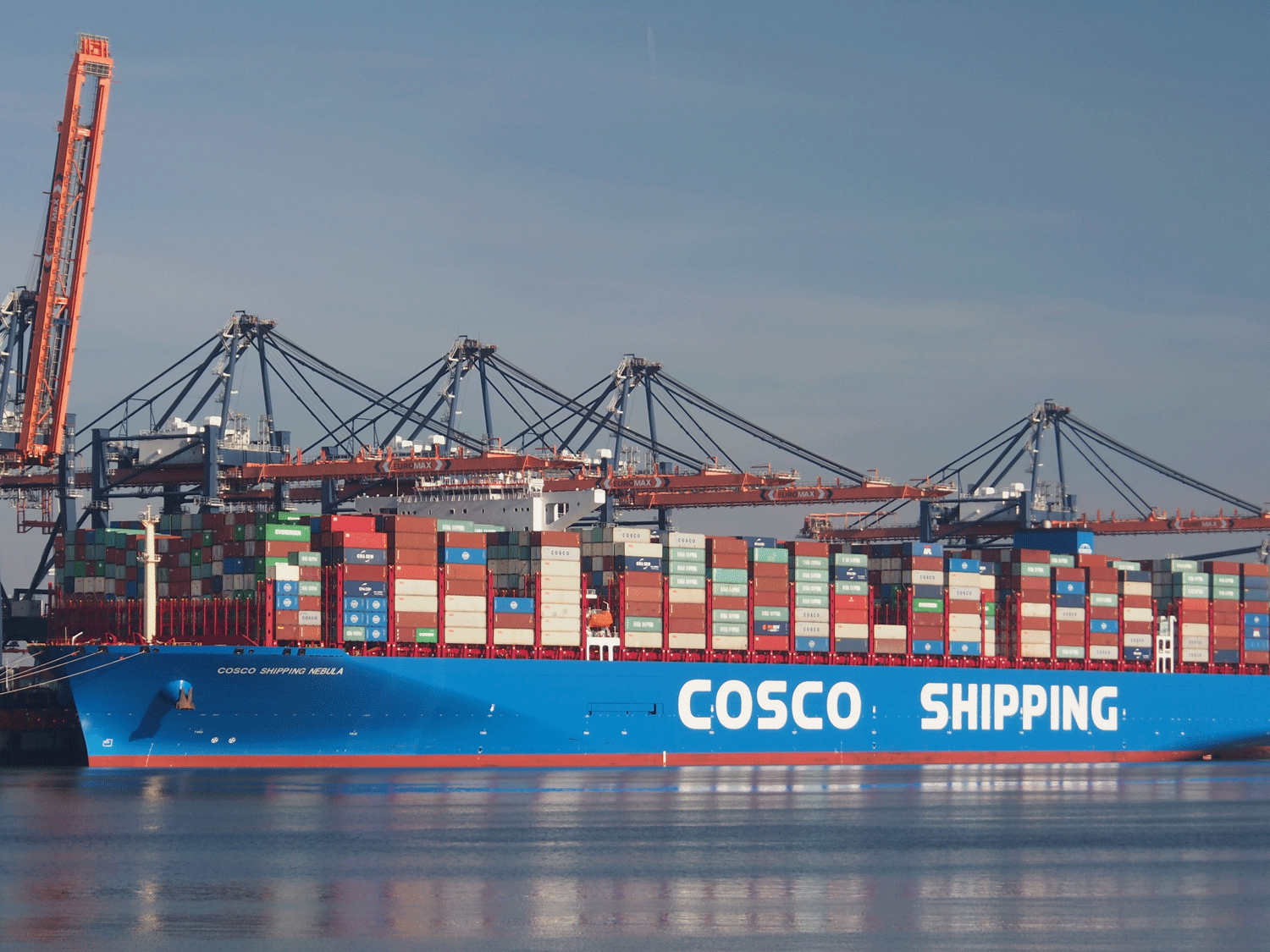
To combat China’s dominance in shipbuilding and revive the US maritime sector, a sweeping proposal from the Trump administration to penalise container ships built in China has sent shockwaves through the global shipping industry. The policy would levy up to $1.5 million per port call on Chinese-built or Chinese-operated vessels entering American ports. 

The scale and scope of these potential fees have alarmed the world’s largest container shipping lines, who warn that the move could disrupt global supply chains and dramatically increase costs for shippers and ultimately consumers.

China has become the undisputed powerhouse of global shipbuilding, accounting for over 80% of all newly built container vessels. The largest ocean carriers — including MSC, Maersk, CMA CGM, and Hapag-Lloyd — have heavily invested in Chinese shipyards due to their cost-efficiency, financing advantages, and output capacity. For instance, MSC, the world’s largest carrier, has 24% of its fleet built in China, with 92% of its order-book also tied to Chinese yards. Maersk and CMA CGM show similar reliance, with well over half of their future tonnage scheduled from China.

The proposed fees would apply not only to Chinese-owned carriers like COSCO, but also to foreign lines that have Chinese-built vessels in their fleets or on order. This has drawn strong opposition from the industry, with MSC CEO Soren Toft warning that the policy could add between $600 and $800 to the cost of moving a single container.

That cost, he stressed, would either have to be absorbed by carriers, prompting a withdrawal from US trades, or passed down the supply chain to cargo owners and consumers.

To avoid the financial hit, carriers may consolidate services, eliminating calls at smaller ports and serve only major hubs. This will inevitably create congestion at the terminals and strain inland transport, as containers pile up in fewer locations lacking the right mix of trucks, chassis, and rail capacity.

Reduced carrier capacity, port consolidation, and higher operational costs will all converge to drive prices up. As Andrew Abbott, CEO of ACL, put it bluntly, the plan “would cause a freight rate explosion that would dwarf the COVID-era increase.”

US Trade Representative (USTR) Hearings
The policy has mobilised intense opposition, with over 500 submissions made to the USTR, and dozens of executives testifying at public hearings in recent weeks. Alternative mechanisms such as phased implementation, tiered fees based on vessel type or service region, or per-container charges instead of flat port call levies have been proposed, with the USTR’s final proposals due later in April.

The Trump administration argues that these measures are necessary to rebuild US maritime capacity and ensure national security. But critics note that the US lacks the infrastructure, workforce, and financing mechanisms to quickly scale up shipbuilding, and that domestic vessels are not only four times more expensive to build but also cost double to operate. Even if construction began tomorrow, new ships would not be delivered for years and US exports and imports would suffer in the meantime.

If implemented in its current form, the port fee proposal would reshape global liner networks, drive up transportation costs, and jeopardise the competitive position of US exporters. It may also lead to structural realignments in trade patterns, with cargo diverted to Canadian and Mexican ports, and long-term erosion of US port and logistics competitiveness.

We’re working closely with clients as we monitor regulatory developments, ready to react and adapt container shipping strategies in real time. If your supply chain depends on US port access, now is the time to assess your exposure and prepare contingencies.

EMAIL our Managing Director, Andrew Smith, to learn how we can protect your network, manage cost risks, and keep you competitive — no matter how the tide turns.

Sea Freight Market Review

Sea Freight Market Review

The global ocean freight market is undergoing a period of transition in 2025, influenced by regulatory changes, shifting trade patterns, and evolving carrier alliances. While demand remains strong in key regions, rate volatility persists due to supply chain disruptions and excess capacity.

The ocean freight sector is experiencing considerable adjustments as carriers adapt to regulatory and economic shifts. The EU ETS expansion now covers 70% of maritime emissions, leading to higher surcharges and operational costs for carriers.

Supply/Demand
Capacity growth is projected to slow to 5% in 2025 after record vessel deliveries in 2024. However, supply chain disruptions persist due to global port congestion and ongoing Red Sea diversions are soaking up excess capacity.

The restructuring of major shipping alliances is further shaping the industry landscape, with the dissolution of 2M, the formation of the Premier Alliance by THE Alliance, and the launch of Gemini Cooperation in February 2025.

Proforma scheduled liner capacity on the Asia-North Europe trade is set to be reduced by around 11% once the transition to the new shipping alliance set-up is complete. The combined weekly capacity drop of some 28,000 TEU equates to a total reduction of 221,000 TEU across all services. However, the number of individual weekly sailings between Asia and North Europe is expected to increase from 26 (under the previous alliances and standalone services) to 28, potentially improving frequency and flexibility for shippers.

Global port congestion remains a pressing issue, particularly in China and vessel utilisation remains high, with only 0.2% of the global liner fleet currently idle. The industry is also witnessing an increase in blank sailings, with 47 announced through mid-April, affecting Transpacific and Asia-Europe trade routes. The Transpacific market, in particular, is experiencing notable disruptions, with 43% of blank sailings concentrated in this corridor.

Expectations that Red Sea diversions would ease, returning an estimated 2 million TEU to global circulation, were dampened over the weekend following missile exchanges between the US and Yemen’s Houthi rebels. MSC CEO Soren Toft stated, “Suez simply isn’t safe to transit at the moment, and there’s no immediate prospect of a return.” This continued instability may prolong disruptions and return pressure on rates.

Market
Meanwhile, the Shanghai Containerised Freight Index (SCFI) has dropped 17% since January and despite strong cargo demand in select regions, the market remains vulnerable to downward pricing pressures.

Demand remains resilient but uneven, with North America and India seeing stronger performance, whereas Europe’s slower economic growth is weighing on export activity. Chinese exports have exceeded expectations, driven in part by early shipments ahead of potential tariff adjustments.

The Drewry World Container Index (WCI) has reached its lowest level since January 2024 and while rates are below their pandemic-era peaks they are still 79% higher than pre-pandemic averages from 2019.

At Metro, our fixed-rate agreements on popular shipping routes provide a practical safeguard against rate volatility, offering predictable costs for effective budgeting. Whether you’re managing high-volume trade lanes or seeking greater stability for your supply chain, our tailored solutions can help you thrive in 2025.

To discover how Metro can strengthen your business and provide peace of mind, EMAIL our Managing Director, Andy Smith, today.

Air Freight Market Review

Air Freight Market Review

The global air freight market in February and early March reflected moderate year-on-year (YoY) growth, with total worldwide tonnages up 5% in February and 2% higher YoY in early March.

However, market dynamics remain volatile, influenced by shifting trade policies, geopolitical factors, and eCommerce trends.

Asia-Europe air cargo showed strong demand recovery in March, with tonnages rising 4% week-on-week (WoW) and while average spot rates softened they remain 20% higher YoY. Meanwhile, transatlantic routes saw weaker demand from Europe, with London Heathrow and Frankfurt spot rates declining amid softer outbound trade.

Market Situation
Global air cargo tonnages rose 5% YoY in February, supported by an 8% surge from Asia Pacific and a 4% rise in North America and Europe. However, Middle East & South Asia (MESA) volumes declined by 6%, reflecting last year’s Red Sea-driven demand spike.

By early March (Week 10), Asia-Europe trade saw significant WoW volume gains:

  • China to Europe tonnages increased by 5%
  • Hong Kong to Europe volumes grew by 6%
  • Japan & Taiwan to Europe rose by 7%
  • Thailand & Singapore to Europe surged by 9%

Despite these volume increases, average spot price indices on Asia-Europe lanes declined by 3%. However, YoY spot rates remain significantly higher (+20%), supported by China (+14%), Hong Kong (+22%), Japan (+19%), and Thailand (+38%).

Global air cargo markets remained relatively stable through February and early March, with weekly demand fluctuations balancing out across key regions.

  • Asia-Europe: Despite a 4% WoW tonnage rebound in Week 10, rates dipped as supply-demand balances shifted.
  • Transatlantic (Europe to USA): Weaker outbound demand put spot rates under pressure at London Heathrow and Frankfurt.
  • Middle East to Europe: Demand weakened with Dubai-to-Europe tonnages falling 15% WoW.

Global air freight rates remained 6% higher YoY, though Asia-Europe pricing showed a mixed trend, with falls on all the major trade lanes, though rates remain significantly higher than last year.

  • Asia-Europe remains 20% higher YoY.
  • China to Europe still stands 14% higher YoY.
  • Hong Kong to Europe are up 22% YoY.

The Asia-Europe air cargo market rebounded in early March, with tonnage gains but slightly softer rates as market conditions adjusted. Meanwhile, transatlantic routes saw demand weakness, leading to rate declines from major European hubs. Moving forward, trade policies, geopolitical shifts, and capacity adjustments will continue to influence global air cargo pricing and volumes.

In a volatile air cargo market, securing capacity and competitive rates is critical. Metro’s air freight, charter, and sea/air solutions ensure your shipments move efficiently, even on the busiest trade lanes. With block space agreements (BSA) and capacity purchase agreements (CPA) in place, we guarantee space and stable pricing when you need it most.

Whether you’re shipping urgent, high-value, or sensitive cargo, our global expertise and strategic carrier partnerships keep your supply chain running on time and within budget.

EMAIL Elliot Carlile, Operations Director, today to explore how Metro’s air freight solutions can optimise your logistics.

Key Takeaways from TPM25

Key Takeaways from TPM25

The 25th anniversary of the Trans-Pacific Maritime (TPM) Conference in Long Beach, California, reaffirmed its position as the premier global forum for senior supply chain executives carriers, and technology providers shaping the future of global trade.

This year’s event unfolded against a backdrop of intensifying geopolitical tensions, with supply chain resilience and service reliability emerging as dominant themes.

As hostilities between U.S. forces and Houthi rebels in Yemen resumed over the weekend, it is evident that safe passage through the Red Sea and the Suez Canal will remain compromised for the foreseeable future.

With security risks heightened, carriers are expected to continue rerouting vessels around the Cape of Good Hope, adding transit times, costs, and complexity to global trade.

Engaging with Industry Leaders
Metro’s Managing Director, Andrew Smith, and Head of Ocean Pricing, Chris Jones, played an active role in TPM25, engaging in key discussions on market volatility, geopolitical risks, and the evolving carrier landscape.

During in-depth conversations with carriers and customers, Metro explored strategies to mitigate ongoing disruptions in the Red Sea, as well as how emerging shipping alliances are reshaping service offerings. Understanding carrier market pressures and operational adjustments remains a priority for Metro, ensuring that we continue to deliver the most resilient and efficient logistics solutions for our clients.

Beyond TPM
Following the conference’s close, Andrew and Chris extended their commitment to direct client engagement with visits to Minneapolis and Chicago. Their series of meetings provided an invaluable opportunity to gain firsthand insights into the challenges facing shippers, including changing regulations, shifting trade dynamics, and the ongoing impact of global events.

By working closely with customers on tailored supply chain strategies, Metro continues to bridge the gap between industry-wide challenges and customer-specific solutions, reinforcing our role as a trusted partner in an unpredictable market.

A recurring theme throughout TPM25 was the industry’s relentless pursuit of stability amidst growing uncertainty. Discussions highlighted the urgent need for agile, data-driven solutions, with many industry leaders acknowledging that technology, real-time intelligence, and predictive analytics will be key differentiators in navigating the complexities of modern supply chains.

Metro remains at the forefront of this transformation, actively integrating AI-driven analytics, digital platform enhancements, and predictive modelling to help customers make informed, real-time decisions.

This commitment is clearly demonstrated this week, with Metro integrating CO2 emissions data directly into freight invoices, together with the launch of new tools that give customers greater financial control, reduced administrative burdens and enhanced efficiency.

As we reflect on the insights gained at TPM25 and our follow-up discussions with customers, Metro reaffirms its commitment to staying ahead of global trade challenges, ensuring that our partners remain competitive, informed, and prepared in a rapidly evolving landscape.

To discover how Metro can support your Transpacific or Transatlantic trade needs, or to discuss any of the issues highlighted here, please reach out to Andrew Smith via EMAIL