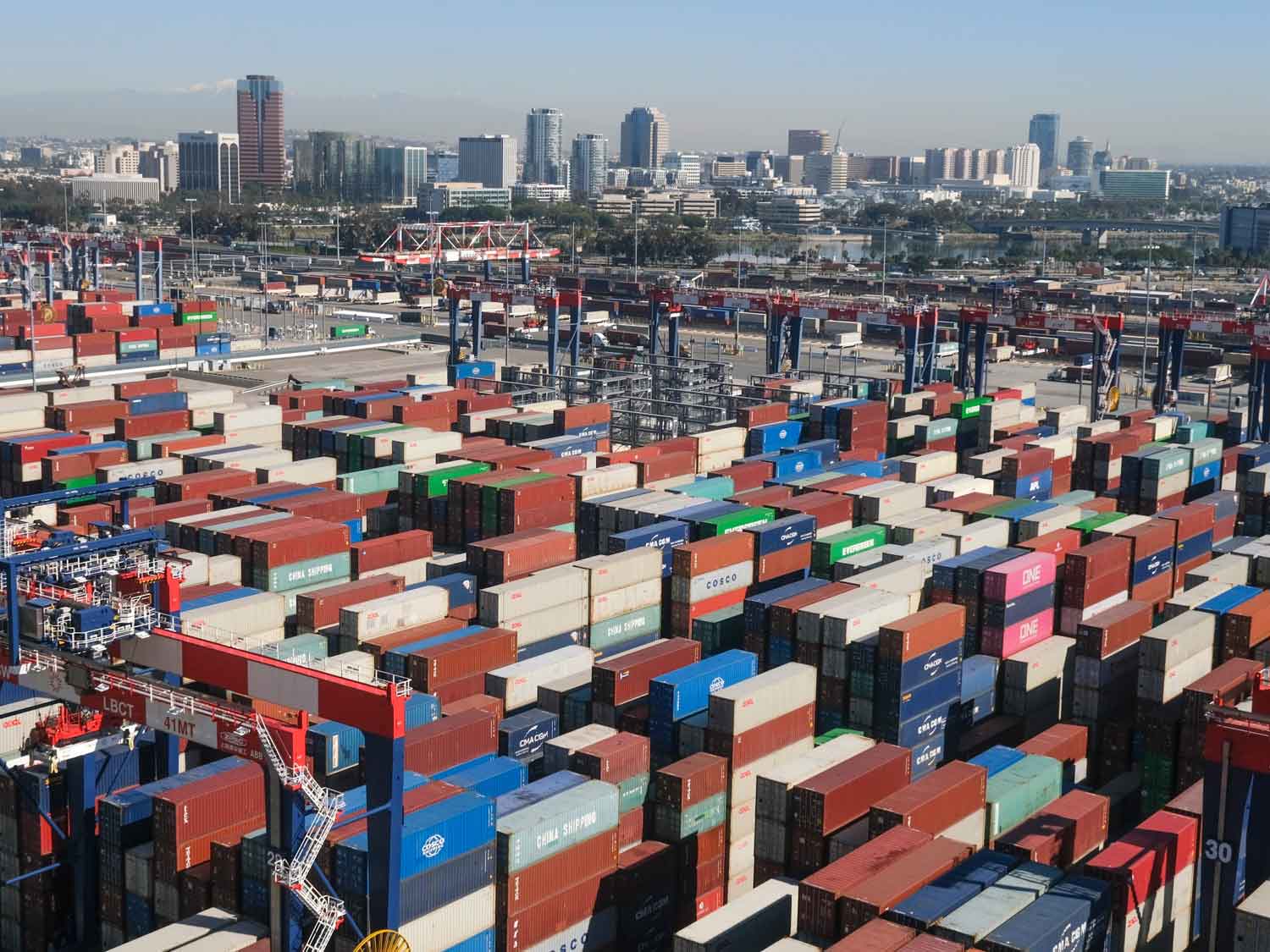
Long Beach 1

The transpacific container shipping outlook

Transpacific container shipping lines are imposing surcharges and higher freight rates due to the ongoing Suez and Panama Canal disruptions, with the cost burden felt most by small volume shippers, but the biggest cargo owners are also feeling the heat. 

Since the major container shipping lines began diverting vessels around Africa’s Cape of Good Hope in mid-December, spot container rates have, on average, doubled globally.

Shipping lines have told the US government that the longer transit around southern Africa increases the distance a container ship travels from Asia by about 3,300 nautical miles. Resulting in an additional five to 16 days of transit time depending on the destination.

Along with the higher operating expenses of a 40% longer voyage, the lines argue that they need to rewire their entire global network. Which means making schedule changes, adding ships to maintain weekly port calls on a service loop and repositioning containers, all of which point to higher costs for carriers.

The sudden and sharp increase in ocean freight costs came as the market was expecting normalised demand and a surplus of new ships to keep freight rates suppressed during 2024.

Since the unfolding of the Red Sea crisis, and the drought impacting ship transits on the Panama Canal, carriers have levied an array of surcharges, but the surcharges are not being widely applied to BCOs, as they often have protections in their contracts, and mostly carriers are honouring those protections.

But ocean carriers are now looking for ways around those protections. In January, the FMC granted waivers to its 30-day notice period for adding new surcharges, allowing carriers to immediately add the charges due to the urgency of the Red Sea security situation.

A poll of the biggest shippers, beneficial cargo owners (BCOs) found that only 35% of them are having laden containers accepted under their original contract terms, with the vast majority being pushed to FAK [freight-all-kinds] spot market rates, which include added surcharges.

BCOs in the United States believe that ocean carriers have been targeting certain customers for higher rates and surcharges, pushing them towards FAK spot rates that are 400% higher to the US West Coast and 300% higher to the East Coast, for cargo loading in the second half of January.

Many major BCOs with volume commitments above 60,000 FEUs annually are still paying their contracted rates, which suggests an unwillingness by the transPacific shipping lines to upset their largest customers, particularly for gains that may be short-term.

Ocean carriers including Maersk, Hapag-Lloyd and CMA CGM are also using emergency clauses to say they cannot fulfil existing contracts under current terms, requiring shippers to pay surcharges to move their freight.

While ocean freight rates are nowhere near the highs experienced during the pandemic, increases are not just being applied to directly impacted cargo, but also to other routes, because of equipment availability, with shippers often subject to “emergency operational surcharges” on various trade lanes due to the Red Sea crisis.

The impact of Suez-related surcharges and rate hikes on shippers will be the focus of a Federal Maritime Commission hearing this week, to ensure the new fees and surcharges actually cover real costs and are not intended for profit.

We negotiate long-term and protected contracts with shipping lines across the alliances to secure space and rates, so that we can provide the best alternatives and options, whatever the situation.

To learn how we can support transpacific trade, or to learn more about our ocean and air solutions, please EMAILour Chief Commercial Officer, Andy Smith. 
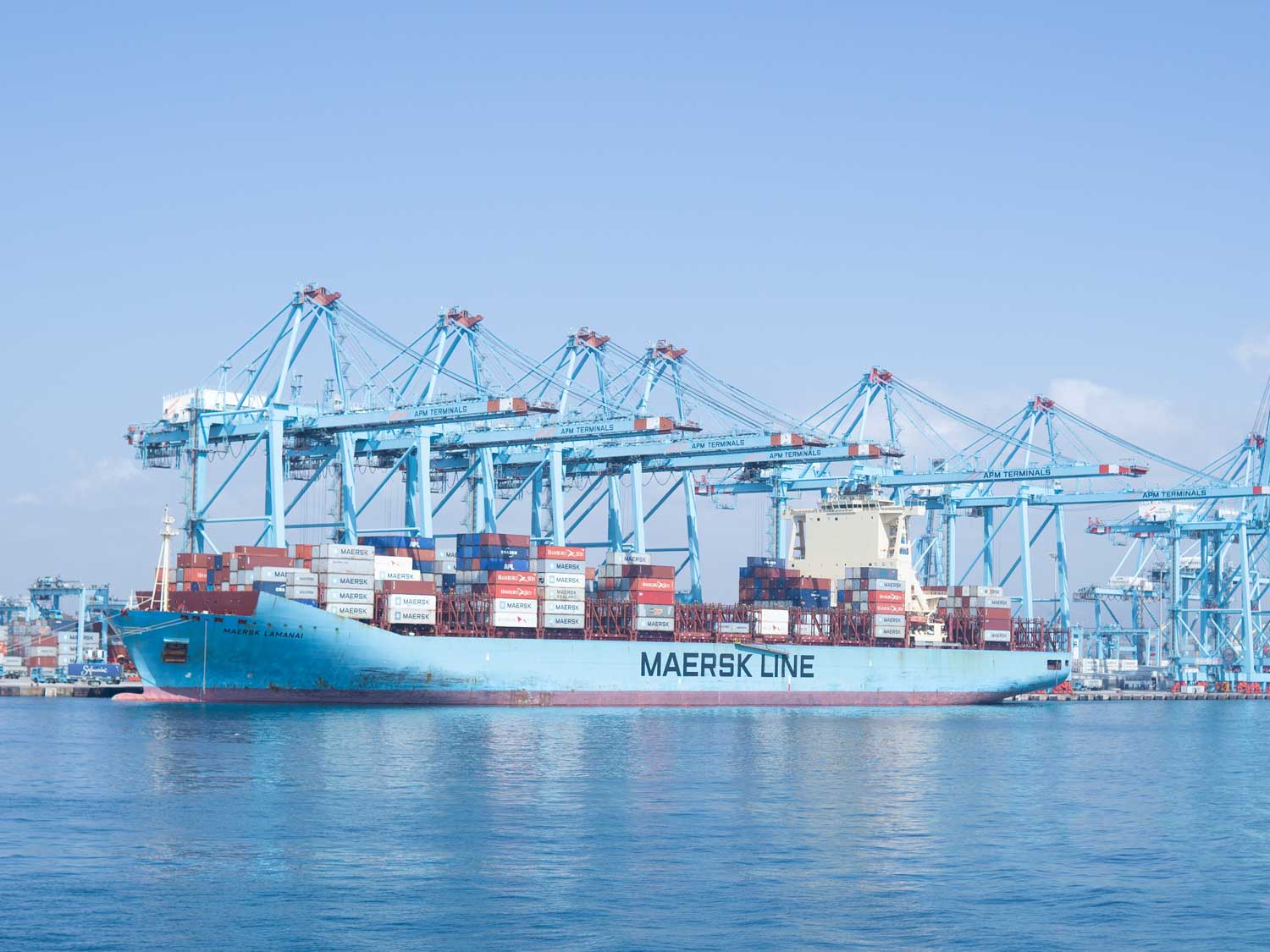
Maersk

The Gemini Cooperation

On the 17th January 2024, the 33rd day of the Red Sea crisis, Maersk and Hapag-Lloyd announced that they were forming a new shipping alliance – The Gemini Cooperation – in a major shake-up to the container shipping market on the East-West trade lanes.

Industry analysts have been predicting that with 2M’s demise already in the works for 2025, the remaining alliances would be breaking up over the coming year and we would see a new alignment of partnerships on the east-west trade.

Hapag-Lloyd will exit THE Alliance and link up with Maersk in February 2025 after the dissolution of the 2M Alliance, to form the Gemini Cooperation’

Operating a combined fleet of 290 vessels (equivalent to 3.4 million TEUs) Gemini will cover seven global trades, including coverage of the Europe – Middle East and Indian Subcontinent trades, besides the East-West trades.

Gemini’s network will be structured around 12 ‘hub-and-spoke’ terminals in Asia, EMEA, North and South America, from which Gemini will offer 26 mainline services, with schedule reliability in excess of 90%, a level that would differentiate Gemini from other alliances.

This leaves ONE, Yang Ming and HMM in a very vulnerable position, potentially unable to build a network matching those of the Ocean Alliance, MSC and Gemini.

The pressure is then on these three carriers to either lure a new partner out from Ocean Alliance, or re-invent a new service concept.

But, with the playing field having changed so radically the pressure is also on Ocean Alliance members CMA-CGM, COSCO and Evergreen, who will be asking themselves whether the current alliance setup is still fit for purpose or whether a new partnership might be better.

Additionally, the removal of the EU anti-trust exemption by the end of April 2024 could add to the pressure on Ocean Alliance as they will be significantly larger than the other groupings, and could well become the focus for competition authorities if they have a political need to show action following the exemption removal.

While Maersk and Hapag-Lloyd will be part of the Gemini partnership for three years, after which a 12-month notice period will be required, Alliances tend to have a lifespan of roughly 5-8 years, which means the re-calibration we see now is most likely be the shape of the market on the East-West services into the early 2030s.

If you have any questions or concerns about the Gemini Cooperation, or would like to discuss the wider implications of the shipping alliances, please EMAIL our Chief Commercial Officer, Andy Smith.

steel in car manufacturing

Red Sea diversions disrupt China’s car supply chains

Carmakers had been struggling with a lack of car carrier RoRo capacity before the Houthi attacks began in the Red Sea and now with NYK and K Line suspending sailings via the Suez Canal nearly all big car car-carrier operators are diverting round the Cape of Good Hope, further reducing already squeezed capacity on the key trade route.

The boxlike RoRo car carriers ship thousands of vehicles and are vital in transporting cars between key Japan, China, South Korea and European markets, with long-distance ocean car shipments up 17% in 2023, largely because of big increases in exports from China and comes after large numbers of car carriers were scrapped during a market downturn in 2020. 

The extra 3,500 miles around the Cape means car makers will be able to transport fewer vehicles annually, as the global fleet’s effective capacity is cut and the 185 new vessels on order with shipyards this year are expected to increase fleet capacity by only 7%.

China may have overtaken Japan as the world’s largest auto exporter in 2023, with car exports jumping 62% to a record 3.83 million vehicles last year, but the shortage of seaborne capacity is putting the brakes on their ambitions in the UK and Europe.

With a few exceptions there is no immediate prospect that car carriers will return to their traditional Suez Canal route until they believe there’s a safe transit and with the current threat in Yemen, it is not felt that any military protection will be sufficient.

With about 25% of global, long-distance RoRo seaborne movements of cars typically moving through the Suez Canal, only container shipping is suffering bigger a upheaval as a result of the current problems in the Red Sea. 

However, the challenges for car-carrier operators are fundamentally different from those for container lines because there was a global excess of container ships before the latest crisis and container shipping lines have been able to reactivate idle ships to replace the capacity lost to longer journeys. 

While car companies have built up some extra inventory in key markets over the past year, they will run those stocks down as new vehicle deliveries from Asia are cut.

If you have questions or concerns about your automotive supply chain, trade with the Middle East, Africa, Indian Sub and beyond or any of the issues outlined here, please EMAIL our Automotive team who are standing by to assist.

City of London

Economic impact of Suez Canal diversions

For the UK and Europe fears are growing that any prolonged denial of access to the Suez Canal could impact faltering economies and derail plans to start cutting interest rates later this year.

Despite the confidence of European and UK central banks, uncertainties about the Red Sea crisis' impact remain and prolonged denial of access to the Suez Canal could derail plans to start cutting interest rates this year.

No major impact from the Houthi attacks in the Red Sea has yet turned up in main economic indicators, including December inflation numbers, which ticked up only slightly.

The global economy is still performing below par, suggesting plenty of slack around the system.

Oil prices were the most obvious commodity to hit economies in Europe and beyond, but they haven't surged because supplies haven’t been impacted and demand is slowing.

Less sanguine, the World Bank says the Middle East crisis, with the war in Ukraine, could still lead to surging energy prices, with broader implications for global activity and inflation.

Bangladesh is the world’s second-largest apparel exporter and garments are its main foreign currency earner. Ocean freight rates have gone up 40% from Chittagong to Europe and America, as a direct result of the security crisis in the Red Sea, with fears growing that buyers will begin to look for alternative sourcing.

Sea freight rates from India to the UK and Europe are up an astonishing 500% and there are some signs that the extended equipment turnarounds are leading to equipment scarcity, with fewer 40’ HC empties at busy ports, including Mundra and some inland container depots in northern India.  

Oxford Economics estimates that gains in container transport prices would add just 0.6% to UK inflation in a year. The ECB is expecting Euro zone inflation to fall from 5.4% in 2023 to 2.7% this year, with the BoE expecting UK inflation to average 2.4% in 2024, which suggests that a sustained closure of the Red Sea wouldn't prevent inflation from falling, though it would slow the speed at which it returns to normal.

In the longer term, some companies may advance plans for alternative, more predictable supply routes, which could involve longer but more secure trade paths or "near-shoring" to bring production closer. 

Whichever options are considered, the likelihood is they will involve higher costs, and supply chain risk by its very nature is unpredictable.

Metro support our customers continuing success, by protecting their supply chains, with innovation and resilience, whatever the economic or operational challenges.  

Our unique blend of experience, systems and processes means that we can react quickly to overcome challenges or exploit opportunities; optimising global inventory, reducing costs and streamlining the supply chain. 

Please EMAIL Andy Smith to discuss how we can optimise your supply chain and help you overcome the issues you currently face.