Blanking is biting

Blanked Sailings Amid Geopolitical Shifts

Global sea freight is navigating a complex landscape marked by geopolitical tensions, fluctuating demand, and strategic capacity adjustments and while a temporary US-China tariff truce offers a glimmer of hope, challenges persist across major trade lanes.

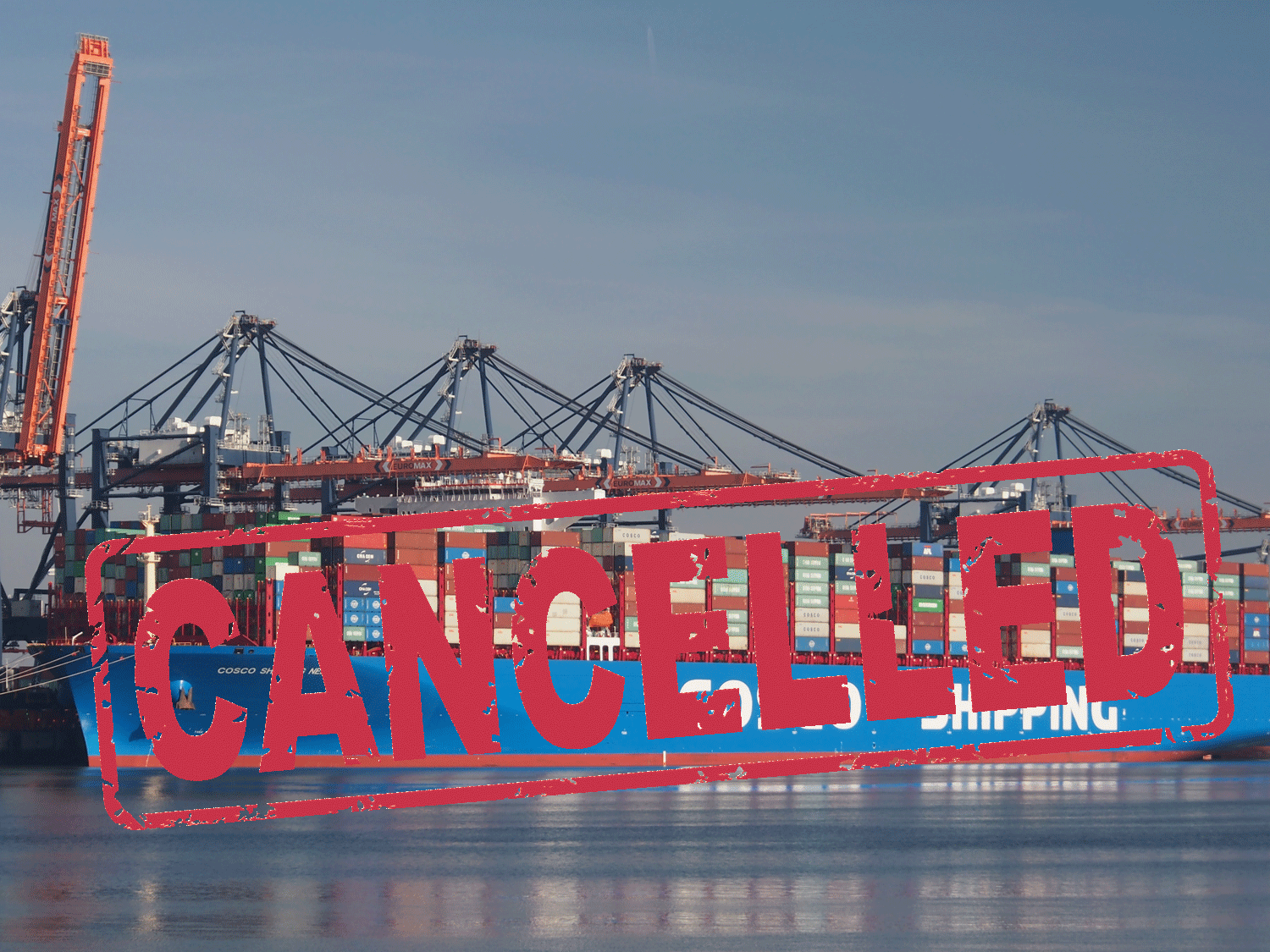
In response to weakening demand, particularly on transpacific routes, ocean carriers have taken aggressive steps to manage overcapacity. Year-on-year capacity reductions of around 4% to 5% have been recorded on Asia-North America trades for April and May. The Asia to US East Coast route has been especially impacted, with reports suggesting shippers face as much as a 40% cut in weekly slot availability due to a sharp rise in blanked sailings. Some weeks have seen up to 10 scheduled services withdrawn.

The trend of blank sailings is not uniform across all alliances. Major players have taken divergent approaches, with some choosing to maintain network stability while others have opted for deep cuts to protect rate levels. MSC, the world’s largest shipping line, has launched a sweeping revamp of its east-west network, consolidating services and shifting vessels between routes in an effort to optimise capacity and mitigate the financial impacts of underutilised sailings.

The effect of these service cancellations has been most visible in spot rate volatility. Container spot rates between Asia and Europe have been pressured as additional capacity and lower-than-expected booking levels weigh on prices. In contrast, rates from Asia to the US, particularly the US West Coast, have remained relatively firm due to tighter supply caused by blank sailings and ongoing retailer inventory replenishments.

The scale of blanked sailings is contributing to a growing sense of uncertainty in booking reliability. With last-minute sailing cancellations and frequent schedule changes becoming increasingly common, an emerging trend has been to split bookings across multiple carriers to hedge against cancellations.

US-China Tariff Truce: A Temporary Respite
Amid this volatile environment, the recent US-China agreement to temporarily reduce tariffs for 90 days from May 14 offers some hope. The US has lowered tariffs on Chinese goods from 145% to 30%, while China has eased tariffs on US imports from 125% to 10%.

The impact of the tariff pause has yet to fully filter through to shipping demand. However, many in the industry hope it could reignite volumes, especially in the transpacific trade, which has been hardest hit by tariff-driven disruptions and reduced consumer demand. The long-term benefits depend on whether this truce leads to a broader and more lasting trade agreement.

Looking Ahead: A Market in Flux
Even with the tariff reprieve, the global sea freight market faces lingering challenges. The combination of excessive vessel deliveries into a market of uncertain demand is expected to maintain downward pressure on rates in the months ahead. Ocean carriers are likely to continue balancing network adjustments, including further blank sailings and service restructures, to keep load factors at sustainable levels.

Some industry observers note that capacity cascading is already underway, with surplus vessels being redeployed to secondary trades such as Asia-Europe or intra-Asia, although these markets cannot fully absorb the overflow from the transpacific.

The situation remains fluid, with geopolitical risks, shifting consumer spending patterns, and global economic uncertainty all contributing to ongoing volatility. While the short-term outlook is mixed, we remain focused on managing risk and seeking stability in what continues to be a highly dynamic and unpredictable market.

The global sea freight market continues to adjust to shifting demand and capacity changes. With significant change underway, now is the ideal time to review your ocean freight strategy to ensure continuity and flexibility. EMAIL Andy Smith, Managing Director, to discuss how we can support your business with tailored solutions that keep your supply chain resilient and competitive.

Hong Kong X ray costs and delay fears

Transpacific Air and Sea Downturns amid Capacity Volatility

As demand falters on both sides of the transpacific, container and air freight flows are facing extreme volatility, with sharp drops in bookings and vessel space coinciding with sweeping tariff changes and regulatory disruptions.

The number of blanked sailings has surged, with the share of Asia–North America West Coast blanked capacity more than doubling in a week, reaching nearly 30% by late April. On East Coast routes, blank sailings jumped to over 40% of planned capacity by early May. These cancellations mirror typical post-holiday slowdowns but have appeared abruptly and without the usual lead time, suggesting a reactionary market driven by plummeting demand.

The root cause lies in a sharp reduction in shipping volumes as US firms halt sourcing and bookings ahead of tariff implementations. Bookings for truck delivery or pick-up in the US have fallen by over 40% month-on-month, with some regions seeing drops as steep as 60%.

Elevated volumes in March, driven by front-loading ahead of tariff deadlines, briefly clogged US ports and inland rail hubs. That surge has since collapsed into a dramatic slowdown, with analysts warning that once global trade conditions stabilise, a sharp rebound in demand could overwhelm logistics networks, triggering widespread delays and pushing up costs. A similar scenario played out during the pandemic, when container rates soared fourfold and a surge in inbound volumes led to vessel backlogs and port gridlock.

While a steep trough dominates the short-term picture, there is growing concern that once inventory is depleted, a spike in import orders later in the year could overwhelm supply chains again, especially if companies rely too heavily on ad hoc bookings and lose access to planned space.

In air freight, the outlook is equally challenging. Growth forecasts have been revised downward in response to the end of the de minimis duty exemption on low-value imports from China on May 2. Previously expected to grow up to 7.4% this year, air cargo is now forecast to contract slightly or, at best, remain flat.

Volumes from China and Hong Kong to the US have declined for four consecutive weeks, down 16% compared to the same period last year. While some Southeast Asian countries, like Vietnam, Taiwan and Thailand, have posted gains, it has not been enough to offset overall transpacific weakness. Air freight rates from Asia to the US have fallen by 8%, with steeper declines from certain markets, such as Vietnam, down 28%.

The rollout of new customs processes in the US is adding further complexity, with low-value shipments from China previously exempt under de minimis rules now facing steep duties, with some goods increasing in price by over 160%. Manual duty calculations are placing additional strain on customs brokers, particularly as the US Customs & Border Protection’s automated system struggles to cope with last-minute updates.

Together, these developments point to a precarious outlook. The shipping slowdown may offer temporary relief from congestion, but structural challenges remain. The combined effect of trade policy shifts, operational uncertainty, and fluctuating demand could see supply chains once again thrown into disarray if and when volumes rebound sharply in the second half of the year.

With cancelled sailings, falling volumes, and shifting demand patterns, pressure on global supply chains is growing. At Metro, we provide integrated sea and air freight solutions that deliver the certainty you need, whatever the market throws at you.

From fixed-rate ocean agreements that protect against volatility, to agile air freight strategies with secured capacity and competitive rates, we help you stay on schedule and in control.

EMAIL Andy Smith, Managing Director, to explore how Metro can strengthen your supply chain across both modes.

businessman stressed

The Rising Risks of Customs Valuation and Tariff Compliance

For importers under pressure to manage margins amid rising tariffs, compliance missteps, even unintentional ones, can trigger severe penalties, criminal sanctions, and lasting reputational damage.

Recent high-profile cases show that even the most established brands are not immune. At one major logistics hub in Europe, authorities are investigating a leading sportswear manufacturer over its import valuation practices.

The issue centres around how the company structured transactions before goods entered the EU — allegedly calculating customs duties based on an earlier, lower sale price rather than the final transaction value, potentially underpaying significant duties and VAT. With potential liabilities reported at €1.5 billion, the case is a stark reminder that customs valuation errors can escalate into major legal and financial risks.

It’s important to recognise that the rules have evolved. While using an earlier sale value was once a common and accepted practice, EU authorities revised their stance in 2016, shifting firmly towards the “last sale” principle for determining customs value. Businesses that have not adjusted their processes accordingly are now exposed to greater scrutiny — and enforcement action.

The drive for stricter enforcement is not limited to valuation practices. Across the board, customs authorities now treat tariff evasion including undervaluation, transshipment, and misclassification with the same seriousness as tax fraud.

Consider a company importing consumer electronics from a high-tariff country. To reduce duties, it may consider declaring the goods under a low-tariff category such as “educational devices,” or submit an invoice showing less than the true value. While such schemes might be tempting and yield cost savings, they expose companies to major legal and financial liabilities.

Enforcement is ramping up globally
In March 2025, a federal court sentenced a Florida couple to nearly five years in prison for defrauding US Customs of over $42 million by routing plywood through Malaysia and falsifying documents.

In the same month, a San Francisco-based flooring company agreed to pay $8.1 million to settle allegations that it disguised Chinese flooring as Malaysian to evade antidumping and Section 301 duties.

In February 2025, a UK firm paid over £3.2 million to HMRC after exporting military goods without the necessary licences.

In December 2024, prosecutors raided another leading sports brand’s European headquarters, investigating alleged customs and VAT evasion worth over €1.1 billion.

What Importers Need to Watch
Following the April 2025 introduction of the US’s new tariff regime — with a 10% baseline tariff and stackable surcharges for many countries — authorities have intensified scrutiny of:

  • Country-of-origin declarations
  • Shipment valuations
  • Tariff classifications

In the US, the False Claims Act allows for treble damages and substantial penalties where duties are knowingly underpaid.

In the EU, the Directive on Administrative Cooperation (DAC6) imposes disclosure obligations on cross-border arrangements that obscure transaction value or jurisdiction meaning that rerouting goods or mis-declaring valuations can trigger automatic reporting requirements.

Meanwhile, in the UK, the Criminal Finances Act introduces strict liability for companies that fail to prevent the facilitation of domestic or foreign tax evasion. Businesses must be able to demonstrate “reasonable procedures” to avoid criminal exposure.

How Metro Supports You
At Metro, our customs and compliance experts provide critical support to businesses navigating today’s complex trade landscape.

We help importers to:

  • Verify country-of-origin declarations and supply chain transparency
  • Ensure correct valuation methodologies are applied
  • Review tariff classifications and supporting documentation
  • Establish strong compliance frameworks, audit trails, and proactive reporting systems

Our goal is simple: to help you reduce risk, protect your reputation, and trade with complete confidence across any border.

In today’s environment, customs compliance isn’t just a technical obligation — it’s a strategic imperative.

To review your situation and learn how we can keep you compliant, while protecting your cashflow – please EMAIL Andy Fitchett, Brokerage Manager.

COSCO appoint Metro partner

New US Port Fees Target Chinese and Non-Chinese Carriers

New US port fees aimed at Chinese-owned and Chinese-built ships are set to begin in October 2025, challenging China’s dominance in shipbuilding and shipping, while attempting to bolster the US maritime industry.

Under the new structure, Chinese ship owners and operators face charges starting at $120 per container when calling at US ports, with fees increasing annually to reach $250 per container by 2028. Vehicles carried on non-US built ships will incur a separate charge of $150 per vehicle. For container ships, the fee is based on the number of containers carried, rather than the ship’s tonnage.

Non-Chinese carriers operating Chinese-built ships will also be subject to container-based fees, at an initial $120 per container, rising to $153 in 2026 and up to $250 by 2028, aligning with the fee structure for Chinese carriers over time. This convergence means that while initial impacts differ, the long-term cost burden will become comparable.

Each affected vessel will be charged once per US port call, capped at a maximum of five charges per year. Ships arriving empty to collect bulk exports such as coal or grain are exempt.

Despite being less severe than the $1M+ per port call initially proposed, the financial burden remains significant. Analysts estimate that large Chinese container ships could face fees translating into approximately $300 to $600 per container, depending on ship size and cargo load. And for Chinese carriers the financial pressure will be three times higher than that faced by non-Chinese carriers initially.

Already, global trade patterns are shifting, with shipments originally bound for the US diverting to European ports. In the first quarter of 2025, Chinese imports into the UK rose by 15% and into the EU by 12%, contributing to congestion at key ports such as Felixstowe, Rotterdam, and Barcelona.

Carriers are now actively considering reshuffling service networks to minimise exposure to the new fees. Within the Ocean Alliance, partners such as CMA CGM and Evergreen Marine are expected to adjust operations, potentially taking on more US-bound services while Cosco and OOCL redeploy ships to European routes.

The long-term implications for container and vehicle supply chains are profound. Higher operating costs are likely to filter down to consumers, particularly in the US, while European and UK ports could face continued strain from increased cargo volumes. The situation is fluid, and further adjustments by carriers and shippers are expected as the October deadline approaches.

We’re working closely with clients as we monitor regulatory developments, ready to react and adapt container shipping strategies in real time. If your supply chain depends on US port access, now is the time to assess your exposure and prepare contingencies.

EMAIL our Managing Director, Andrew Smith, to learn how we can protect your network, manage cost risks, and keep you competitive — no matter how the tide turns.