France Ends Regime 42: What It Means for Exporters and Why You Should Attend Metro’s December Customs Webinar

France Ends Regime 42: What It Means for Exporters and Why You Should Attend Metro’s December Customs Webinar

France will withdraw Regime 42 from 1 January 2026, removing the VAT simplification that currently allows goods to enter France without import VAT when they are destined for another EU member state.

The ending of Regime 42 has attracted little publicity, but it will directly affect UK exporters shipping on DDP terms through the primary Dover–Calais Channel crossing.

Under DDP, the UK exporter is responsible for EU import formalities. Once Regime 42 is removed, any DDP shipment entering France will require French import VAT accounting, unless the exporter holds a French VAT registration. For many businesses, this introduces new administrative steps and potential cash-flow exposure.

Some exporters may look to reroute via alternative EU entry points, like Belgium or the Netherlands, where Regime 42 will continue. However, the Dover–Calais corridor remains the fastest, most reliable and most cost-efficient route into mainland Europe.

Diverting freight via Belgian or Dutch ports will inevitably add cost, extend transit times and risk congestion if volumes surge.

To ensure continuity, Metro can support exporters with three practical solutions:

  • T1 Transit Solution
    Goods can transit France under a T1, avoiding the need to pay French import VAT. Clearance takes place at the final EU destination, maintaining full route flexibility.
  • French VAT Registration and Returns
    For exporters wishing to continue using Dover–Calais without a transit procedure, Metro can arrange and manage French VAT registration and periodic returns.
  • Routing via alternative port pairs
    Where customers prefer to use Dutch or Belgian ports to retain Regime 42 benefits, Metro can support and coordinate these routings through established carrier and agent networks.

For many DDP exporters, the T1 transit route or French VAT registration, supported by Metro, will offer the best combination of compliance, speed and cost-efficiency.

Exporters should review their EU import arrangements early to ensure seamless operations ahead of January 2026.

Metro’s customs and compliance specialists are working with exporting customers to identify exposure, adapt procedures, and ensure every movement remains compliant and cost-efficient under the new rules.

EMAIL Andrew Smith, Managing Director, to discuss how we can help safeguard your European exports and keep your goods flowing smoothly through the transition.

Upcoming Metro Webinar: Essential Customs Changes for 2026

To help businesses prepare for these and other major regulatory shifts, Metro’s customs specialists will host a one-hour webinar in December.

Webinar Title

Avoid EU Border Disruption in 2026: The Key Customs Changes and How to Prepare Now

What We’ll Cover
A focused, practical review of:

  • ICS2 and the new GB ENS requirements
  • The end of Regime 42 in France: who is affected and what to do
  • French Douane ELO rules and their impact on all French port traffic
  • EUDR, CBAM and the UK’s expected approach
  • 2026 trade agreements and anticipated regulatory changes
  • Accessing CDS data free of charge
  • De minimis rule changes and the end of low-value relief
  • Compliance requirements for 2026 – what they mean in real terms

5 December @ 11:00 AM (1 hour) – CLICK TO BOOK

Exporters, importers and supply chain managers are strongly encouraged to attend. This session provides clarity on the border changes that will define 2026, and the actions businesses need to take now to stay compliant and competitive.

Continued Airfreight Growth Amid Emerging Challenges

Continued Airfreight Growth Amid Emerging Challenges

Global air freight markets have continued to post positive year-on-year growth through September and October, reinforced by stronger than anticipated build up to peak season volumes, but recent indicators point to a moderating pace and emerging challenges that merit close attention.

While recent data points to a slowdown in momentum, overall performance remains solid, underpinned by stable demand, improved belly capacity and expanding connectivity on Asia-Europe and Trans-Pacific routes.

September: Stronger Demand and Broad-Based Recovery

According to IATA’s latest data, global air cargo demand rose nearly 3% year-on-year in September, with international volumes up 3.2%. Capacity grew by roughly 3%, maintaining a healthy balance between supply and demand. The Asia-Pacific region led the expansion with a 6.8% increase in volumes, while Europe recorded a 2.5% rise and Africa posted double-digit growth.

Growth was especially strong on the Europe–Asia (up over 12%) and 10% up within Asia corridors, reflecting continued confidence among exporters and manufacturers leveraging airfreight for time-sensitive and high-value cargo. With global manufacturing activity steadying and cross-border trade recovering, September marked one of the most stable months of the year for international air logistics.

October: Consistent Throughput Amid Changing Conditions

Preliminary October data shows global air cargo volumes continuing to rise (around 4% higher than last year) indicating that demand remains robust heading into the traditional year-end peak. Industry analysts note that the pace of expansion is easing slightly as the market adjusts to higher passenger aircraft capacity and shifting economic conditions, but the overall picture remains positive.

Regional patterns are mixed: Asia continues to drive growth, supported by strong eCommerce flows and resilient intra-regional trade, while the transatlantic market remains steady. Importantly, network connectivity and schedule reliability have improved further, helping shippers achieve greater predictability and shorter transit times across major gateways.

Outlook: Stable, Predictable and Customer-Focused

While the pace of growth is slowing, there are reasons for optimism, including sustained peak season volumes, robust growth across key Asian and African corridors, and ongoing demand from eCommerce and modal shifts due to ocean shipping disruption.

The industry faces headwinds from weakening rate trends and demand imbalances, but steady year-on-year increases, even as momentum tapers, position air freight for a resilient conclusion to 2025.

Overall, air cargo remains on a positive trajectory, delivering growth despite moderating demand and evolving market challenges, with adaptability and strategic planning key for stakeholders navigating this dynamic landscape.

With demand steady and networks evolving, securing lift and predictability is all about smart planning. Metro’s air team proactively monitors capacity, fine-tunes routings, and works with trusted carrier partners to keep your cargo moving—reliably and on time.

Our platform adds real-time confidence with flight telemetry that delivers:

  • Live aircraft position and route mapping
  • Accurate departure/arrival confirmation
  • Time-stamped milestones, updated in real time

Plan with certainty, optimise inventory, and protect service levels—even when conditions change.

EMAIL Andrew Smith, Managing Director, to explore smarter, faster, and more resilient air-freight solutions powered by live data and long-standing carrier relationships.

RoRo-in-US

USTR Port Fee Shockwave Hits Chinese Shipping and Vehicle Carrier Sectors

The U.S. Trade Representative’s (USTR) newly imposed port fee regime is massively impacting container and roll-on/roll-off (RoRo) operators, inflating operating costs, tightening vessel capacity, and prompting warnings of severe disruption to U.S. logistics.

UPDATE 30 OCTOBER – Donald Trump and Xi Jinping have agreed to end tit-for-tat levies on each other’s shipping industries, but there is no certainty yet as to when this will take effect.

Effective 14 October, the USTR introduced port service fees applying to all Chinese-operated and Chinese-built vessels calling at U.S. ports. Chinese-operated ships face a levy of $50 per net ton on their first port call of the year, escalating annually through 2028. For vessels merely built in China but operated by foreign lines, the higher of $18 per ton or $120 per discharged container applies.

Although originally aimed at Chinese maritime dominance, the policy has ensnared a much wider range of operators, including global RoRo and vehicle-carrier fleets built in Asian shipyards. The scope extends to nearly all non-U.S.-built ships, creating a sweeping cost burden across the international car-carrier sector.

Early Impact on China-Linked Carriers

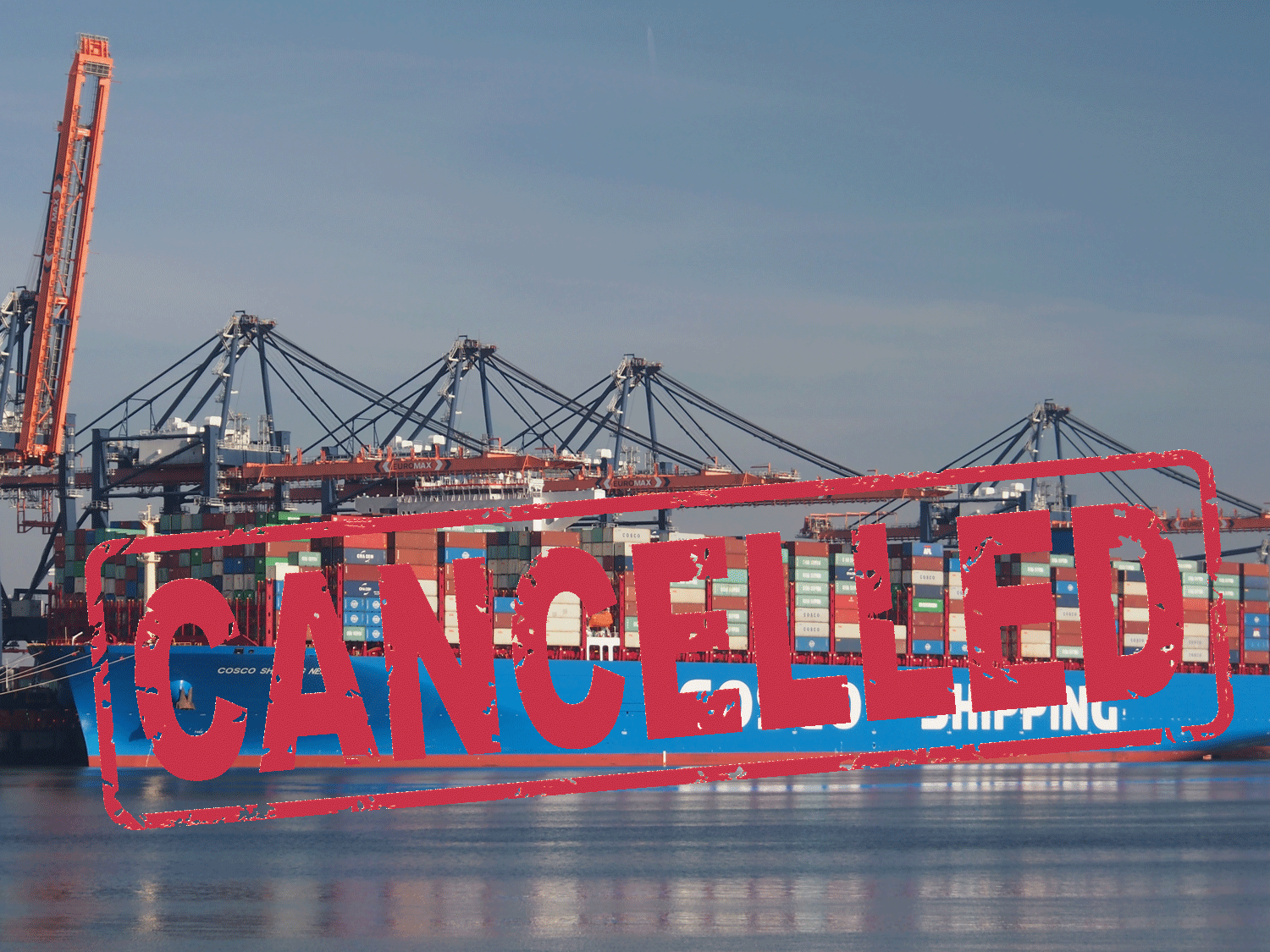
Within the first week of implementation, Chinese shipping giants Cosco and OOCL incurred more than $42 million in port fees from just 15 U.S. port calls. Based on current deployment, annual exposure for the two lines could exceed $2 billion, representing as much as 7 % of combined revenue.

While some carriers have avoided Chinese tonnage by redeploying vessels built elsewhere, many have no alternative. Post-Panamax container ships and vehicle carriers built in China but owned by global operators remain fully liable under the new rules.

RoRo Operators Face Steep Increases

The new regime has been even more damaging for vehicle and equipment carriers. The levy on all foreign-built vessels, not just those tied to China, rose from $14 to $46 per net ton, tripling the original charge announced in June. This means a large car carrier now faces about $1.2 million per port call, capped at five annual calls per vessel.

Operators such as Wallenius Wilhelmsen and Höegh Autoliners are facing unprecedented annual costs, estimated near $1 billion and $225 million respectively, which will inevitably feed through to manufacturers and exporters. The burden will be particularly heavy on automotive and heavy-equipment producers that rely on U.S.–Europe and U.S.–Asia RoRo services.

Outlook

As public consultation on further extensions of the scheme continues, the maritime industry is bracing for additional cost escalation and route restructuring. Unless revised, the USTR’s fee framework could reshape port-call economics, amplify freight volatility, and reduce U.S. competitiveness in key manufacturing export markets.

Metro’s sea freight and RoRo specialists support automotive, machinery, and project cargo shippers potentially facing rising U.S. port charges amid changing compliance requirements. With deep expertise in vehicle logistics and carrier management, we minimise disruption and optimise cost efficiency across global trade lanes. EMAIL Andrew Smith, Managing Director, to discuss tailored solutions for your automotive supply chain.

When the Suez Canal Comes Back Online: Hidden Risks for Supply Chains

When the Suez Canal Comes Back Online: Hidden Risks for Supply Chains

With hopes rising of stabilising conflict in the Red Sea region, analysts are increasingly considering what it would mean if shipping lines resume full use of the Suez Canal route, and it’s not all good news. 

While the shorter route from Asia to Europe might seem like a logistical boon, the modelling suggests there are several material pitfalls ahead that shippers need to be aware of.

Since late 2023, container shipping lines operating on Asia–Europe and Asia–North America routes have avoided the Suez Canal, opting instead to sail around the Cape of Good Hope. This detour has extended transit times and absorbed a significant amount of global container capacity. According to Sea-Intelligence, a full and immediate return to the Suez Canal could release up to 2.1 million TEU of capacity, equivalent to around 6.5 % of the global fleet, back into circulation.

However, this sudden release would create a powerful surge of imports into Europe. Modelling suggests that if all carriers reverted to Suez routing at once, inbound volumes from Asia could double for a period of up to two weeks, pushing overall port handling demand almost 40 % higher than previous peaks. 

Even if the transition were more gradual, spread over six to eight weeks, European ports would still face throughput levels around 10 % above historical highs, straining terminal operations, inland connections, and storage capacity.

Key Areas of Risk

  • European Port Congestion and Hinterland Strain
    European ports are already under pressure. A sudden import surge could stretch terminal capacity, yard space, and inland networks, leading to delays, higher handling costs, and increased demurrage.
  • Short-Term Disruption Despite Long-Term Gains
    While the Suez route offers shorter transits and lower fuel use, the transition back is complex. Network structures have been rebuilt around the Cape, and reverting will require major re-engineering, with temporary schedule changes and service disruption.
  • Lingering Risk and Insurance Costs
    The security issues that diverted ships from Suez persist. Even after reopening, residual war-risk premiums and contingency measures could keep operating costs elevated.
  • Capacity Overshoot and Rate Pressure
    Releasing 2.1 million TEU of capacity is likely to swing supply–demand balance, pushing rates down and while shippers may benefit in the short-term, it is likely that carriers would take drastic action to protect margins.
  • Timing and Readiness
    The timing of a full return remains uncertain. Analysts stress that rushing back before networks and ports are ready could trigger fresh disruption rather than restoring stability.

Metro’s sea freight team are already modelling reopening scenarios to ensure capacity, routing, and contingency plans are ready when trade flows shift back through the Suez Canal. 

EMAIL Managing Director, Andrew Smith to arrange a strategic review of your shipping patterns, risk exposure, and options to protect service continuity and cost efficiency when routes realign.