National Cyber Security Centre 1440x1080 1

Metro attains Government-backed Cyber Essentials certification

Metro has achieved Cyber Essentials certification, the UK Government-backed baseline for protecting organisations against the most common cyber threats.

Achieving Cyber Essentials builds on our ISO/IEC 27001:2022 certification awarded in July, reinforcing a layered, standards-led approach to information security across our operations and supply chain.

With business and procurement leaders reporting a marked rise in attacks and cascading disruption risks, strengthening first-line cyber controls at each node in the chain is now a business continuity priority, not just an IT task. Our Cyber Essentials certification evidences robust baseline controls, while ISO 27001 provides the governance, risk and assurance framework above them.

Cyber Essentials focuses on five technical controls proven to block or defend against the most prevalent cyber-attacks:

  • Firewalls & internet gateways to prevent unauthorised access
  • Secure configuration of devices, software and services
  • User access control with least-privilege principles and strong authentication
  • Malware protection to detect and stop malicious code (including ransomware)
  • Patch management to close known vulnerabilities promptly

Certification is independently assessed and renewed annually, driving continual improvement and accountability.

A continuum of assurance

  • ISO/IEC 27001:2022 (achieved July 2025) sets the overarching Information Security Management System (ISMS) covering policy, risk assessment, controls and audit.
  • Cyber Essentials complements this with mandated, practical safeguards at the device and network edge. A tangible signal to customers that foundational defences are in place and verified. 

UK guidance continues to emphasise board-level accountability for cyber resilience, reflecting the escalating tempo and impact of attacks. Metro’s combined certifications align with this direction of travel and with customer expectations for measurable, third-party-validated controls across their logistics partners.

What customers can expect

  • Trusted handling of data and systems across bookings, visibility tools and integrations
  • Consistent security standards applied to partners and internal processes
  • Ongoing improvement via annual Cyber Essentials renewal and ISO 27001 surveillance

Cyber Essentials certification is a further step in our long-term programme to deliver secure, technology-driven solutions that help you operate with confidence in an increasingly digital trading environment.

To discuss secure integrations, data exchange or platform connectivity, EMAIL Ian Powell, Customer & Technical Solutions Director.

Dover queue 2

France Ends Regime 42: What It Means for Exporters and Why You Should Attend Metro’s December Customs Webinar

France will withdraw Regime 42 from 1 January 2026, removing the VAT simplification that currently allows goods to enter France without import VAT when they are destined for another EU member state.

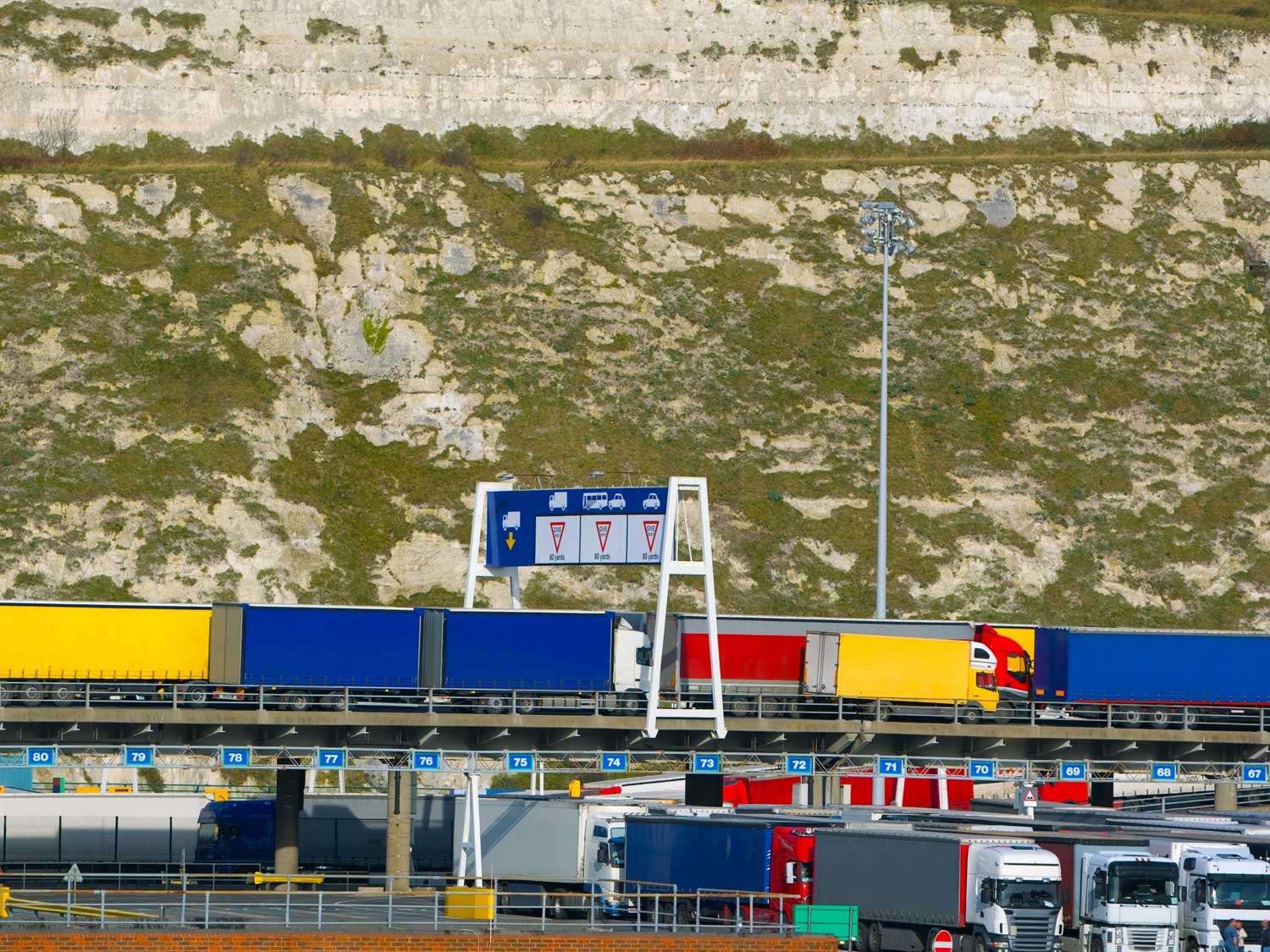
The ending of Regime 42 has attracted little publicity, but it will directly affect UK exporters shipping on DDP terms through the primary Dover–Calais Channel crossing.

Under DDP, the UK exporter is responsible for EU import formalities. Once Regime 42 is removed, any DDP shipment entering France will require French import VAT accounting, unless the exporter holds a French VAT registration. For many businesses, this introduces new administrative steps and potential cash-flow exposure.

Some exporters may look to reroute via alternative EU entry points, like Belgium or the Netherlands, where Regime 42 will continue. However, the Dover–Calais corridor remains the fastest, most reliable and most cost-efficient route into mainland Europe.

Diverting freight via Belgian or Dutch ports will inevitably add cost, extend transit times and risk congestion if volumes surge.

To ensure continuity, Metro can support exporters with three practical solutions:

  • T1 Transit Solution
    Goods can transit France under a T1, avoiding the need to pay French import VAT. Clearance takes place at the final EU destination, maintaining full route flexibility.
  • French VAT Registration and Returns
    For exporters wishing to continue using Dover–Calais without a transit procedure, Metro can arrange and manage French VAT registration and periodic returns.
  • Routing via alternative port pairs
    Where customers prefer to use Dutch or Belgian ports to retain Regime 42 benefits, Metro can support and coordinate these routings through established carrier and agent networks.

For many DDP exporters, the T1 transit route or French VAT registration, supported by Metro, will offer the best combination of compliance, speed and cost-efficiency.

Exporters should review their EU import arrangements early to ensure seamless operations ahead of January 2026.

Metro’s customs and compliance specialists are working with exporting customers to identify exposure, adapt procedures, and ensure every movement remains compliant and cost-efficient under the new rules.

EMAIL Andrew Smith, Managing Director, to discuss how we can help safeguard your European exports and keep your goods flowing smoothly through the transition.

Upcoming Metro Webinar: Essential Customs Changes for 2026

To help businesses prepare for these and other major regulatory shifts, Metro’s customs specialists will host a one-hour webinar in December.

Webinar Title

Avoid EU Border Disruption in 2026: The Key Customs Changes and How to Prepare Now

What We’ll Cover
A focused, practical review of:

  • ICS2 and the new GB ENS requirements
  • The end of Regime 42 in France: who is affected and what to do
  • French Douane ELO rules and their impact on all French port traffic
  • EUDR, CBAM and the UK’s expected approach
  • 2026 trade agreements and anticipated regulatory changes
  • Accessing CDS data free of charge
  • De minimis rule changes and the end of low-value relief
  • Compliance requirements for 2026 – what they mean in real terms

5 December @ 11:00 AM (1 hour) – CLICK TO BOOK

Exporters, importers and supply chain managers are strongly encouraged to attend. This session provides clarity on the border changes that will define 2026, and the actions businesses need to take now to stay compliant and competitive.

factory emissions

CSRD: Turning Mandatory Reporting into a Competitive Edge

The European Union’s Corporate Sustainability Reporting Directive (CSRD) makes sustainability disclosures mandatory for thousands of companies. Deloitte’s recent assessment of 200 early adopters reveals both compliance challenges and an emerging opportunity to use reporting as a strategic differentiator.

The CSRD sets new standards for transparency, requiring businesses to detail environmental and social impacts throughout their value chains. According to Deloitte’s analysis, supply chain and procurement teams are adapting rapidly, embedding sustainability tracking into every facet of operations.

Consumer-facing industries lead the charge, actively mapping suppliers and reporting indirect, Scope 3 emissions. Nearly all consumer businesses (over 90%) now disclose emissions linked to purchased goods and services, and 94% report on emissions from upstream transport and distribution. Circular economy commitments are also on the rise, with disclosures commonly covering product lifecycle improvements, such as recyclability and the use of secondary materials.

Companies in technology, media, and telecommunications are incorporating further disclosures on labour standards and responsible data use, with around 60% reporting on workers within their value chain. Industrial firms, meanwhile, are setting ambitious targets for climate transition and resource conservation, with 30 firms disclosing explicit net zero targets for Scope 3 emissions, 73% reporting on biodiversity and ecosystems, and 51 publishing climate transition plans.

In financial services, 90% of banks now disclose specific targets for financed emissions, though there’s still a reliance on estimates rather than direct supplier or counterparty data. 

Demand for Robust Data Systems

Deloitte’s study makes one challenge clear: the shift from voluntary reporting to regulated, finance-grade disclosure is demanding robust IT solutions and integrated platforms.

Accurate measurement and granular, actionable insights are now essential, not just for compliance, but to drive better decision-making and strategic change.

Metro’s MVT ECO platform supports the complexities of CSRD and wider ESG regulations, combining real-time data capture, carbon footprint analytics, and transparent reporting for every shipment across all modes and origins.

Metro delivers scalable IT capability so sustainability teams can easily track, drill down, and export the relevant emissions data needed for formal disclosure, climate planning, and offset strategies.

Scope 3 Emissions, Circularity, and Beyond

In line with CSRD’s requirements, Metro’s cloud-based system measures and reports CO₂ equivalent emissions for every consignment by mode and route, making Scope 3 tracking efficient and actionable.

The software is accredited to leading sustainability standards, providing trustworthy data for both internal and third-party audits and ensuring conformance with the Global Logistics Emissions Council (GLEC) and EN 16258 frameworks.

As circular economy practices, such as material recyclability and durability, become integral to supply chain design, MVT ECO gives businesses the data they need to embed these strategies and assess their environmental performance.

Verified Offset and Transparent Action

A unique feature of the MVT ECO platform is the ability for customers to participate in verified carbon offset programmes, supporting projects from renewable energy delivery to rainforest conservation. This not only helps eradicate residual emissions but also offers advantages aligned with UN Sustainable Development Goals, strengthening community, social, and biodiversity outcomes.

Continuous technological improvement means Metro customers can anticipate regulatory change, report with confidence, and make sustainability the cornerstone of performance and growth.

Empowering the Future of Sustainable Supply Chains

As CSRD raises the bar for supply chain sustainability, companies must move beyond compliance to proactive, data-driven improvement. With Metro’s MVT ECO platform, supply chain managers and sustainability teams gain the measurement, reporting, and offsetting capabilities needed for rigorous CSRD disclosure, and the competitive agility required in a rapidly changing market.

EMAIL Andrew Smith, Managing Director, today to learn more.

conservation 1440x1080 1

EU Deforestation-Free Product Law Faces Further Delays

The EU Regulation on Deforestation-Free Products (EUDR), which defines compliance obligations for businesses trading with the European market, is facing further implementation delays.

Designed to prevent the sale and export of goods linked to deforestation and forest degradation, EUDR applies to a wide range of commodities, including wood, paper, palm oil, rubber, coffee, cocoa, soy, and livestock.

On 23 September 2025, the European Commission announced it is considering another one-year delay to EUDR enforcement—postponing the application of the law from December 2025 for large companies to December 2026, and for smaller firms from June 2026 to June 2027.

This marks the second official delay as EU authorities struggle to roll out the IT infrastructure needed to handle due diligence statements and monitor supply chain transactions at scale.

Defining the EUDR

The EUDR is a core plank of the EU Green Deal, aiming to sever the link between Europe’s consumption and global forest loss. Companies placing relevant products on the EU market or exporting them from the bloc will be required to prove those goods are legal, traceable, and entirely deforestation-free.

To comply, businesses must maintain paperwork and geolocation data showing that commodities are sourced from land that has not been deforested after December 2020.

Due diligence statements will need to demonstrate negligible risk and trace every relevant batch from origin to final sale. Third-party certifications like FSC can help streamline compliance but do not serve as automatic proof; additional geolocation mapping and risk assessment remain mandatory for full EUDR compliance.

The latest delays are being linked with concerns over potential system “slowdowns” and disruptions that could stall trade and make compliance impossible for thousands of businesses.

The risk of further simplifications or legislative changes has also emerged, with some political groups pushing to amend the law’s benchmarking system and even introduce a “zero-risk” exemption for certain countries.

Implications for Metro Customers

  • The delay gives economic operators slightly more time to adapt their sourcing and compliance systems but increases uncertainty for businesses who have already invested in EUDR preparation.
  • Large and small companies alike must now track shifting requirements, especially as the regulation could change further in parliamentary negotiations.
  • Businesses sourcing affected commodities (timber, coffee, soy, cocoa, etc.) should continue mapping supply chains, aligning procurement strategies with deforestation-free criteria, and strengthening traceability processes, particularly around geolocation data and documentation.
  • If companies use FSC certification, extra steps are now needed: ensuring plot-level traceability and robust risk evaluation, not just certification documents.

What Comes Next?

The European Commission’s latest proposal is not yet final. Metro customers trading with or into the EU should stay up to date as legislative details and IT infrastructure roll out, and be ready to pivot quickly if further changes to EUDR emerge.

As enforcement eventually resumes, the EUDR is set to become a defining feature of UK–EU supply chain management and trade compliance, shaping how Metro supports customers in navigating new environmental obligations and regulatory risks.

EMAIL Andrew Smith, Managing Director, today to explore how we can support EUDR compliance and reporting.