CMA CGM Montmarte

OCEAN Alliance seek stability

Although there was market speculation that a member of the OCEAN Alliance might be tempted to leave and join THE Alliance in 2027, a new agreement by the remaining members makes it very unlikely this decade.

Seeking to send a clear message of stability, after Hapag Lloyd’s defection to the Gemini Cooperation, the remaining OCEAN Alliance members – CMA CGM, Cosco Shipping, Evergreen and OOCL – have formally agreed to continue their alliance until at least 2032.

Founded in 2017 under a 10-year deal, the OCEAN Alliance members will now continue their vessel-sharing agreement until the end of March 2032, after their respective CEO’s signing a new agreement in Shanghai on the 27th February.

With the Gemini Cooperation and OCEAN Alliance structure and participants now agreed, it just leaves MSC and THE Alliance (THEA) members ONE, YangMing and HMM to confirm their intentions.

OCEAN Alliance will have the greatest number of east-west trade loops, with 40 across its network, followed by Gemini with 21, THEA with 19 and MSC with 15.

The OCEAN Alliance’s decision to extend their partnership does mean that as the largest alliance they might attract attention from EU regulators, when anti-trust exemption for container shipping lines expires at the end of April.

While the anti-trust expiration does not prohibit large alliances, should regulators be pressured by shipper lobby groups or politicians to open an investigation, OCEAN Alliance would be the obvious test case.

Everyone’s expectation is that MSC have the scale to largely go it alone and the freedom of not having to compromise with partners should give them flexibility, which could be leverage to create a strategic advantage.

With 12 ‘hub-and-spoke’ terminals in Asia, EMEA, North and South America, the Gemini Cooperation will clearly have fewer direct port-port combinations and ensuring that terminals manage high port calls, big exchanges and yard pressure effectively is going to be very challenging and If they don’t get it right, they will be in trouble.

So ONE, YangMing and HMM could decide to leverage THEA’s scale by designing their network to fit market niches and could consider differentiating with direct port-port calls, for shippers that want to avoid transhipments.

There is speculation that Wan Hai, with its fleet of 18 neo-panamax ships, may join the THEA and while sceptics may doubt they will plug the gap left by Hapag, who’s fleet recently passed 2Mteu, they are not the biggest tonnage contributor in THEA.

Hapag-Lloyd supplies 26% of all alliance capacity, which compares to 39% for ONE, 18% for Yang Ming and 17% for HMM.

THEA may also decide to extend alliance cooperation beyond their east-west partnership and move into the Intra-Asia, Middle East and African markets, but whichever route they choose, the pressure is clearly on ONE, HMM and YangMing.

We will keep you advised and updated on important developments within the container ocean freight market as they materialise.

If you have any questions or concerns about the OCEAN Alliance agreement, or would like to discuss the wider implications of the shipping alliances, please EMAIL our Chief Commercial Officer, Andy Smith.

container ship and naval escort

Red Sea crisis; situation report

The UK Maritime Trade Operations (UKMTO) is already reporting multiple new Houthi attacks on vessels, following two missile strikes on the British registered general cargo vessel “Rubymar” on Sunday, which the crew had to abandon on Monday.

The Rubymar attack was followed by a merchant vessel being tracked by at least two drones and then a second attack in the Bab al-Mandeb strait, where a vessel was hit by a drone resulting in superficial damage to the superstructure.

The EU formally announced operation Aspides which will see at least four frigates being sent to the Red Sea to protect shipping in few weeks, but for now it is clear that despite the offensive posture of US and UK forces this has done nothing to reduce the frequency of Houthi attacks.

At the UN, China and Russia accused the US and UK of illegal military action against the Houthis, as such actions were not sanctioned by the UN Security Council. Interestingly it appears they are not complaining about Houthi and/or Iranian involvement, which is most certainly also not sanctioned by the UN Security Council.

It is quite clear that the Houthis have not been deterred by military action and maritime security is unlikely to improve anytime soon, with the ongoing war in Gaza and associated geopolitical tensions in the Middle East. The knock-on effects could take us well into 2024.

Rate movements 
With the pre-CNY surge now behind us, spot rate data shows Asia-Europe rates softening, but the pace of decline has slowed and while they might be 20% down on their peak in January, it is still 170% above the pre-Red Sea crisis level.

Similarly, Asia-Med rates, if they continue the present trajectory, have dropped over 20% on their peak, but are nearly 200% above pre-crisis levels.

On the Pacific both USEC and USWC spot rates have reached a plateau, but remain far above end 2023 levels and are not yet showing any material decline. 

Equipment
With the exception of a few isolated routes, the container shipping lines have largely been successful in managing the supply of equipment across their networks, but supply does remain tight in certain regions, including India.

The carriers are desperate to maximise revenue earning opportunities by avoiding any equipment availability problems, as the market settles into the new normal of transits around the Cape of Good Hope (COGH).

Vessel scheduling
After circumnavigating the African continent twice, the first of the containerships that diverted away from the Suez route have now begun to arrive back in Asia with substantial delays. 

These delays are challenging for carriers’ efforts to maintain weekly sailings from the Far East to Europe. At least two – and preferably three – extra vessels need to be added to each loop to guarantee all scheduled departures. 

For carriers, it is a ‘lucky’ coincidence that the return of the first batch of divert-ed ships falls in the traditionally ‘slow’ period after Chinese New Year, when shipping lines tend to blank a number of sailings. 

So far, only MSC and Maersk have announced a blank sailing program for the Chinese New Year period, with seven sailings voided to North Europe and four to the Med. 

Amidst the Red Sea crisis, global shipping schedule reliability decreased by 5% in December 2023, the largest monthly drop since February 2021 to 56.8%. It is inevitable that these figures will drop further as January’s COGH’s diversions are factored in, but they will then be expected to improve. At least until the Suez route reopens.

If you have any questions or concerns about the impact of the Suez situation on your Asia supply chain, or would like to discuss its wider implications, please EMAIL our Chief Commercial Officer, Andy Smith.

For questions about automotive supply chains, trade with the Middle East, Africa, Indian Sub and beyond, please EMAIL our Automotive team who are standing by to assist.

Questions or concerns relating to marine insurance and/or the Suez situation, or to discuss wider implications please EMAIL our Chief Finance Officer Laurence Burford.

Panama COSCO ship

Transpacific container shipping

If we were to try and define a single factor that defined transpacific container shipping (along with most other routes) in 2023, it would probably be shipper complacency brought about by the rebalancing and normalisation of supply chains, following the unprecedented disruption of the COVID years. 

However, ‘normal’ tends have a very limited span in shipping, and the next cycle of disruption is never far away. 

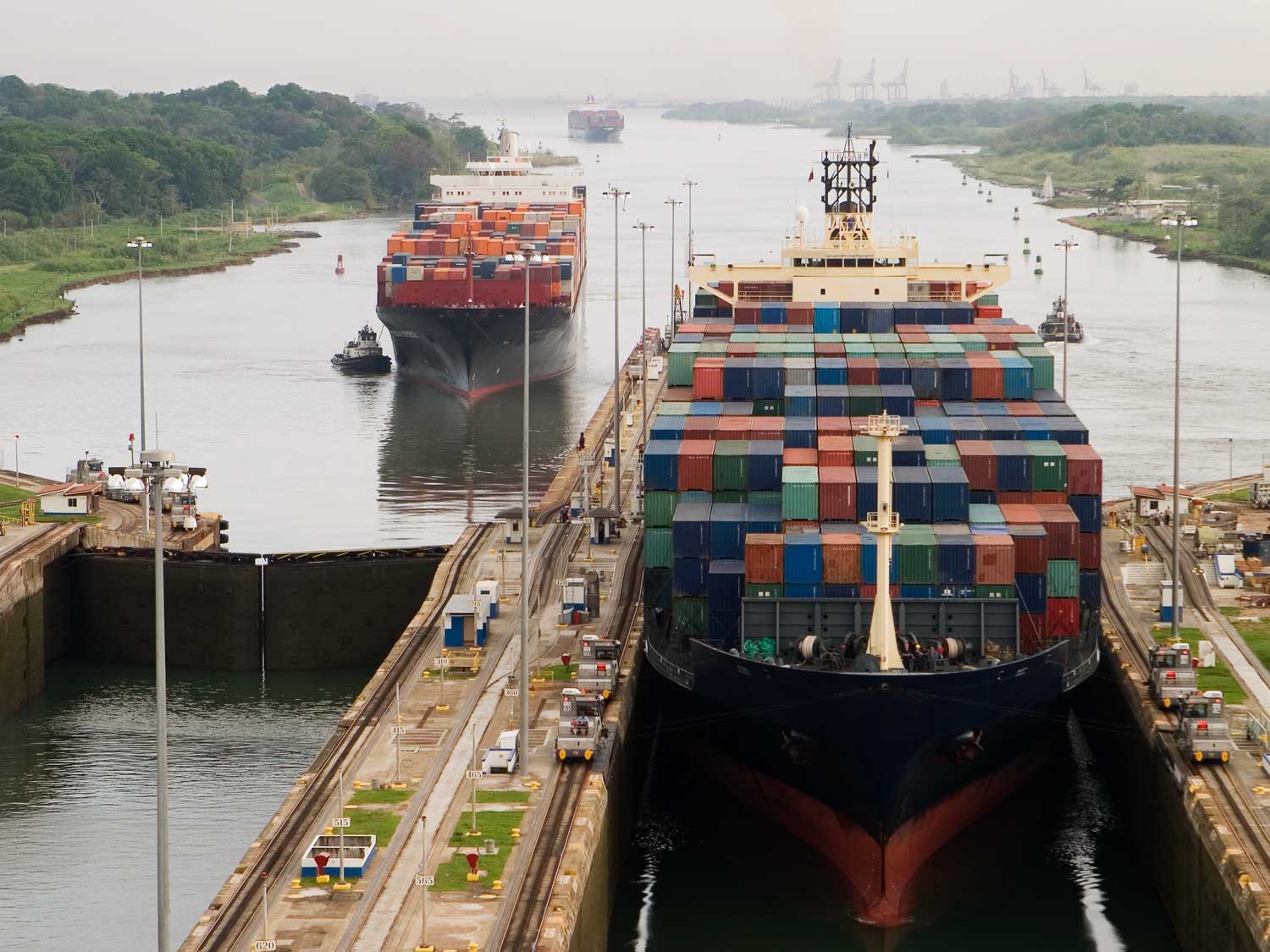
The first warning signs began to emerge last summer when the Panama Canal Authority first began to restrict canal transits due to the historic drought impacting Central America. 

Then in December the Red Sea Crisis first made headlines and within a matter of weeks hundreds of container ships were forced to divert away from the Suez Canal routing to avoid attacks by Houthi rebels off the western coast of Yemen. 

The resulting diversion around southern Africa’s Cape of Good Hope has absorbed much of the capacity carriers had laid up during the lull, delayed cargo deliveries, and doubled rates on some lanes, while also prompting carriers to implement war-risk and other surcharges. 

Cooling spot market
Spot rates from the Far East into the US have softened since the last round of GRIs at the start of February, with FAK rates into both the West Coast and East Coast falling slightly, but remaining at very elevated levels.

But a cooling spot market doesn’t mean the crisis is over, with spot rates from the Far East to the US West Coast still almost 200% higher than the end of 2023, with East Coast rates  up 140% and the shipping lines will be doing everything they can to make the latest mid-February GRIs stick.

How long the Red Sea disruption will continue is unknown, but it’s likely that shippers will face pressure on prices and disruption through the first half of 2024. 

Uncertainty and unease
While the Panama Canal situation did not result in excessive delays during H2 2023, it has created disruption and added cost, encouraging many US importers to seek East Coast services and/or overland rail connections from the West Coast.

And now we learn that, with the drought continuing, water levels in the reservoir that feeds the operation of the Panama Canal will sink below the record low levels seen last year – around 8ft lower than ideal for safe navigation.

If established rainfall trends hold, reservoir water levels will fall well below last year’s record lows, forcing limits on the number of vessels that use the canal, restrictions on vessel utilisations and surcharges of some 6.5%.

Add to that the uncertainty surrounding labour negotiations that will begin in the spring on a new longshore contract on the East and Gulf coasts, and 2024 is shaping up to be a year of great unease for transpacific shippers.

If you have any questions or concerns about the issues raised in this article, we can review your situation and explain your options, including alternative carriers, ports and routes.

To discover how we can support your transpacific or transatlantic trade, or to learn more about our ocean solutions, please EMAIL Metro’s Chief Commercial Officer, Andy Smith. 

Ellerman boxes

Our unique transatlantic shipping line

We have been supporting bi-lateral UK/USA trade, with air and sea freight services, for over four decades, which is why we are so excited by our in-house shipping line, Ellerman City Liners, transatlantic capacity deal with the world’s biggest shipping line, MSC.

Ellerman’s weekly sailing United States Express Service (USX) is supported by our own offices and delivers some of the fastest containerised transit times available – direct to Philadelphia from just 13 days – and because it utilises non-congested ports and terminals, port clearance and inland movements are seamless too. 

USX is the only direct service operating to and from Jacksonville, serving the Baltic, Scandinavia, Europe and the United States, with four calls on the East Coast, including Philadelphia.

The MSC and Ellerman City Liners agreement utilises a combination of MSC capacity and our own independent vessel between ports, with a set weekly volume and an option to increase as required, covering dry and refrigerated containers.

Pasquale Formisano, Senior Vice President of MSC, said, “I’m very pleased we’re extending our strategic partnership with Ellerman, one of the shipping industry’s great names. This agreement is all about efficiency. Guaranteed cargo means we can operate at maximum capacity and, therefore, minimise the environmental impact of each TEU we carry. The more we can do that, the more we can reduce emissions.”

Peter Andrews, Commercial Director of Ellerman, said, “We are delighted to announce this co-operation with MSC, the world’s largest shipping company. This agreement allows Ellerman to operate with greater efficiency, reducing our environmental footprint whilst also broadening our geographical scope in both Europe and the United States.”

The agreement covers routes between ports in Sweden, Poland, Lithuania, Germany, UK, Belgium and France, and ports on the Atlantic Coast of the United States, from New York to Florida. It also includes the capacity to extend services to include routes around the world.

The Ellerman US Express (USX) service has a complete port rotation of Klaipeda – Gdynia – Gothenburg – Bremerhaven – Felixstowe – Antwerp – Le Havre – New York – Philadelphia – Norfolk – Jacksonville.

ELLERMAN CITY LINERS – United States Express Service 
– Fast and reliable transit times with a weekly service
– Tailor made end to end solutions
– Direct port calls in Scandinavia and Baltics 
– Own offices in Spain, Portugal, UK and Germany 
– All equipment types offered
– Only direct sailings to/from Jacksonville
– Fast & reliable transhipment options 

To learn more about our USX solutions, please EMAIL Chief Commercial Officer, Andy Smith.

Header image reproduced courtesy of Ellerman City Liners