businessman stressed

2021; a year of supply chain challenges

All around the world, companies have been impacted by supply chain challenges in 2021. With the pandemic’s disruption exacerbated by ‘Black Swan events', from Brexit, to the Suez Canal blockage, we have been working tirelessly to help our customers overcome these challenges and share critical information, so that they are always informed of what lies ahead.

Ensuring the right product is available for delivery, to the right customer, at the right time, in the right quantity and in the right condition becomes increasingly difficult when supply chains are pressured and unforeseen events impact operations.

To keep our customers and followers informed during 2021 we have been approached for our opinions regularly by the trade and national press, contributed to countless articles and shared breaking supply chain news, guides and insights, including:

  • 40 supply chain bulletins, to a combined audience of 32,000
  • 200 news updates on our web site attracting >100K page views
  • 1000+ social media posts, reaching over a quarter of a million users

Our first bulletin of 2021 highlighted early Brexit-related issues and outlined the rates, vessel space and equipment availability challenges that lay ahead.

A few bulletins in and we were considering the supply chain impact of the UK’s vaccine programme and, in preparation for the anticipated volume increases, were adding new personnel in key operational departments.

US port operations, particularly on the West Coast began to buckle under relentless volumes in early March, while European, North American and UK ports were anticipating a lull after the Evergreen EverGiven blocked the Suez Canal for six days, from the 23rd March. 

Lockdowns continued to ripple across Asia from April and container equipment shortages really began to bite, exacerbated by the ‘Suez Effect’, driving desperate shippers to move urgent cargo to air freight, with massive rate increases impacting many trade lanes and Metro’s Sea/Air services proving very popular with increasing numbers of smarter shippers.

May; and the same week we’re urging shippers to start planning their Christmas shipping schedules, the key Chinese port of Yantian stops accepting containers, after a coronavirus outbreak in the port area. Within weeks and the impact of the port’s closure has spread way beyond southern China, with carriers recording their worst ever transit times and rates at historic highs - 1,000% higher than 2020!

News of the heavy goods vehicle (HGV) driver shortage made mainstream news in June and Yantian finally opened, though Ningbo was to close just weeks later, after a single port worker tested positive for COVID-19, contributing to further sea freight rates increases, pushing increasing quantities of ‘distressed’ ocean cargo to air freight.

Throughout the year, while air freight has been uncertain, it has proven stable in comparison to shipping, with airlines being reactive and agile, switching on flights quickly to meet demand, where they have perceived a reasonable return on the investment and we have been ready to add charter capacity, to ensure that our customers’ expectations are met and delivery deadlines achieved.

Into the 3rd quarter and vessel space and the container equipment crunch continues, with market demand exceeding supply and rates skyrocketing. HGV drivers are considering strikes for better conditions, while demand for haulage is more than twice the 2019 level and 70% of hauliers are concerned about EU border checks due to come into force at the beginning of next year.

Metro’s technology team, meanwhile, have been integrating HMRC’s Customs Declaration Service (CDS), which will serve as the UK’s single customs platform, with our market-leading MVT supply chain platform and the CuDoS system, which automates and submits customs declarations in line with HMRC and EU regimes.

Our team also supported the development and adoption of emerging technology, across the shipping industry, by participating in the successful testing of new e-Bill of Lading (eFBL) standards, with FIATA , the trade association for 40,000 freight forwarding and logistics firms in 150 countries.

The final quarter of 2021 and the HGV driver shortage is intensified by further losses to the retail sector, factories in China are forced to close, due to power shortages, container carrier reliability drops to all-time lows, with ports subsequently omitted, to try and restore schedules.

Passenger airlines finally begin to convert and reduce the number of aircraft operated in ‘preighter’ configurations and return to flying scheduled passenger services on European, transatlantic and long-haul routes. 

As the year draws to a close, experts warn that the UK may run out of warehouse space, many shippers are still not ready for full UK border controls, manufacturing costs reach a three decade high, Omicron makes its debut and we share some Critical Christmas considerations.

This year we have also welcomed 60 new colleagues, to our Birmingham HQ and expanded our operations and platforms significantly, to ensure we deliver continued excellence, proactive communication and essential planning to customers. It’s what we do, to ensure we remain at the forefront of the industry, leading the evolution of freight and the dynamic solutions that benefit your supply chains.

However this year ends and whatever next year brings, you can rest assured that we will be available and ready to keep your supply chain running. Let’s keep talking and evolving as partners in an unpredictable environment and world. You are in safe hands!

Thank you for your support, Merry Christmas and Happy New Year.

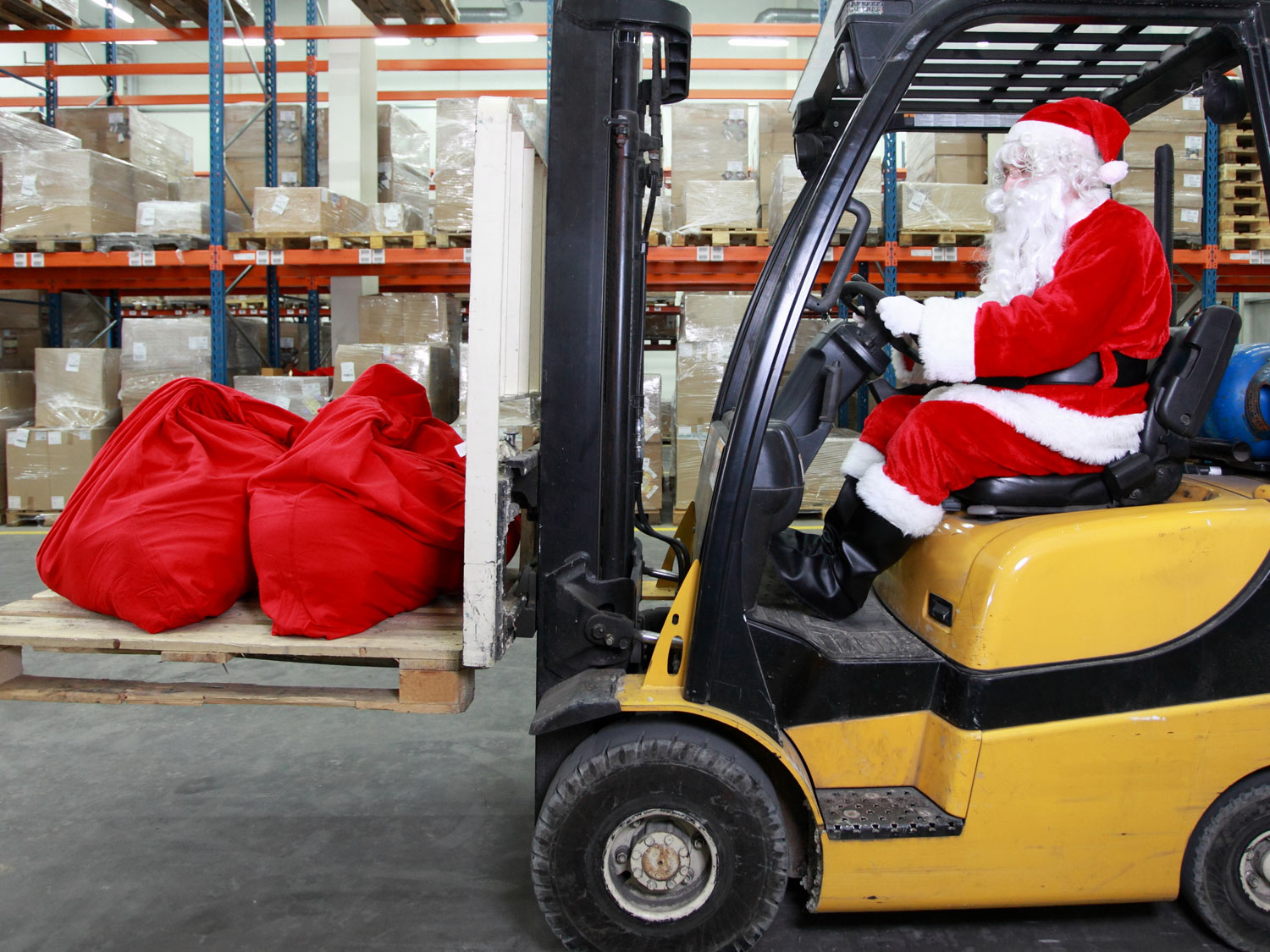
Father Christmas

Critical Christmas considerations

Current supply chain stresses and Christmas holiday dates are combining to create specific festive challenges, that may impact your supply chain, which is why we have compiled those most likely to have an operational or financial impact. 

As we come towards the close of the year we are faced with challenges across the board, on all modes of transport, in all directions. With this year’s festive holiday period basically offering a two day delivery window, between the 24th December and 4th January. 

Issues that are being experienced and expected to escalate during the 10 day holiday period include:

  1. Ports, airports, rail heads will be lightly staffed, slowing vessel unloading/ loading with potential for delays, backlog of vessels or UK ports being omitted.
  2. Hauliers and drivers taking holiday will restrict vehicle availability and capacity.
  3. Clients’ warehouses/ DC’s will be closed or working on restricted staff numbers, with reduced booking windows.
  4. Vessels continue to arrive off schedule and are still changing daily on ETA/ETD or omitting ports.
  5. Airlines are cancelling large numbers of scheduled flights due to falling travel demand creating a shortage of cargo capacity, especially on long haul routes such as North America and Asia creating a spike in prices.
  6. Hauliers and shipping lines currently are primarily only accepting transport transactions after January 4th 2022.
  7. If ports become congested due to a slow down in equipment release and acceptance it is highly likely that they will not be able to receive either laden or unladen containers and these will be redirected to other interim holding areas/ ports as a consequence.
  8. Customs authorities will be operating with skeleton staff throughout UK and Europe – for any urgent brokerage requirements please ensure that these are highlighted as soon as possible.
  9. Shipping lines and Ports are not giving any extended free time or detention and demurrage days resulting in additional costs being incurred. These are likely to be incurred 5 to 7 days after arrival of vessels, when they do eventually berth.
  10. This list is by no means exhaustive and these observations are without the growing effect of the Omicron COVID variant, which looks likely to massively impact the UK infrastructure over coming weeks, leading to working restrictions and possible firebreak lockdowns.

Metro are doing everything that we can to mitigate additional costs but the reality is with a 10 day ‘virtual closure’ of the logistics sector in the UK and the growing influence of Omicron, additional costs may be unavoidable, whether as a recovery of issues as they occur, or through storage charges that are applied after free time periods are exceeded.

We will continue to keep you updated and advised on the conditions and events as they occur and we will advise on additional costs that are incurred, or likely to be incurred, as soon as we are aware of these.

We are asking customers to advise on their own arrangements for the festive period, in relation to warehouse availability, office attendance and out of office contact details so that we are able to communicate everything with you during the Christmas and New Year holiday season.

Metro will continue to operate, as key workers, from the office and remotely from home with the statutory holidays being observed, when we will be closed, like most other organisations. We understand the need for proactive and high level communication during the period, and as always, we will ensure that you are kept advised of the situation down to consignment transaction level.

Thank you for your support, Merry Christmas and Happy New Year.

Ningbo

Port congestion eases, but challenges will continue to remain

Asias largest ports are showing signs that congestion is easing ahead of the Christmas holiday season, with Shanghai traffic declining 0.2%, Hong Kong ship count dropping 10.4% and Singapore dropping 14.7% according to an analysis by Bloomberg.

While any easing of volume is welcome, Bloomberg’s results are based on a single week’s traffic and the latest data from the World Container Index shows basically no changes in pricing at all compared to the previous week.

It would be great to think that Bloomberg’s advisory, that a drop in volumes, is the beginning of a large decline and a reversal to normal rate levels, but we would suggest caution in concluding this just yet. Or for the foreseeable future – as there are many mixed messages currently – and most are based on short term data and not considering the long term effects and impact, as an observation.

It seems more likely that the worst pressure on the trans-Pacific trade might have been alleviated, but the global capacity shortage persists and we cannot see a similar impact on Asia-Europe or Europe-North America.

Bad weather, accidents, COVID-related work constraints and increasing spending, due to COVID19 related consumer demand, have contributed to Chinese terminal lockdowns and logistical port challenges for almost two years, resulting in record levels of congestion, from manufacturing hubs in China to import gateways in the US and Northwest Europe.

Comparing levels of container congestion across China, 2021 started at similar levels to the previous two years, with the count of vessels waiting averaging just 88 per day between January and April. However, over the past six months, there has been a significant increase in the number of vessels waiting and numbers are still higher than they were at the beginning of the year.

Levels of congestion in China peaked at the end of July at 361 vessels, as typhoon In-Fa struck. With vessels unable to safely enter a port, queues built up and caused further disruptions to schedules. Since then, over the past three months, we have seen Container congestion gradually decrease in China, but there were still around 180 vessels, a total of 936,073 TEU, waiting off China at the end of last month.

Delays are still being felt in the UK, as retailers try to fill shelves in time for Christmas, with 40% of the UK’s containerised imports moving through Felixstowe alone.

The port has received around 45% fewer container ships this month compared to the same period in 2020, and around 50% less than the same period in 2019, which reflects carriers missing Felixstowe on rotation and suggests that the port is struggling with turnaround times, as a severe shortage of HGV drivers and terminal congestion means boxes are not leaving port quickly enough to clear space for the return of empty containers. None of this helps the disruption and challenges being experienced daily, which seem to be relentless.

While the current drop in Asian volumes is most likely a blip, it may be that we will see a lull in demand in the New Year, with the Christmas period ending and Chinese New Year.

This could ease congestion slightly, but if the high number of vessels waiting remains, it’s possible that clearing the backlog of vessels may extend into the second quarter of 2022.

Importers and especially those shipping via Felixstowe stand to benefit significantly from our new 750,000 sq ft and 100K pallet position mega distribution centre, located beside the container port.

The new Felixstowe Mega Distribution Centre offers the smart executive access to plenty of space and the opportunity to cut costs, simplify processes and improve cash flow. 

We are creative with our solutions, investments and customer engagement. So that is what you need, we deliver, to build satisfaction in the long and short term. 

Please contact Grant Liddell to discuss further – it will be productive and have a meaningful outcome.

FMDC

Mega Felixstowe DC offers so much more than space – it’s UNIque

With warehouse space becoming increasingly scarce, access to 100,000 pallet spaces would be welcomed by most shippers. The new group Mega Distribution Centre beside Felixstowe port, offers the smart executive access to plenty of space and the opportunity to cut costs, simplify processes and improve cash flow.

The new 750,000 sq ft Felixstowe Mega DC (FMDC) is just 400 metres from the UK’s largest container port, offering shippers all the benefits of port-centric logistics.

Rather than transporting goods away from the port, often hundreds of miles, to inland warehouses, the port-centric model lets you replace costly, time-consuming links in the supply chain, with simple solutions from ship to doorstep.

1. Reduce cost

Immediately remove the difficult to arrange and often costly haulage from port to inland warehouse as well as totally avoiding the high - and often unavoidable - costs of quay rent and container detention.

2. Reduce complexity

Simplify the supply chain by removing handling stages through the storage and distribution process. Holding buffer stocks at the point of import, until call-off and direct delivery, avoids wasted freight miles, provides buffer stock and frees up inland warehouse resource.

3. Quicker access to goods

Port-centric warehousing provides the quickest route for product to inventory, reducing lead times and giving visibility of the quality and quantity of goods in the fastest way possible.

4. Improved cash flow

Bonded storage improves cash flow by deferring payment for duty and VAT until goods are released for sale in the UK. Calling off stock as it is needed provides cashflow control and contingencies back into the supply-chain planning.

Located on a 28-acre site alongside the A14 and Felixstowe, the 750,000 sq ft fulfilment centre opened in the second quarter of 2021. It is British Retail Consortium (BRC) food grade accredited and Customs-bonded for wet and dry goods.

     
  • 400,000 sq ft narrow/wide aisle pallet racking
  • 200,000 sq ft eFulfilment zone
  • 100,000 sq ft cold store
  • 80,000 ambient pallet spaces
  • 18,000 pallet spaces of frozen storage
  • 10 levels of racking
  • 4 mezzanine floors
  • Advanced electrical mechanical handling equipment
  • Significant green credentials

If you need and desire a strategy that is future-proof, that will deliver your product to the right place, at the right time, please contact Chris Carlie. We can scope and profile your full requirements and aspirations, to demonstrate how we can assist you in a challenging environment. 

We recommend a collaborative approach, to identify the many other benefits and opportunities we can offer within your supply chains, that will allow you to focus on distribution and manufacturing of your core business platform. 

We would be delighted to arrange a virtual tour, online meeting and ideally a visit and tour of the facilities that truly are market leading and enhancing to our customers.