Panama Canal

Risk of Panama Canal disruption rising

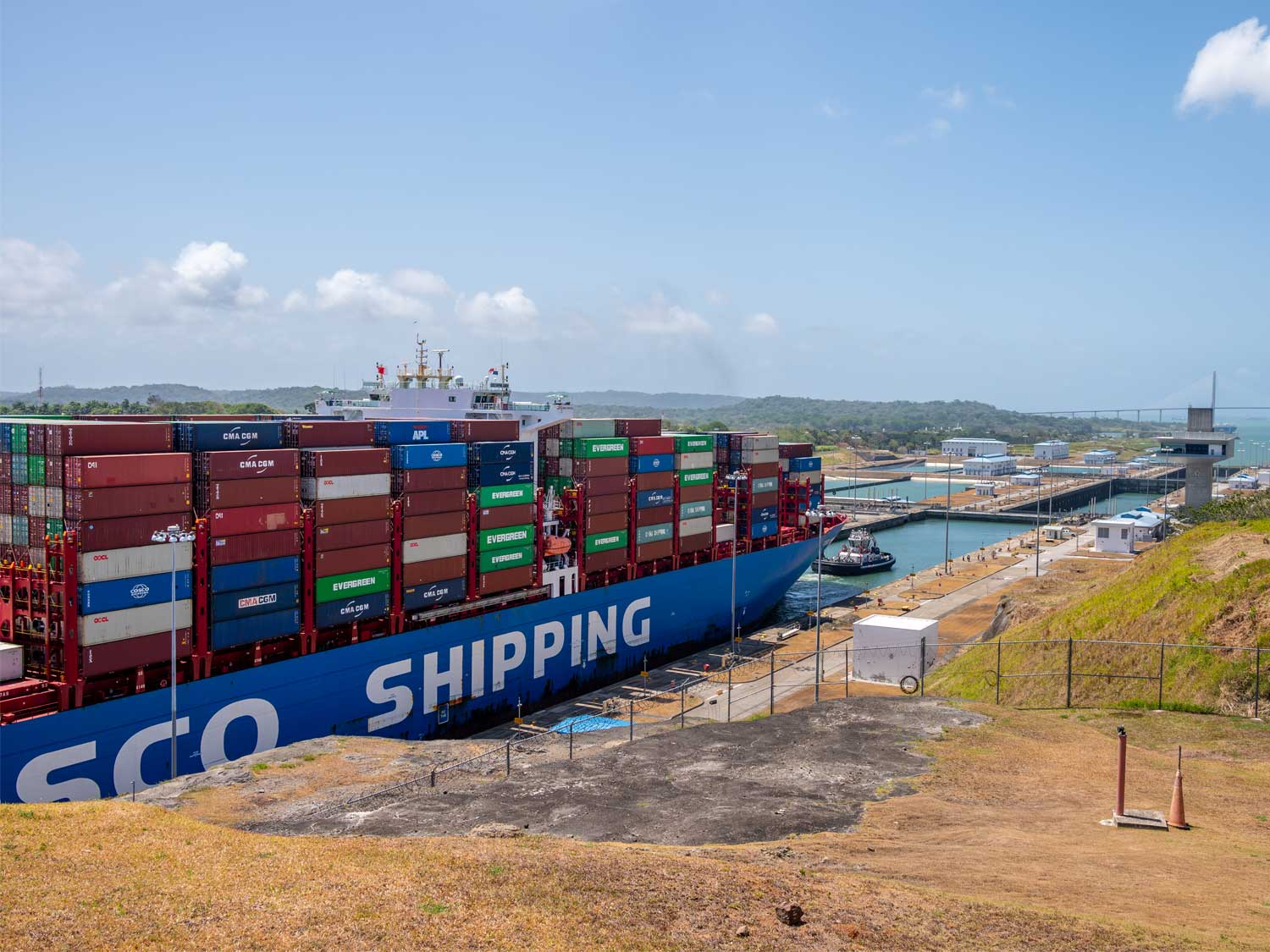
Unpredictable weather patterns and drought for most of 2023 have driven the Panama Canal Authority to impose numerous draft restrictions, reducing vessel transit numbers, and cutting vessel booking slots for lock usage, due to low water levels.

The Panama Canal consists of the man-made lakes of Miraflores and Gatun, with the panamax locks taking vessels with up to a 12.5 m draft and the neo-panamax locks for vessels up to a 15.2 m draft. 

The dual system is run on fresh water, with only the new system able to reuse some of the water used to transit the vessels, and with the lowest rainfall this century, the Panama Canal Authority’s limits on daily transit and vessel draft restrictions will stay in place for the rest of the year and throughout 2024.

While the ongoing restrictions have not impacted shippers yet, we are monitoring the canal situation closely, because extended delays for goods coming into the US for the coming autumn and winter seasons, could impact capacity, schedules and prices. 

The backlog of ships trying to enter the Panama Canal is growing, with current estimates putting the number at over 200 vessels. Containerships are the canal’s biggest users and are usually given preferential status, which means most have avoided the worst of the disruption, but neo-Panamax ships are waiting up to 18 days for northward transits, with similar delays for southbound transits.

Despite the wait, delays have not translated into noticeably late arrivals at US East and Gulf coast ports and with vessel capacity utilisation currently low, there has been capacity to absorb, and it will probably be a while yet before any delays are seen at the ports.

The number of daily transits through the canal has been capped at 32, compared with the 34 to 42 it can handle at peak capacity, in a bid to conserve water and some carriers are re-routing to avoid the backlog.

Ordinarily, neo-Panamax vessels move through the canal at an average 50 feet of draft but this has now been reduced to 44 feet to cope with the drought conditions, which means large container ships with good utilisation may have to offload containers, to make the vessel lighter and match the lower water draught.

In view of the draft restriction, some carriers have reduced maximum payloads, while others are still accepting heavyweight cargo and carriers have not yet been aggressive in imposing Panama Canal surcharges, though there is a suspicion that many have already rolled them into the ocean freight rate.

If you have any concerns about the issues raised in this article, we can review your situation and explain your options, including alternative carriers, ports and routes.

With a collaborative approach, we will provide the most efficient and cost-effective solutions, to ensure that your supply chain expectations are met.

Picket

The shipper’s new normal

The rapidity of the collapse in air and sea freight rates has given carriers the same level of trauma and shock experienced by shippers when freight rates exploded in  2021 and while the turnabout in the market was anticipated, its intensity and extent is far greater than expected, with shippers very much back in the driver’s seat.

The pandemic triggered supply chain disruptions of the last few years were particularly profound and far outside anything we might expect and while we should not expect new challenges or disruptions to have anything like that impact again, there will always be competitive pressure in the market, that will create capacity issues and rate fluctuations.

Many commentators describe the return of ocean freight rates to pre-pandemic levels as a ‘return to normal’ but 2019, which is often taken as a reference year, was a bad year for shipping company results on East-West routes and carriers’ operating costs have increased by about 30%.

A real ‘return to normal’ would require a return to schedule reliability, normal sailing speeds and freight rates at sustainable levels, to support long-term planning.

None of these three conditions currently applies on the major trade lanes and therefore, it is, incorrect to talk about a return to normal, in these terms. 

And it is important to keep in mind that a normal freight market is not the same as a global shipping market with no changes or disruptions.

There will always be challenges and operational disruptions. 

In the United States, we may have avoided strike action on the US West Coast (subject to ratification), but labour negotiations in Vancouver have failed to avert an ILWU Canada strike, which began on the 1st July, with no end date announced and a drought on the Panama Canal has been impacting container vessels transiting to the US East Coast. 

Just as operational disruption will manifest anywhere, at any time, there is always a point in global supply chains that is being impacted by adverse weather conditions, such as storms or fog. 

It may not feel like it, but all things considered, the markets are much more normal and maybe this will be as good as it gets for the short-term.

It is because businesses need to thrive against this backdrop of a complex supply chain environment that our MVT platform provides end-to-end visibility, with purchase order management and transparency of inventory throughout the supply chain.

Synchronising inventory across all transport modes and locations, with accurate real-time dashboards and reports, MVT provides supply chain executives with the data they need to assess and react to operational challenges.

Please EMAIL our Chief Commercial Officer, Andy Smith, for ‘normal’ insights and intelligence.

Intermodal 2

Supercharging supply chains for growth

The pandemic laid bare the critical importance of supply chains and executives tasked with managing them are much more significant figures in their businesses, as continuing success is highly dependent on improving supply chains.

For too many businesses the gap between supply chain planning, and the execution of that plan continues to grow, because the environment has already changed.

The pandemic, Brexit and Ukraine are the most recent examples of external factors having profound impacts on supply chains without warning.

At the same time, customer expectations are evolving, with increasing demands, including rapid delivery times and a growing number that want more focus on sustainability, so they can reduce the environmental impact of their supply chain. 

Supply chain resilience is essential for organisations to overcome the black swan events which are becoming more frequent and severe, and while over 54% of respondents to a CapGemini survey acknowledged that their supply chains have altered significantly in the past two years, only 27% are implementing end- to-end supply-chain transformation.

Businesses that want to thrive against the backdrop of a complex supply chain environment must pivot towards technology that provides end-to-end visibility, with purchase order management and transparency of inventory throughout the supply chain.

Synchronising inventory across all transport modes and locations, with accurate real-time dashboards and reports, provides executives with the data they need to assess and react to supply chain challenges.

Many supply chains have become too long and difficult to manage in an increasingly disrupted world and where once concentration was on scale and lowest transport cost, this generation of supply chains is characterised by resilience, sustainability and a broader definition of value.

To improve the quality and speed of decision making Metro’s MVT platform provides supply chain visibility and control, with the additional benefit of providing transparency to consumers, that products are on schedule and sourced with sustainably assured.

Metro’s supply chain audit embraces every event, process and participant, to uncover opportunities in five specific areas: Efficiency | Existing/new markets | Cost savings | Enhancing quality | Agility.

The audit is designed to add efficiencies, cut costs, increase profit and free up cashflow, by simplifying the end-to-end process. From raising the initial PO, through production, shipment, delivery and receipt to stock, we map the product flows, events and milestones, so that the customer can intercede on an order, at any time through the supply chain process, to SKU level.

Metro’s cloud-based supply chain management platform, MVT, helps our customers remove supply chain risk in challenging economic conditions, by managing their supply chain effectively, while tightening their control over inventory and suppliers. 

MVT helps companies adapt vendor and production strategy, by expanding procurement control and evolving their supply chain to match the future, with PO management, visibility and communication tools that manage and integrate new suppliers into the supply chain.

EMAIL Simon George, Technical Solutions Director, to learn more or arrange a demo.

EV charging

Automotive trends – We are in lockstep 

In a sign of the growing strategic significance of supply chain management for carmakers, two major manufacturers have appointed chief supply chain officers (CSCO) this month. Their appointments come after the industry has battled disruption to production and supply chains, shortages in semiconductors, and supply and logistics cost and capacity challenges.

The Ford and Renault appointments come as automotive manufacturers increasingly put top priority on efficiency, capacity, quality and digitalisation across their supply chains, with UK car sales recovering from their slump in the pandemic and Ford reclaiming the best-seller title.

Keeping up with demand
New car registrations rose by 16.7% in May, the 10th consecutive month of growth as supply continues to improve. Large fleet registrations continued to drive the growth, up by 36.9%, which has been attributed to greater availability following challenging supply issues in 2022.

British car manufacturing continues its resurgence, with output growing 9.9% in the latest monthly figures and exports up 14.7%, with 80% of UK-made cars being exported

UK car production is up 13.1%, driven by uplift in exports, with the EU the largest market, followed by the US, China and Australia.

The global volume challenges of RoRo PCC and  PTCT services are well-document in the trade press and are likely to remain a serious challenge for several years.

Metro is supporting exports by shipping cars in containers, with significantly lower port to port freight costs, to avoid the long wait for delayed RoRo services, which have seen freight rates spiral due to congestion and shortage of space.

Standard 40’ containers can accommodate two large cars, properly secured and, with a rack, four small vehicles can be loaded which, with container rates falling to new lows, offers massive efficiency gains and costs that are in line with historic RoRo levels.

Digitalisation
David Leich, executive director of global supply chain at General Motors said last year that those working in supply chain faced up to 200 unique global supply chain disruptions a week impacting the delivery of inbound parts and the delivery of finished vehicles, while only 6% of them have full visibility of those supply chains.

To monitor its supply chain for potential risks that could delay or halt shipments JLR is planning to use a combination of Artificial Intelligence, predictive analytics and machine learning in combination with “human intuition”, to help avoid industrial disruption that could affect production and increase costs.

The introduction of the technology, by JLR and other manufacturers, is part of a wider move to digitally enable supply chains, with end-to-end visibility and security.

Metro is increasing use of predictive and AI technology, to collate real-time carrier updates, to maintain accurate vessel ETA’s, data for purchase order management, route optimisation and supply chain visibility. 

We are developing our telematics capability, to offer shippers a much more effective alternative to the data aggregators, who are quite simply compiling data from open APIs and screen scraping historic data. We favour the ‘smart container’ technology that a number of carriers are developing, and are actively involved with UN CEFACT in creating industry standards for sharing this data.

In addition to creating visibility along the supply chain, Metro’s technical solutions team have worked hard to ensure the quality of data and provide a suite of reporting tools that make it easier to interpret and implement actions in a meaningful way.  

Lithium Batteries
Growing demand from consumers and government incentives are driving demand for EVs globally and with more EV models coming out from more brands over the next two or three years, the added growth in battery demand means that manufacturers and supply chain infrastructure will struggle to satisfy demand. 

Bloomberg Intelligence, told Automotive Logistics that while the semiconductor supply constraints are now beginning to ease, battery supply to meet demand will be the next problem, with potential bottlenecks from 2025 for the supply of lithium batteries into electric vehicle (EV) production.

Metro’s automotive teams handle the movement of thousands of EV’s and battery components every month, by all modes of transport including - when appropriate - the use of refrigerated equipment, to maintain ambient temperature levels, for additional safety precautions.

We started developing our Lithium battery logistics platform over six years ago and since then we have invested in the resource to serve this vertical, including training to cover all modes. 

Our Li-ion transportation expertise is increasingly recognised as market-leading, with our automotive team’s manager invited to address the International EV battery conference.

If you would like to learn more about our automotive logistics capability, or to discuss any of the issues raised here handling, please EMAIL Ian Tubbs, Automotive Manager at our Birmingham HQ.