Suez empty

Middle East: Disruption ripples through global supply chains

The ongoing disruption across the Middle East is now sending shockwaves far beyond the region itself, with upstream impacts emerging across air cargo networks, ocean shipping services and global freight pricing.

What began as a regional security crisis affecting Gulf airspace and the Strait of Hormuz is increasingly triggering structural changes in how global supply chains move cargo between Asia, Europe and the Americas.

Carriers and airlines are rapidly restructuring networks, while a growing number of emergency surcharges are being introduced as transport providers attempt to offset rising operational risks and fuel costs.

Air cargo networks feel the strain

Air cargo capacity has begun to stabilise slightly, but significant gaps remain in global lift availability.

Global air cargo capacity is currently down around 8%, improving from the 18% decline recorded earlier in the week. However, the regional disruption remains severe.

Outbound capacity from the Middle East to Europe remains 52% below normal levels, although this is an improvement on the 61% reduction seen earlier in the crisis.

At the same time, capacity from Asia Pacific to the Middle East remains 57% lower week-on-week, reflecting the continued disruption to key Gulf hub airports.

To compensate, airlines have increased direct Asia–Europe flights by around 14%, bypassing traditional stopovers in Dubai, Doha and Abu Dhabi and operating longer non-stop sectors.

However, direct flying cannot fully replace the connectivity normally provided by the Middle East’s hub-and-spoke air cargo networks.

Approximately a quarter of China–Europe air cargo capacity normally transits the Middle East, meaning the sudden loss of these hubs is creating structural gaps in the global network.

South Asia exports under particular pressure

The disruption is particularly acute for exporters across South and Southeast Asia, where cargo flows to Europe and North America rely heavily on Middle Eastern transit hubs.

Across South Asia–Europe corridors, available cargo tonne kilometres (ACTK) have fallen by 39%, leaving shippers scrambling to secure alternative routings.

Air cargo markets across the Indian Subcontinent and Bangladesh are already feeling the secondary effects.

Export capacity from Dhaka has tightened significantly, pushing airfreight rates up by roughly 20%.

In India, where many cargo services traditionally route via Gulf hubs, capacity constraints are becoming increasingly visible. Several major origins are now overbooked, some locations have temporarily stopped accepting cargo for five to seven days, and freight rates have increased by two to three times on certain lanes.

As capacity normally routed through the Middle East disappears, cargo destined for Europe and North America is expected to begin stacking up at Asian airports, creating a growing imbalance between available lift and cargo demand.

Early signs of pricing pressure are already emerging.

Spot rate indices have increased 2% from China to North America, 7% to Northern Europe, and 3% eastbound across the Atlantic.

The developing supply-demand imbalance is drawing comparisons with airfreight market conditions seen during the COVID-19 pandemic, when ocean disruptions pushed large volumes of cargo into the air freight market and triggered rapid rate increases.

Disruption spreads through global shipping networks

The ocean freight sector is experiencing a similar cascade effect.

Maritime tensions intensified further this week when the 1,700-TEU container vessel Safeen Prestige was struck by a missile in the Strait of Hormuz, bringing the total number of vessels hit during the crisis to six tankers and one container ship.

Although only a small proportion of the global fleet is physically located in the immediate risk zone, the operational consequences extend much further.

Currently around 2% of the global container fleet is located inside or near the Persian Gulf.

However, the wider network impact extends far beyond those vessels.

A total of 124 liner services include at least one Arabian Gulf port in their scheduled rotations, representing:

  • 520 container vessels
  • 3.6 million TEU of deployed capacity

As a result, the current disruption is directly affecting more than 10% of the global container shipping fleet by deployed capacity.

Carriers are already restructuring services, redeploying vessels and adjusting port rotations across multiple trade lanes as they attempt to maintain network stability.

Emergency surcharges begin to emerge

Alongside operational disruption, shipping lines have begun implementing a growing range of emergency surcharges linked to security risks, fuel costs and network congestion.

These charges are appearing under several different names, including:

  • ECS – Emergency Conflict Surcharge
  • WRS – War Risk Surcharge
  • EFS – Emergency Fuel Surcharge
  • EFQ – Emergency Fuel Quarterly surcharge

While terminology varies, the purpose is broadly similar: to offset the additional costs associated with longer sailing distances, higher insurance premiums and volatile fuel markets.

In some cases, the surcharges being discussed across the market are significant and may reach four-figure levels per container, depending on the trade lane, equipment type and carrier policy.

Because these charges differ between carriers and routes, shippers may encounter multiple surcharges applied simultaneously as conditions evolve.

Alongside new surcharges, carriers are also introducing operational measures designed to manage equipment supply and limit container accumulation at intermediate ports.

In one recent example, a major carrier has introduced a requirement for import containers discharged at certain ports to be collected from the quay within 48 hours.

Failure to remove containers within that timeframe may trigger additional charges, which in some cases are in a substantial four figure range.

Cargo backing up upstream

The ripple effects are already visible at origin.

In Bangladesh, more than 1,000 containers are currently stranded at Chittagong port and inland depots, while hundreds of containers already shipped remain stuck at Middle Eastern ports or on vessels awaiting discharge.

Similar pressures are beginning to appear at other Asian export hubs as Gulf-bound cargo stalls and vessels adjust schedules.

Nearly every major Asia export port is now experiencing some level of disruption, either through delayed sailings, suspended services or uncertainty around onward routing.

As shipping lines and airlines continue restructuring their networks, the full impact is expected to spread further across global supply chains.

Ocean carriers may redeploy vessels across Asia–Europe and Asia–US trade lanes, while airlines continue adjusting long-haul flight paths to compensate for the loss of Gulf connectivity.

Managing disruption

In light of the rapidly evolving situation, Metro is working closely with customers to assess the need for contingency airfreight on a shipment-by-shipment basis.

Our team can also advise on alternative routing options, particularly for cargo that would normally transit Middle Eastern hubs, helping customers minimise disruption and maintain supply chain resilience.

Customers with shipments moving through the region are encouraged to contact their Metro representative to review routing options and obtain the latest operational guidance.

Chennai office view from 1440x1080 1

Metro Expands Indian Presence with New Chennai Facility

Metro’s momentum in India continues to accelerate, with the opening of a second office in Chennai to support the ongoing expansion of Metro’s operations globally.

Designed to accommodate an additional 130 colleagues, this brand-new facility complements our existing Chennai headquarters and is a clear signal of our long-term investment in India.

This expansion marks another important milestone in Metro’s growth journey across the Indian Subcontinent. With the dual platforms of Metro Global India (MGI), delivering tailored services to select global customers directly in India, and Metro Indian Subcontinent (M-ISC), which serves as our Global Operational Centre (GOC), providing critical operational, accounting, financial, commercial, and administrative support for Metro’s global network.

India is fast becoming a critical operational hub and by the end of 2025, we expect to have more colleagues based in India than in our other global locations combined.

Metro’s Indian presence is powered by two critical pillars:

  • Service excellence for our key global customers business in India, delivered locally through MGI’s expanding footprint.
  • Global support services, delivered through M-ISC’s high-performance teams working across our advanced digital platforms.

This dual approach enables us to deliver tailored, efficient, and scalable solutions for customers in India and around the world, supported by deep local knowledge and global integration.

Our latest investment in Chennai is just the beginning. We have ambitious plans to grow further in the region, including the expansion of our specialist industrial sector division within MGI to meet increasing demand in this high-growth vertical.

Metro’s global expansion is driven by the needs and ambitions of our customers. As their operations grow in scale and complexity, we continue to build the teams, platforms, and facilities needed to support them locally.

Grant Liddell, Metro’s Chief Executive Officer commented. “We are incredibly proud of our Indian teams and their contribution to Metro’s global success. Congratulations to all colleagues in Chennai and across the country on this latest achievement and thank you for your continued commitment to delivering excellence for our customers worldwide.”

To learn more about our services in India or explore opportunities to collaborate, please EMAIL our managing director, Andrew Smith. We’d be delighted to support your supply chain.

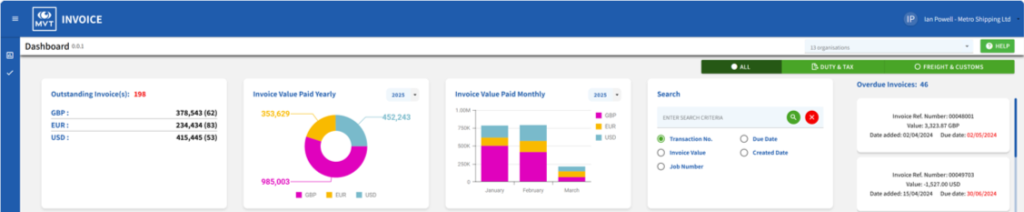
MVT invoice app 1440x960 1

Metro Unveils Leading-Edge Invoice Application

At Metro, innovation is at the heart of everything we do. Our latest advancement, the MVT Invoice Application, is set to transform how customers manage invoices and financial transactions.

Launching for BETA testing on March 17th, this new feature enhances our My Visibility Tool (MVT), delivering seamless, integrated invoice management.

With real-time tracking, a dynamic dashboard, and full visibility across all trading currencies, customers can monitor outstanding payments and settled transactions effortlessly. Advanced search, quick filters, and an intuitive invoice type switcher streamline workflows, eliminating manual effort and saving valuable time.

Additionally, the ability to view and download invoices and credit notes instantly ensures a hassle-free, centralised experience. This innovation empowers users with greater financial control, reduces administrative burdens, and enhances overall efficiency.

Key Features & Functionality:
Visual Dashboard – Get a summarised view of outstanding invoices across all trading currencies at a glance.
Paid Invoice Overview – Track monthly and yearly invoice values in real time across multiple currencies.
Advanced Search Function – Quickly find and retrieve invoices and credit notes with an intuitive search tool.
Invoice Type Switcher – Effortlessly toggle between Freight & Customs and Duty & VAT transactions for better organisation and clarity.
Pre-configured Quick Filters – Navigate to the most relevant data instantly using streamlined widget-based filtering.
View & Download Capability – No more chasing paperwork! Instantly view PDF invoices and credit notes or download bulk invoice documentation in spreadsheet format.
Transaction Summary – Gain quick insights into charged codes and line items with an information icon providing clear transaction details.
Settled Transactions Access – Easily review settled transactions and retrieve necessary records in just a few clicks.

DOWNLOAD PDF Feature Summary

Join the Beta Testing Group
To ensure our new Invoice Application meets the highest standards of functionality and user experience, we are inviting a select group of customers to participate in the BETA phase. This exclusive opportunity allows participants to shape the future of Metro’s digital financial tools while gaining priority access to the latest enhancements.

Interested? Reach out to your key account manager or EMAIL Ian Powell, Customer & Technical Solutions Director.

Metro remains committed to leveraging technology to streamline operations and enhance customer experiences. The MVT Invoice Application is just one of many initiatives designed to bring greater control, visibility, and efficiency to our customers.

Stay tuned for further updates and the official launch.

Antwerp

ICS2 Phase 2: What you need to know and how we can help

On 4th December 2024, Phase 2 of the Import Control System 2 (ICS2) was deployed, requiring maritime and inland waterways house-level filers, including Metro, to directly submit detailed safety and security data to EU customs authorities.

ICS2 is the EU’s advanced customs system designed to enhance supply chain security and facilitate smooth trade across its external borders. By collecting and analysing cargo data in advance, ICS2 allows customs authorities to identify risks early, ensuring efficient processing of low-risk goods while prioritising inspections for high-risk consignments.

Key benefits of ICS2

ICS2 streamlines customs procedures while securing the supply chain by:
Proactively identifying high-risk consignments for early intervention.
Reducing delays and costs through faster and smoother cross-border clearance.
Simplifying data exchange between Economic Operators (EOs) and customs authorities.

Enhanced data requirements
To comply with ICS2, all exporters and logistics providers must provide comprehensive data via the Entry Summary Declaration (ENS), including:

6-digit Harmonised System Code.
Commercial descriptions of goods.
EU-registered EORI numbers.

Complete details of the seller, buyer, and consignee.Prompt submission of this data enables accurate risk assessments, helping to avoid shipment delays.

ENS filing timelines

For maritime transport, ENS submissions must adhere to strict timelines:
1. Two hours before arrival at the first EU port of entry for goods from nearby regions (e.g., Greenland, Morocco, or the Mediterranean) with journeys under 24 hours.
2. Four hours before arrival for bulk cargo in other cases.
3. 24 hours before loading for containerised cargo on longer journeys.

Please note, some carriers may require submissions earlier, such as 24 hours before the estimated time of arrival (ETA) at the port of departure.

Implementation timeline
ICS2 is being deployed in three stages:

1.3rd June 2024: Maritime and inland waterways carriers.
2.4th December 2024: Maritime and inland waterways house-level filers.
3.1st April 2025: Road and rail carriers.

Since 4th December, Metro has been filing directly with EU customs authorities, ensuring compliance and early clearance of shipments. Non-compliance or incomplete ENS submissions can result in shipment delays, stops, and fines.

How we support your compliance

To simplify your compliance with ICS2 Phase 2, we’ve adapted our CuDoS customs brokerage platform to integrate seamlessly with the Shared Trader Interface (STI). This ensures your shipments are cleared early in the process, avoiding costly disruptions.

Our dedicated brokerage team is here to:
Guide you through ICS2 requirements.
Assist with data provision and ENS submissions.
Provide comprehensive support for import and export documentation across the EU.

Don’t let delays or penalties impact your operations. EMAIL Andy Fitchett today to learn how we can help ensure a seamless transition to ICS2 Phase 2 and keep your supply chain moving smoothly.