Singapore

<strong>Vessel schedule reliability falls</strong>

The reliability of container shipping lines’ vessel schedules dropped at the beginning of 2023, with Sea-Intelligence reporting that schedule reliability improved for the majority of 2022, but a fall of 3.8% in January meant reliability sat at just 52.6%.

The vessel schedule reliability of all top 14 carriers fell in January 2023, with Wan Hai recording the biggest decline at 15.4% and Hapag-Lloyd the smallest at 0.4%.

ZIM was the least reliable carrier in January 2023 with schedule reliability of 41% In January, while Maersk was the most reliable line, with 58.3%, followed closely by MSC at 57.7%.

CMA-CGM, Hapag-Lloyd and Hamburg Süd’s schedule reliability passed 50%, with the remaining carriers recording schedule reliability of between 40 and 50%.

Despite January’s 3.8% schedule reliability fall to 52.6%, it is still considerably higher than the previous two years and sits some way above 2022’s dreadful schedule reliability of just 30.4%.

In January 2023, all carriers except for Hamburg Süd recorded double-digit year-on-year improvements in schedule reliability, while the average delay for late vessel arrivals is currently 5.26 days, a month-to-month improvement of 0.24 days.

From a low base, global vessel reliability improved throughout last year, particularly over the last quarter with almost 57% of all ships arriving on time at the end of the year, up from 30% in January 2022.

On the main shipping routes, the greatest improvement was seen for cargo from Europe to Asia, where reliability increased from 13% at worst to 52% now. 

In contrast, congestion on the US east coast led to the least improvement being seen among the major routes: from Asia to the US east coast and from Europe to the US east coast, where on both routes more than 40% of ships still do not arrive on schedule.

Overall vessel delays have improved significantly, meaning only 5.5% of the global container vessel fleet is unavailable due to delays and if operations continue to improve at the same pace, alongside the currently suppressed demand, global operational performance could return to normal over the next months.

The freight market is changing constantly, across all transport modes, routes and regions, which is why we work closely with our offices and network partners to monitor the global situation and share the latest intelligence, as it emerges.

To learn how we can help you avoid vessel delays, to develop supply chain resilience, or to request our regular ocean market report, please EMAIL our sea freight director, Andy Smith, who can advise on the best solutions for your ocean supply chain. 

Coronavirus hits car carrier fleet

<strong>RoRo car carrier market attracting container shipping lines</strong>

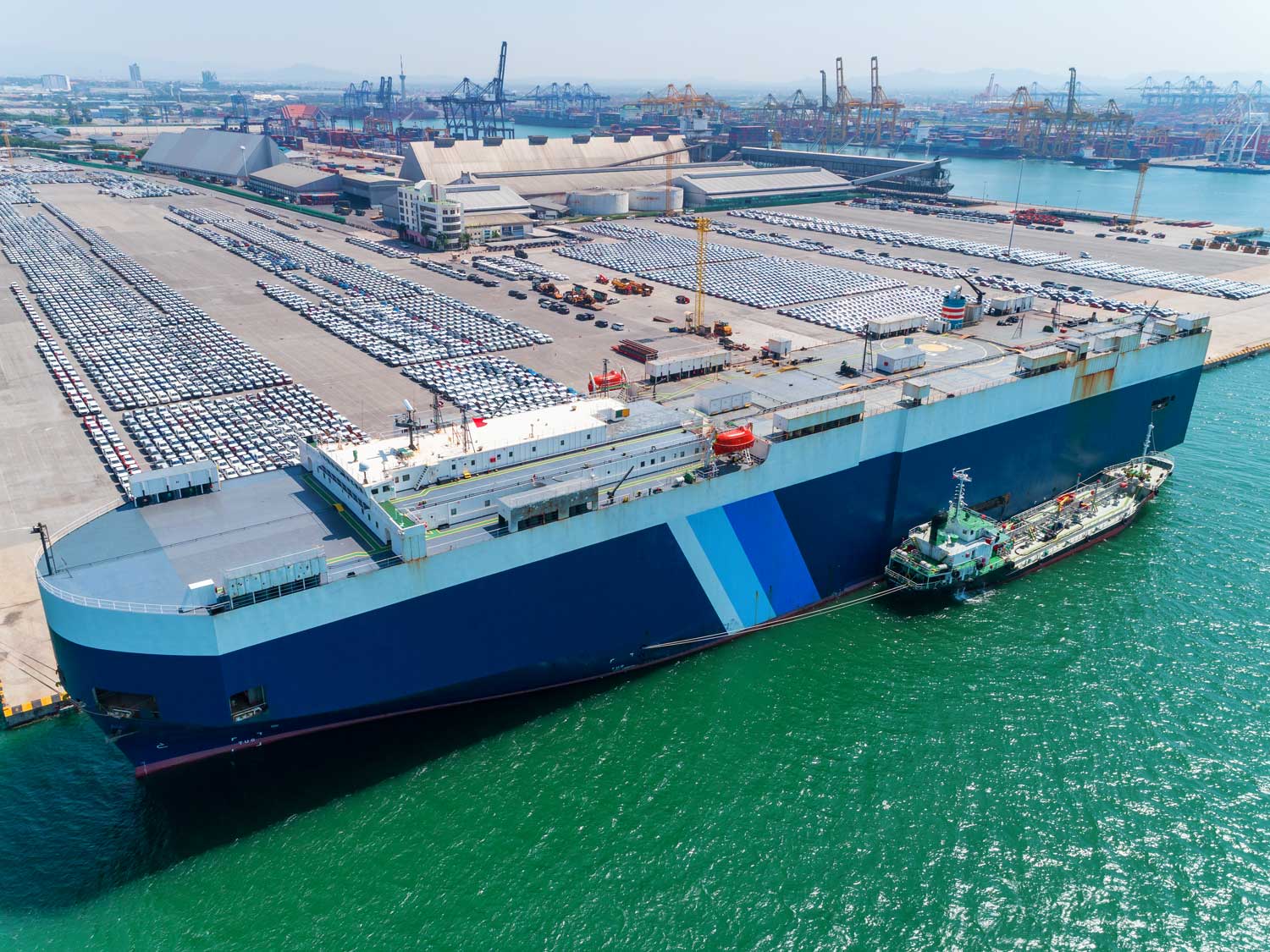
After a long recovery from the impacts of the COVID19 pandemic the RoRo Car Carrier sector recorded high freight rates and a surge in demand, that has continued through 2022 and is now attracting new market entrants from the container shipping sector.

Five consecutive years of low orders for pure car carriers and other RoRo configurations up to 2021, combined with significant scrapping over the same period, laid the foundations for the challenging supply conditions the market has been experiencing. 

Last year began to reverse the trend, with 53 new vessel orders, which is up 124% versus the historical average, but it was left too late and many shipyards closed out last year, fully booked until 2025.

China’s vehicle export volumes increased 56.9% year-on-year in 2022 and the export value made a substantial growth of 74.8%, leading Chinese automotive manufacturer Chery to develop a car carrier construction base in Weihai, Shandong province, to meet its growing automobile transportation demands, by building batches of 6,000 ceu car carriers.

China’s Guangzhou Shipyard International most recently agreed contracts for three 8,600 ceu car carriers order, bringing its order book to 25 dual-fuel car carrier’s, while leading carrier Grimaldi has firmed options for five Pure Car & Truck Carriers (PCTCs) with China Merchants Heavy Industries in Jiangsu, which brings the number of car carriers ordered by Grimaldi to 15 in under three months.

Looking for alternative revenue streams, to counter the global lull in container shipping demand, carriers have been looking at investing in the car and truck market.

Cosco Shipping’s recently established automobile transport unit, Cosco Shipping Car Carrier, placed orders for four 7,000 ceu PCTCs, which join the 21 car carriers that they already have on order, while CMA CGM, is looking to charter four vessels and HMM is reportedly looking for opportunities to benefit from the booming car-carrying trade.

Metro has specialised in the automotive, construction and agricultural vehicle sectors for over four decades, working with many of the most respected and established global brands, to coordinate the end to end movement of vehicles and machinery around the world, by RoRo and container services.

Long-standing partnerships and volume agreements with the leading RoRo, PCTC and container shipping lines means we can offer the widest choice of services, routes and solutions for automotive, truck and knocked-down-vehicle movements.

To learn more, or to discuss our automotive capability, EMAIL Ian Tubbs.

Savannah Port

<strong>US West Coast volumes drift to South and Southeastern ports</strong>

Negotiations between the International Longshore and Warehouse Union (ILWU) and West Coast port employers, represented by the Pacific Maritime Association (PMA) began last May and while talks continue, both are hopeful of reaching a deal soon, as US importers continue to divert cargo to Eastern and Southeastern ports.

The ILWU represents 22,000 port workers in California, Oregon, and Washington, while the PMA negotiate on behalf of 29 West Coast ports, including Los Angeles and Long Beach, which handle over 30% of US containerised imports.

Negotiations on new labour contracts began on the 10th May 2022, with the last deal expiring at the start of July, and while the PMA and ILWU are eager to stop West Coast cargo erosion to East Coast and Gulf Coast ports, maintaining productivity levels and issuing positive statements has failed to stop volume drift.

Despite 2022 imports from Asia into the US being broadly similar to 2021, Southeast ports - Savannah, Norfolk, Charleston, Wilmington, Jacksonville, Everglades, and Miami -saw a 5.2% increase In volumes, while West Coast volumes declined by 6.1% over the same period.

Savannah was the biggest Southeast winner, with a 6.1% rise in volume, with Charleston’s shipments spiking 14.6% in shipments and Norfolk’s volumes rising just 0.2% year over year. 

The initial shifting of volume from the West Coast created backlogs and delays at East and Gulf Coast ports, but as demand and volume declined over the last two quarters, most ports have cleared backlogs and have worked to improve efficiencies, implementing enhancements that will accommodate additional volumes over the long term.

How much of this growth will continue to flow through Southeast ports, when risk is reduced after the ILWU and PMA agree on a new contract is uncertain. 

Moving cargo from Asia through the West Coast provides lower ocean freight rates and transit times, but if cargo is destined for the East Coast, it may make sense for importers to use ports like Charleston.

The ILWU and PMA have reached agreement on some issues and while talks continue, they are keenly aware about West Coast cargo erosion to East Coast and Gulf Coast ports. They issued a joint statement last month, in which they said both sides “remain hopeful of reaching a deal soon” and both want to work with West Coast ports to recover lost volumes and move forward with market growth.

We negotiate long-term and FAK contracts with shipping lines across all three alliances to secure space and rates, that provide the best alternatives and options, whatever the situation.

We leverage agreements across the alliances and work with smaller niche shipping lines, when appropriate, to access specific regional ports that offer efficiencies, or to work around bottlenecks, to maintain resilient and reliable supply chains.

To learn how we can support your trade with the United States, or to learn more about our ocean solutions, please EMAIL our chief commercial officer, Andy Smith. 

Singapore

<strong>Sea freight update March</strong>

The huge downward push on freight rates did slow in January and the continuing weak demand will put the brakes on any rate increases, with expectations for post-CNY volumes bearish, although some lines have been attempting surcharges on transatlantic, transpacific and ex India routes. 

The decline in global container freight rates that began last year, abated somewhat in January on major routes as supply-side efforts to reduce capacity excesses appeared to find some purchase, with capacity deployed on the two largest east west trades falling from 43.7% to 39.8% year on year. 

Poor cargo demand in China and the falling ocean spot freight rates encouraged the leading container shipping lines to make significant changes to global fleet deployment, with 565,000 teu of capacity withdrawn from Asia-North America and Asia- Europe trades last year. 

The highest percentage increase was seen on the transatlantic, which recorded a 16.2% increase in capacity with the addition of 162,300 teu slots, as the transatlantic market remained resilient, despite the demand downturns seen elsewhere. 

The current blank sailing program from Asia to Europe is balancing out demand with -27% of capacity removed until mid of February and the lines are adding more blank sailings, as they deem necessary, to stabilise the market after Chinese New Year and the time it takes for cargo volumes to recover. 

Ex-Asia box rates are back under pressure post-CNY and the Shanghai Freight Index (SCFI) confirms that rate erosion has started again, albeit at a reduced pace. 

And while freight rates have been softening, the carriers’ per- unit costs have increased, because their operational and administration costs increased significantly during the pandemic. 

Some market analysts attribute the more balanced rates seen during the month as a signal that the market is bottoming out, as rates draw near to breakeven points for carriers on major deep-sea trades. 

But even as the container shipping lines struggle to balance supply and demand, many carriers are preparing to receive new build ultra-large container vessels (ULCVs).

The nine members of the three global alliances plus ZIM and Wan Hai Lines, are scheduled to receive a total of 89 container ships in 2023, ranging in size from 7,000 to 24,000 teu. 

Some of this year’s deliveries may be deferred to 2024, but there are another 100+ vessels already due in 2024, with a further 80+ in 2025.

MSC and Maersk, the two largest container shipping lines in the world, announced an end to their 2M alliance in 2025. Their decision may increase competition, trigger rate wars and put other alliances under pressure, while leaving Maersk, with a limited order- book and an already strained network, looking for alternatives. 

The breakup of the 2M shipping alliance is going to be the start of a total re-shaping of the alliances and vessel sharing agreements globally and especially on the major east-west trades. 

Shipping alliances, VSA’s and new service launches, over the next two years, will alter competitive dynamics on all the major trade-lanes, which is why we will stay close to our industry partners and contacts, to identify opportunities for our customers, strengthen existing carrier relationships, build new ones and help shape whatever finally replaces today’s three alliances.

If you have any questions or concerns about the developments outlined in this month’s sea freight update, please EMAIL our Chief Commercial Officer, Andy Smith, for the latest insights and intelligence.