ECO globe

Metro’s ECO tool launches today – tracking and offsetting your carbon emissions within the supply chain

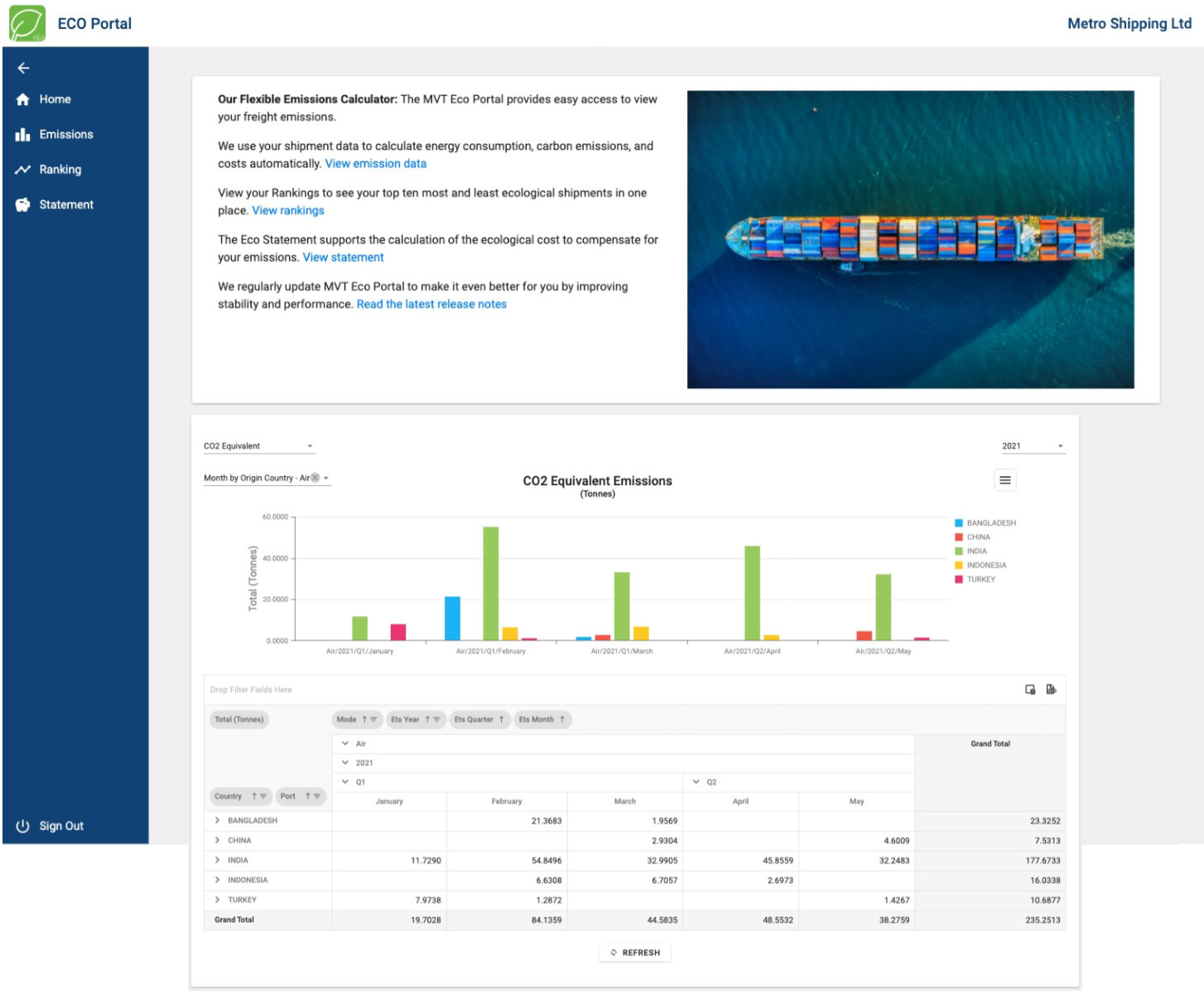
The new MVT ECO module that is launched today, with selected customers, monitors the energy emissions, emission costs and CO2 equivalent emissions, of every consignment we move, by every mode, so that shippers can monitor and have the option to offset their CO2 emissions.

As a non-asset owning 3PL, 99% of our carbon footprint is generated by our customers’ shipments on planes, ships and trucks, that we do not own or operate, but this does not diminish our determination to be carbon neutral and support our customers’ in achieving the same ambition.

By working with customers, suppliers and carrier partners we are measuring, reporting and offsetting emissions, to build greener supply chains that drive down CO2 and waste. We forecast a swift uptake, and encourage this as soon as possible, and we will keep on launching new initiatives to ensure that we contribute to reduced climate change, intelligent freight movement and sustainable development in the future, for all the reasons that are now becoming critical.

The MVT ECO module is a cloud-based, software-as-a-solution, that is available, free-of-charge, to all our shippers on their MVT dashboard, where they can view key eco statistics related to their movements, to see which areas will benefit most from emissions offsetting and where efforts can have the most impact.

To ensure our customers can have confidence in the data, our free emissions reports have been verified and conform to EN16258 for the calculation and declaration of energy consumption and greenhouse gas (GHG) emissions.

The MVT ECO data hub consolidates emission data across all routes and transport modes and is accredited by Smart Freight Centre (SFC) with reporting methodology that is in conformance with the Global Logistics Emissions Council (GLEC) framework.

We are working with Comply Direct to help to source Verified Carbon Standard offsets and support a number of verified carbon offset projects including renewable energy and natural resource conservation, for customers wanting to offset the emissions associated with their shipments. 

Visit the MVT ECO portal web page

OR

Request a demo and see how easy ECO reporting is
In a one-on-one demo we show you how MVT ECO collates a customer’s carbon emissions data across carriers, modes and origins, with click-through interrogation and simple summaries that can be used for reporting, sustainable supply chain planning and offsetting.

ecoportal

Metro’s ECO portal prepares for July launch

The new MVT Eco module monitors the energy emissions, emission costs and CO2 equivalent emissions, of each consignment we move, by every mode and will be available free from the 1st July, which means that Metro customers can monitor the environmental impact of their supply chains and participate in offset projects that will eradicate their CO2 footprint.

As a non-asset owning 3PL, 99% of our carbon footprint is generated by our customers’ shipments on planes, ships and trucks, that we do not own or operate, but this has not diminished our determination to be carbon neutral and support our customers in achieving the same ambition.

Consumers and corporate B2B customers are more aware of their carbon footprint, and there is increasing demand for goods, services and suppliers with a reduced environmental impact.

Companies who monitor, understand and minimise their carbon emissions have an advantage, creating an opportunity for differentiation based on sustainable practices.

We are creating innovative supply chain solutions that will help our customers to reduce CO2 emissions, set sustainability goals and achieve their environmental targets. 

Originally designed as part of our 4PL platform, the MVT Eco module will be available via our new MVT Portal. Customers can view key eco statistics related to their movements and export this data for further internal analysis.

To ensure our customers can have confidence in the data, our free emissions reports have been verified and conform to EN16258 to calculate and declare energy consumption and greenhouse gas (GHG) emissions.

The MVT ECO data hub consolidates emission data across all routes and transport modes. It is accredited by Smart Freight Centre (SFC) with reporting methodology in conformance with the Global Logistics Emissions Council (GLEC) framework.

We are working with Comply Direct to help source Verified Carbon Standard offsets for customers wanting to offset the emissions associated with their shipments.

CO2 by origin
Cost by mode
ECO statement
CO2 country example

Subject to third party verification to one of the leading standards for voluntary offsets, these are a robust and reliable means to offset carbon emissions. In line with the UN sustainable development goals, the projects on offer also include additional community, social, environmental and biodiversity benefits. 

Examples of project types include protecting the Amazon rainforest, providing clean cookstoves to communities currently cooking on open fires, and delivering renewable energy to areas currently not on the grid.

MVT ECO will be officially launched on 1st July and is available to all customers, with simplified adoption and set up, to encourage adoption by our entire client base, with minimal disruption.

  • Track emissions for every shipment by route and modes of transport
  • Dynamic data, simple to interrogate
  • Aligned with the Global Logistics Emissions Council
  • Supply chain auditing to reduce your carbon footprint
  • Advice, guidance and offsetting initiatives to achieve your sustainability goals

For more information or to request a demo of the MVT ECO Portal, please contact Simon George EMAIL, who leads our technical solutions team.

To discuss carbon reduction strategies and the availability of offset projects, please contact Claus Rasmussen EMAIL.

sustainability

Further decreasing our carbon footprint; increasing our green forwarder imprint

As a business we are committed to avoiding negative and enhancing positive impacts on our people, society and the global environment. We want to leverage our core strengths, resources and combined abilities to address and help provide solutions to local, regional and international challenges - and in particular human rights, labour rights and the environment /climate change - through innovation, investment and collaboration with similar minded partners.

As a non-asset owning 3PL freight forwarder, 99% of our carbon footprint is generated by our customers’ shipments on planes, ships and trucks that we do not own or operate. (This is the standard industry model – and we can choose who and how to work with similar minded suppliers.)

But that doesn’t diminish our determination to be carbon neutral, or support our customers’ in achieving the same ambition.

Collaboration is key, in driving down their supply chain emissions, which is why we work with the Global Logistics Emissions Council (GLEC), Smart Freight Centre, EcoTransIT and carriers, to evaluate and endorse our technology, in creating a standard for measuring CO2 emissions and helping our customers transition to low carbon supply chains.

Originally designed as part of our 4PL platform the MVT Eco module has been integrated into our operating systems, and continues to be improved and further enhanced, to monitor the carbon footprint, energy consumption and exhaust gas emissions, of every consignment we move - by every transport mode and type - which means that every customer can monitor the environmental impact of their supply chains and participate in offset projects that eradicate their CO2 foot print.

To provide certainty and confidence, our software is accredited by the Smart Freight Centre to be in accordance with the Global Logistics Emissions Council (GLEC) Frame­work and also meets the requirements of EN16258 and the GHG protocol (Corporate Standard).

For our customers, free reports, that have been verified and conform to EN16258 for the calculation and declaration of energy consumption and greenhouse gas (GHG) emissions, will help them reduce their carbon footprint and become more resource efficient in order to accelerate the move to a sustainable, low carbon economy.

COMING SOON: We explore the unique range of offset options available for this project, that will help our customers achieve carbon neutrality and deliver value to the world, until a balance can be reached. We take and make climate control and a healthy functioning world as part of our customers future. It’s not an option anymore.

eCommerce2

SME eCommerce sellers hit by EU VAT changes – how will this effect trading with the BLOC ?

About 26,000 eCommerce sellers will have to register for VAT for the first time, under the EU’s new “one-stop shop” system and face £180m in additional red tape costs.

On 1st July 2021, the European Union is introducing sweeping reforms to the VAT obligations for B2C e-commerce sellers and marketplaces.

1. Launching the One-Stop-Shop EU VAT return

2. Ending low-value import VAT exemption and new IOSS return

3. Making marketplaces deemed supplier VAT

The UK implemented VAT marketplace liabilities reforms from 1st January 2021, while the EU package was delayed to this July.

The changes also seek to tackle the €5 billion eCommerce VAT fraud gap, by co-opting online marketplaces into collecting VAT in place of sellers.

UK exporters using e-selling platforms will now have three options when trading into the EU: register for VAT in the country where they sold most of their goods, which the European Commission estimates will cost €8,000; subcontract VAT to selling platforms such as Amazon or eBay; or ask the postal service to handle VAT.

1. A single EU VAT return for eCommerce distance selling

The existing ‘Distance Selling Thresholds’ simplifications will be withdrawn and replaced by a single EU VAT return, One Stop Shop (‘OSS’). Sellers shipping goods from their home country to customers across the EU may opt to use OSS to report all their pan-EU sales. This is an extension of the 2015 Mini One-Stop-Shop (‘MOSS’), which successfully trialled a single EU return for B2C sales of digital, telecoms and broadcast services (streaming media, e-books, apps etc.).

2. Closing the import VAT exemption loophole – IOSS return 

From July 2021, the €22 VAT exemption on small parcels being imported into the EU for delivery to consumers will be withdrawn. This exemption has been heavily abused by many sellers mistakenly or deliberately under-declaring the import values of goods to avoid VAT. Instead, VAT must be charged at the point-of-sale for consignments not exceeding €150. This VAT may be declared and paid via a new submission, the ‘Import One Stop Shop’ (IOSS) which will create a more efficient fast-track, or ‘Green Channel’, quick and easy customs clearance.

3. Marketplaces become the deemed supplier and VAT collector

The July 2021 reforms will oblige marketplaces which facilitate cross-border sales to consumers via third parties to become the ‘deemed supplier’ in certain cases. This is also termed the full liability regime. This marketplace VAT liability does extend to product liability.

About 26,000 eCommerce sellers, slightly more than 10% of the UK sector, will have to register for VAT for the first time under the EU’s new “one-stop shop” system, which consultants estimate will cost around €8,000 a year each, or roughly €208m (£180m) in total.

The key will be ensuring the software is there to enable VAT payments at the point of sale, subcontract VAT to selling platforms such as Amazon or eBay, or ask the postal service to handle VAT.

With platforms typically charging 30% of gross prices for their VAT services, companies doing more than 150 transactions a year, which includes most of those doing business in the EU, might be advised to register themselves in the bloc, as the import one-stop shop (IOSS) approach could simplify life for smaller exporters.

Metro continue to monitor the evolving UK/EU customs regime situation, to offer advice and tailored customs brokerage solutions through our CuDoS platform.

While we do not anticipate that any of our customers will be affected by these changes, the whole area of VAT liability and compliance can be a ‘minefield’, which is why our specialist broker team can provide advice and guidance on your situation, to ensure that the most appropriate solution is in place for your trading and business.

For further information please contact Elliot Carlile or Grant Liddell to organise a full review and discussion relating to current issues that you may be facing.