solar panels

Survey confirms Metro’s strategy on environment

A survey by the British International Freight Association (BIFA) confirms that freight forwarders are coming under increasing pressure from customers to show evidence of decarbonisation, while those same customers need to get ready for carbon emission audits now.

The BIFA survey found that legislation compelling change in logistics decarbonisation will be a primary driver for respondents, with nearly a third citing client pressure as the leading motivator.

Results show 69% of respondents consider calculating emissions is part of their daily activities, yet 22% had assigned budgets of under £1,000 for green initiatives within their organisation. 

The conclusion is that there is growing awareness of environmental issues among the BIFA membership and, to some extent, a growing awareness of the need to measure carbon emissions and provide that information to clients.

It is also clear that it will be challenging to determine how they will use this data, and what they can actually do to reduce their carbon emissions. The general consensus is that significant changes will be required by forwarders, but what these will be are not clear at the moment.

The BIFA survey highlights just how far ahead Metro’s environmental strategy and actions are!

In consultation with customers Metro began development of our MVT ECO module in 2021. 

Today Metro is measuring and monitoring the emissions of every shipment, by every mode, for all of our customers, with offsetting alternatives, so they can work towards carbon neutrality in their global supply chain. 

As of 1st July 2023, MVT Eco has reported on 86,766 shipments, with a total CO2 equivalent of 279,864.58 tonnes.

Metro has committed to environmental transparency, using international sustainability reporting standards and through ISO 14001 accreditation, Metro has been fully offsetting emissions through verified carbon offsets.

Metro has been certified Carbon Neutral for two years.

The Corporate Sustainability Reporting Directive (CSRD) that becomes effective from 2024 will extend a company’s obligation to report on sustainability issues, to stimulate the EU’s transition to a sustainable economy.

However, it is likely to cause headaches for companies needing to report on Scope 3 emissions, which are outside their immediate control and brings reporting on emissions to the same level as financial auditing.

Scope 1 emissions are produced directly by companies, while Scope 2 is mainly from energy that is bought in and Scope 3 accounts for all other indirect emissions, the majority of which are in the supply chain. 

Scope 3 emissions account for the most – typically 10 times those of Scope 1 and 2 combined – and they are the hardest to measure, requiring a reliable, automated way to collect data and analyse it against targets.

UK companies operating in the EU will need to report Scope 3 emissions in CSRD and while reporting is currently voluntary in the UK, it will inevitably become mandatory.

MVT Eco uses reporting methodology that is in conformance with the Global Logistics Emissions Council (GLEC) and incorporates 30 pre-built charts and downloadable statements, to simplify Scope 3 reporting compliance for customers in the EU and UK.

The MVT ECO module is available free-of-charge to customers on their MVT dashboard. To request a demo or discuss your requirements, please EMAIL Simon George.

ECO globe

Sustainability is good business

As the effects of climate change intensify, the pressure on the food sector will increase over the coming decades, which is encapsulated by the FDF’s environmental ambition in creating a more sustainable food system. 

Supply chain issues, labour shortages, threats to energy security and rising inflation have added a new set of challenges for the food and drink industry over the last 12 months, however despite these obstacles, FDF members remain focused on their ambition to reach Net Zero by 2040 – a decade earlier than government targets.

The oft-quoted Forbes survey found that 82% of consumers want brands to practice sustainability and while some cracks have crept into the sustainability narrative as the cost of living crisis bites, the global pandemic and recent environmental disasters have maintained demand for sustainable practices and products.

Sustainability is good for business; it builds brand value, meets consumer expectations, attracts talent and creates new opportunities, but only if you communicate your efforts credibly, and avoid being perceived as greenwashing.

According to NielsenIQ survey data, 46% of consumers still expect brands to take the lead on bringing about sustainable change, which means that brands can no longer greenwash themselves. 

Packaging and last-mile delivery are primary sources of emissions with 53% of US and UK consumers wanting brands to produce less packaging and an average of 25% willing to pay a surcharge for eco-friendly delivery.

Manufacturers, producers, brands and retailers are already rethinking their practices, to find sustainable solutions, including the adoption of eco-friendly packaging, more climate-friendly shipping options, optimised waste management and completely eliminating packaging waste.

Despite today’s economic uncertainty, consumers are still open to sustainable products if they are affordable and offer value, which is why effective implementation and communication of these initiatives is critical.

Metro can help shippers switch to sustainable packaging for their products, by sourcing sustainable and ecological packaging materials, while our freight centres use renewable materials, which reduce packaging waste to a minimum.

Through our MVT ECO initiative, Metro is measuring and monitoring the emissions of every shipment, by every mode, for all of our customers, with offsetting alternatives, so they can work towards carbon neutrality in their global supply chain. 

CO2 emissions caused by transport are calculated according to EN 16258 to provide data and reporting that complies with the most demanding frameworks and methodologies. 

Using our latest generation MVT Eco module, we develop intelligent supply chain solutions. With accurate and representative data, that are respectful of the environment, we create low-carbon multi-modal solutions that blend air, road, sea, inland waterways and rail, together with NGV and electric vehicles.

The MVT ECO module is available free-of-charge to customers on their MVT dashboard. To request a demo or discuss your requirements, please EMAIL Simon George.
solar panels

Delivering the sustainable future, today

Alongside customers in key verticals, including food, drink, cars and commercial vehicles, Metro is committed to the highest environmental standards, by maintaining carbon neutrality, investing in alternative fuels and supporting our customers with technology-enabled sustainable supply chains.

The global food system will face significant  pressures over the medium term as demand for resources and the effects of climate change intensify, which is why the sector is fully committed to cutting CO2 emissions, embedding environmental standards in transport and increasing sustainable supply chains.

Despite the challenges that 2022 brought, including supply chain issues, labour shortages and threats to energy security, our food and drink customers remain focused on sustainable, resilient, and responsible supply chains, with an ambition to reach Net Zero by 2040 – a decade earlier than government targets.

The automotive sector continues to improve its sustainability, reducing energy use, sourcing more responsibly and increasing recycling. Indeed, total energy use has declined, by -6.1% on last year, and water use per vehicle fell -6.3%. Waste to landfill also hit a record low, of 0.6%, with 17 leading companies reporting zero waste.

Supply chains need to become more sustainable but you can’t change what you can’t see and experts at Automotive Logistics’ supply chain events agreed that better tools and partnerships are needed to identify emissions in complex supply chains, as a means to start reducing them, because what you can’t measure, you can’t work on.

Hot on the heals of our industry investment in Sustainable Air Fuel (SAF) and the Sustainable Flight Challenge, Metro has invested in solar panels at our UKHQ to move beyond our net zero achievement, toward Climate Positive and joined the Midlands Net Zero Hub, to share the region's vision to decarbonise and support key priorities for the Midlands.

With Metro’s MVT Eco module, all the CO2 measuring and emission analysis tools our customers need can be found in one single place. Eco calculations conform to EN 16258, to provide data and reporting that complies with the most demanding frameworks and methodologies.

Our ‘on demand calculator’ module means that shippers can predict CO2 impact, by any mode and location, based on IATA or UNLOC codes and use those insights to create efficient, low-carbon supply chain solutions.

Using our latest generation MVT Eco module, we develop intelligent supply chain solutions, based on accurate and representative data, that are respectful of the environment. 

Low-carbon multi-modal solutions that blend air, road, sea, inland waterways and rail, together with NGV and electric vehicles.

The MVT ECO module is available free-of-charge to customers on their MVT dashboard. To request a demo or discuss your requirements, please EMAIL Simon George.
Coronavirus update 24th March

Low speed containerships are propping up rates

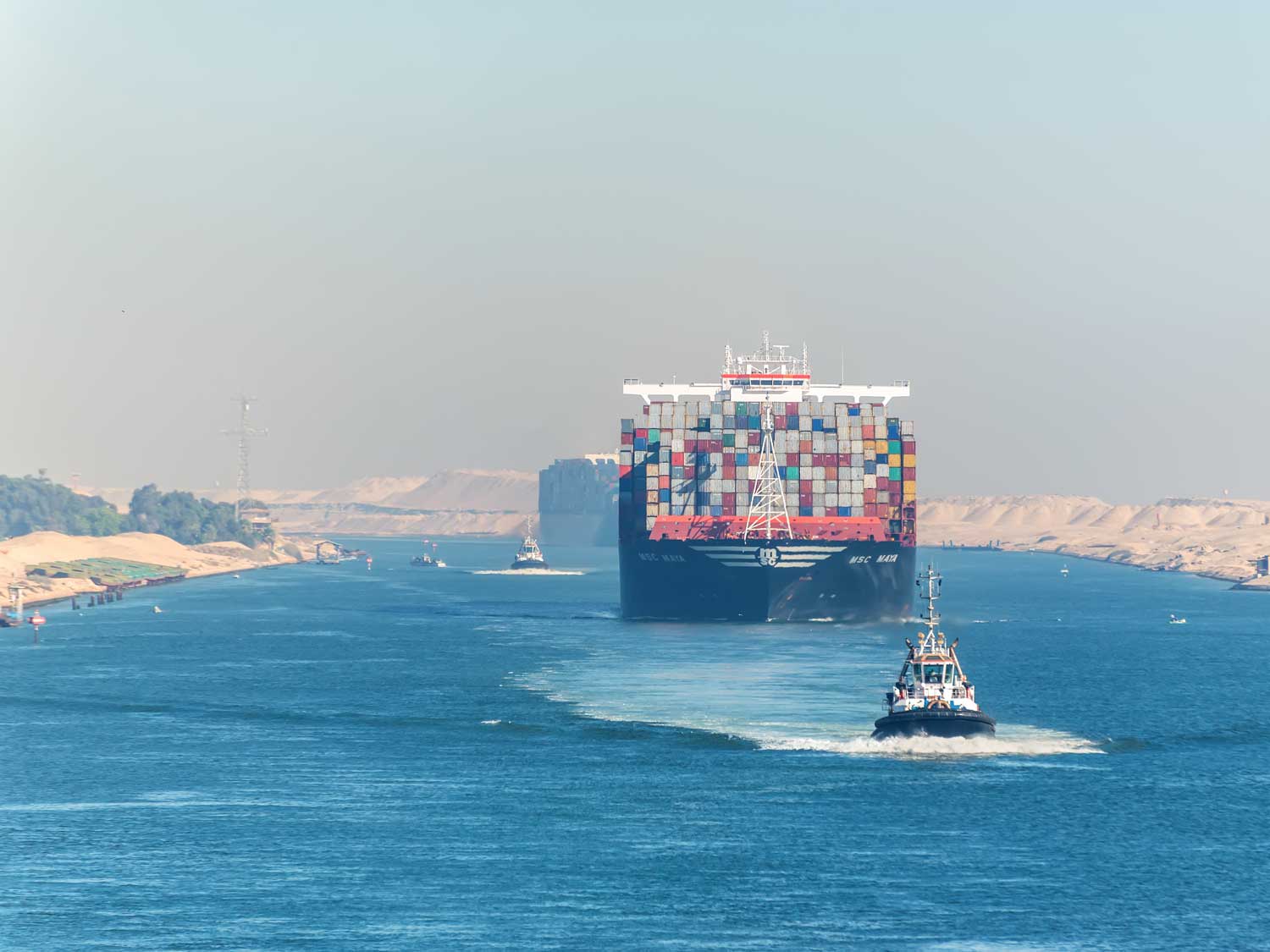
Last year the shipping analyst Drewry’s forecast that the container shipping lines earnings would be down 64% for 2023, but added that there were strategic choices available to the carriers, to protect their revenues, with slow steaming a proven method of removing capacity, to protect rates and comply with environmental regulations.

In the first quarter of 2023, the global container fleet accordingly moved at all-time slow speeds, with analysts suggesting that vessels could go slower still which, despite massive falls, will help carriers keep rates higher than pre-pandemic levels.

During the covid pandemic the container shipping lines increased average sailing speed by 4% to meet strong demand and create spare time, because of widespread port congestion. 

In the first quarter of 2023 the average sailing speed has come back down 4% year-on-year and could drop a further by 10% before 2025, to absorb capacity that would otherwise be surplus. 

Across the global container fleet average speeds went down by about one knot, in the last two years, which does not sound like much, but Alphaliner data shows that is about 6% slower overall, which means you need proportionately more tonnage to carry the same cargo volume. 

For the past couple of decades carriers have adopted slow-steaming whenever there is structural overcapacity or high fuel prices - or both - as is the current situation.

At the same time the shipping lines have ordered record amounts of new vessels and additional capacity is now being delivered into a market with minimal demand growth, new environmental regulations, carbon taxes and rising fuel prices.

Maersk and MSC announced last month they would be adding nine new vessels into the Asia-Europe trade, but that these services would be moving up to three days slower than before, thus absorbing all the new capacity. 

As part of plans to conduct field tests of an onboard carbon capture system (OCCS) for container ships in 2024, South Korea’s HMM will replace the propellers on six of its containerships with more efficient ones specially designed for slow steaming, with HMM also expecting to increase energy efficiency by 8-9%.

The transition to new fuels such as LNG, methanol and ammonia also favours slow speeds, since these fuels will be much more expensive than current ones, which makes sense to deploy extra ships and save fuel.  

Despite a 70-80% fall in freight rates over the last two years, and a worsening of the supply/demand balance, it is quite clear that the container shipping lines have been successful in matching capacity to cargo demand, in keeping rates higher than pre-pandemic levels.

Slow-steaming and evolutions in shipping alliances change competitive dynamics on all the major trade-lanes, which is why we stay close to our carrier partners and contacts, to keep track of changes and identify opportunities for our customers.

If you have any questions or concerns about the developments outlined in this eBulletin, please EMAIL our Chief Commercial Officer, Andy Smith, for the latest insights and intelligence.