UK businesses remain positive about their prospects in Europe, but customs complexity, compliance costs and uncertainty over future trading arrangements may limit the potential for faster growth.
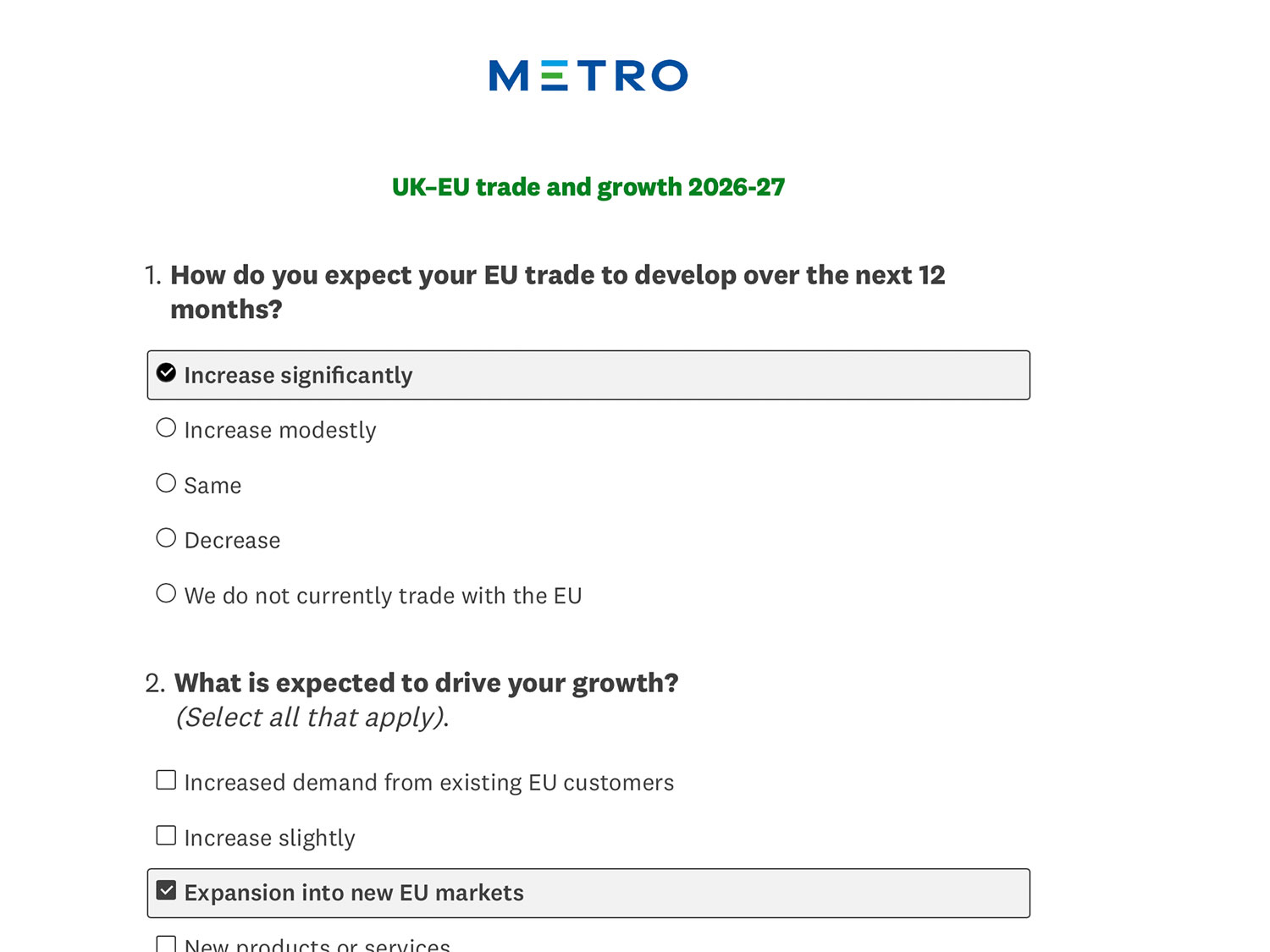
That is the picture emerging from Metro’s latest customer survey, which asked businesses how they expect their EU trade to develop during 2026-27 and what would make cross-border trade easier.
The survey followed Metro’s recent review of the UK’s evolving international trade relationships, including ongoing discussions designed to improve elements of the UK-EU trading environment.
While negotiations between the UK and EU continue, the responses suggest businesses are not waiting for political agreements before pursuing growth. Instead, many are already looking at new products, markets and logistics strategies, while seeking practical ways to reduce the friction associated with European trade.
Almost three quarters expect EU trade to grow
The strongest signal from the survey is confidence.
More than 72% of respondents expect their EU trade to increase over the next 12 months, evenly divided between those anticipating significant growth and those expecting a more modest increase.
This is significant because the relationship has not become operationally simple. Companies continue to deal with customs declarations, VAT considerations, border processes and differing regulatory requirements, but these obstacles do not appear to have materially weakened their appetite to trade.
Respondents expecting growth are not primarily relying on established customers buying more.
Almost two-thirds identified new products or services as a growth driver, making this by far the most selected response. That distinction matters.
European growth appears increasingly linked to active business development rather than organic increases in existing trade. New products and markets can create more complex supply chains, placing greater emphasis on customs, VAT, transport and inventory planning.
Road remains dominant, but businesses are open to alternatives
Accompanied road freight remains the most widely used option, with 80% of respondents currently using it, but they are also using or considering a much broader mix of solutions.
Short-sea shipping already has over 60% penetration, while unaccompanied road freight is established among almost 50% of respondents. Rail and intermodal stand out because interest in considering these services (35%) is considerably higher than the current 18% usage.
Accompanied road freight may remain the default solution for many UK-EU movements, but businesses increasingly benefit from being able to switch between modes and accompanied or unaccompanied, depending on cost, capacity, urgency and border conditions.
Customs friction dominates customer concerns
When respondents were asked what would most improve their ability to trade efficiently with the EU, one issue stood well above the others, with 82% selecting fewer customs formalities and border delays.
Cost and regulatory certainty were the next largest concern, with 55% selecting lower transport and compliance costs, while the same proportion wanted greater clarity over future UK-EU trade rules.
More than a third highlighted simpler VAT and fiscal-representation arrangements.
Together, these findings suggest businesses are less concerned about whether European opportunities exist than about the administrative and financial complexity involved in exploiting them.
That includes avoiding customs errors, preventing unnecessary delays, establishing the correct VAT arrangements and understanding how regulatory changes will affect future supply chains.
More than a quarter of respondents identified simpler food and drink certification requirements as one of the changes that would improve EU trade.
Negotiations over sanitary and phytosanitary standards are intended to reduce some of the inspections, certificates and border requirements affecting agri-food movements.
Compliance support is the service customers value most
Perhaps the most decisive result came when businesses were asked which logistics services would make it easier to grow or operate within the EU. 80% selected customs clearance and compliance support.
Alternative road, short-sea or intermodal transport solutions ranked second at 40%, followed by fiscal representation at 30%.
If customs formalities are the principal obstacle, businesses naturally place the greatest value on expertise capable of removing that obstacle.
For a company entering a new EU market, getting classification, declarations, origin, documentation, VAT and fiscal obligations right from the outset can be just as important as selecting the right transport service.
What the findings mean for successful European trading
Taken together, the survey points towards several practical priorities for businesses targeting EU growth.
Build customs into the commercial strategy. Consider classification, origin, documentation and importer responsibilities before entering a market, rather than when goods are ready to move.
Look at total landed cost. Freight is only one component; customs administration, VAT, compliance, inventory and border delays can all affect profitability.
Maintain modal flexibility. Accompanied road remains important, but unaccompanied, short-sea and intermodal alternatives can provide valuable options as cost, capacity and requirements change.
Plan expansion market by market. New products and new markets can introduce different customs, VAT, regulatory and logistics requirements that need to be understood from the outset.
Watch UK-EU negotiations, but do not wait for them. Future agreements may reduce friction, but businesses can already improve European trade through better customs management, routing and supply-chain planning.
Customs, compliance, cost and regulatory uncertainty remain prominent concerns. Businesses best positioned for growth will be those that treat logistics and customs as part of their European market strategy rather than simply an operational requirement.
Metro combines European freight solutions with customs expertise and supply-chain support, helping businesses assess routes, manage cross-border requirements and build flexible solutions as their European trade develops.
As UK-EU arrangements continue to evolve, that combination of compliance, flexibility and forward planning can help turn confidence in European markets into sustainable growth.
EMAIL Andrew Smith, Metro’s Managing Director.