
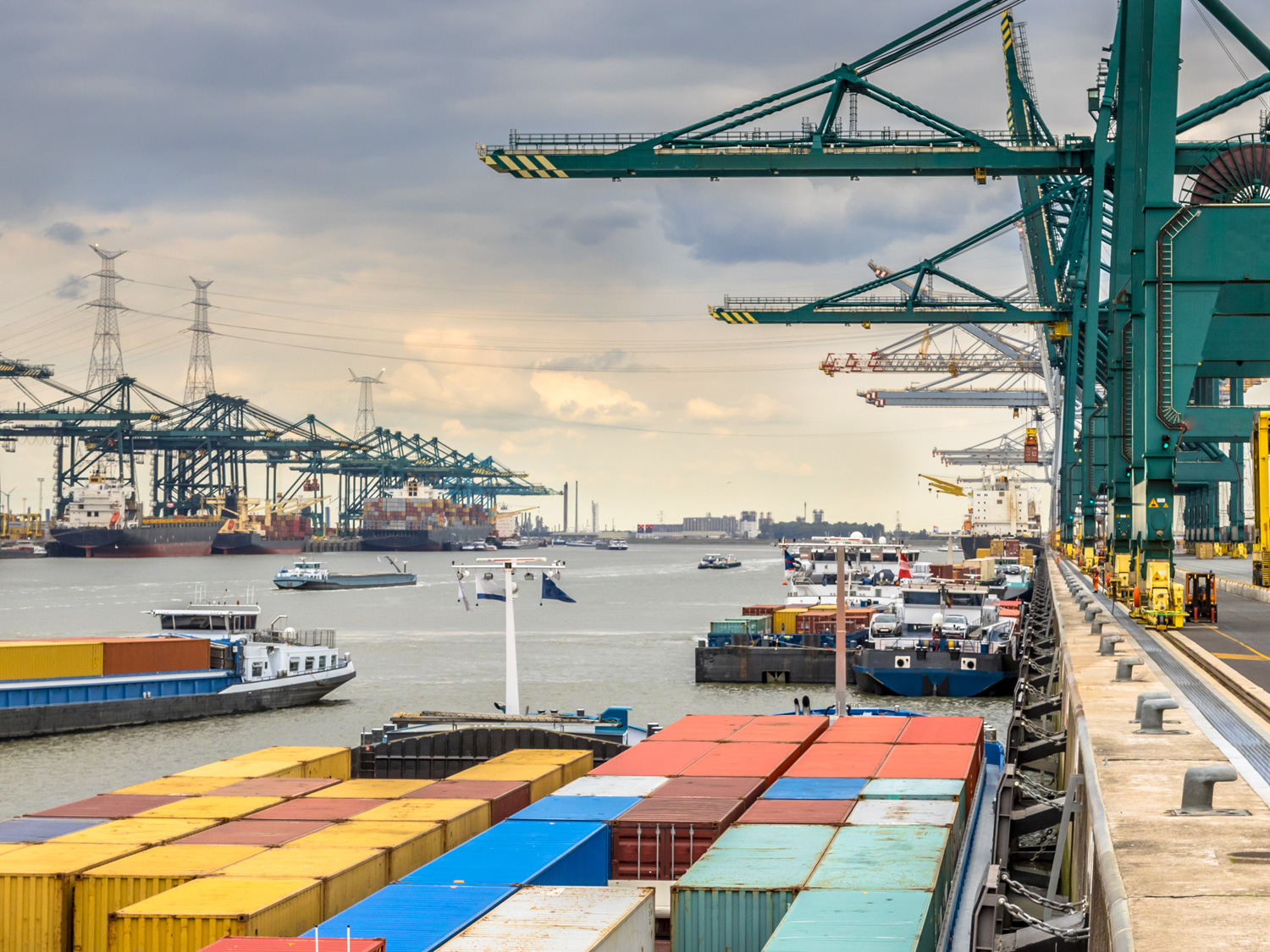
Antwerp

EU-ETS surcharge latest

From the 1st January 2024 the market-based mechanism to tackle greenhouse gas emissions within the European Union known as the EU Emissions Trading System (ETS) will be extended to shipping, triggering new emission linked surcharges.

EU ETS sets an annual absolute limit on greenhouse gas (GHG) emissions and requires the purchase of allowances for emissions known as EU Allowances (EUAs) by the shipping lines.

The inclusion of shipping in the EU ETS aims to create financial incentives for reducing greenhouse gas emissions and promoting a transition to more sustainable practices. 

There will be a phased implementation of carbon pricing for shipping with carriers required to submit allowances equivalent to a portion of their emissions:

2024; submit allowances for 40% of verified emissions
2025; submit allowances for 70% of verified emissions
From 2026; submit allowances for 100% of verified emissions

For every ton of reported CO2 emissions, one EUA must be purchased and submitted to the EU, with EUAs priced according to demand on exchanges such as ICE, EEX and Nasdaq.

The cost of compliance is expected to be significant and will keep increasing with the phased implementation, with the lines passing on the cost in the form of a standalone ‘Emissions Surcharge’ defined on trade basis. 

The Loadstar shared surcharge estimates for all the top carriers. 

Carriers have indicated that surcharge amounts will be reviewed on a monthly or quarterly basis as the volatile price of EUAs adds another layer of complexity to the surcharge, making it hard for the lines to predict how much they will cost.

In their latest Customer Advisory Maersk have stated that only bookings where the Load Port and/or Discharge Port of the ocean journey is located in the EU/EEA scope will be charged with the emissions surcharge.

However, for all bookings from China Maersk will add the EU ETS emissions surcharge to the base freight rate instead of an additional surcharge for regulatory reasons. 

This is a complex and evolving issue, which we will continue to monitor, sharing important developments, because the ETS surcharge, including its methodologies are subject to change.

The cost of ETS compliance for the lines will be significant and will keep increasing with the phased implementation.

EMAIL Andrew Smith, Chief Commercial Officer, if you would like to learn more, or have concerns about any of the issues raised here.
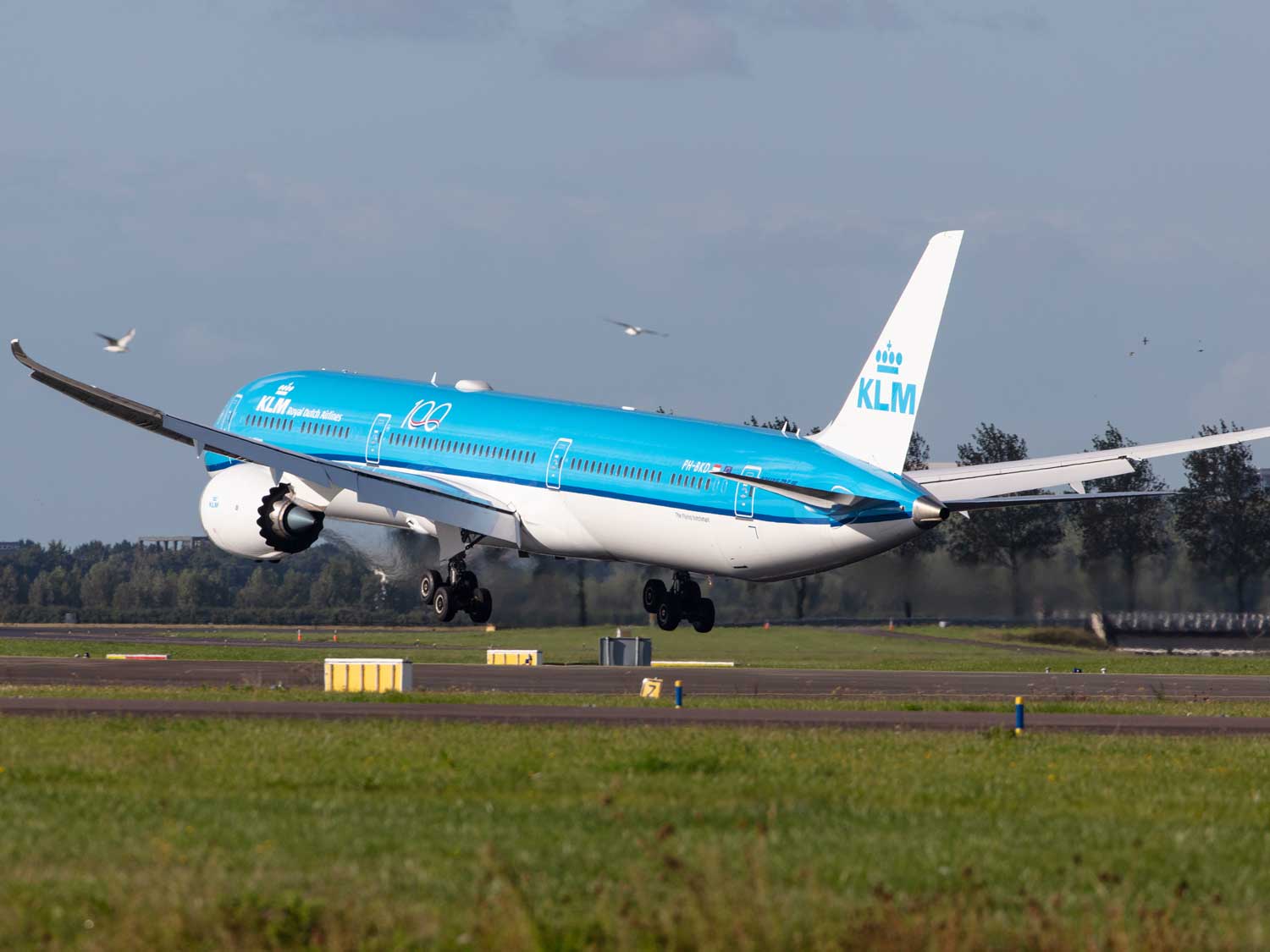
KLM Boeing 787 10 Dreamliner

Supporting sustainable fuel for air and sea freight

As we move into our second year of Sustainable Aviation Fuel (SAF) investment, with Air France, KLM, Martinair, it is great to see the successful transatlantic flight, greater SAF availability and increasing options for green sea freight transport.

The first transatlantic flight by a large passenger plane powered only by SAF landed in the US last week, demonstrating our belief that a greener way of flying freight is possible and that SAF as the most effective tool to help bring net emissions down to zero.

The doubling of SAF biofuel production in 2023 was encouraging as is the expected tripling of production expected in 2024.

However, demand for SAF is not the issue, because every drop produced has been bought and used, it is unlocking supply to meet demand that is the challenge which needs to be solved.

As a portion of renewable fuel production SAF will reach 6% in 2024 and aviation needs between 25% and 30% of renewable fuel production capacity for SAF, so we are on the trajectory needed to reach net zero carbon emissions by 2050. 

There have also been big green steps in container shipping, with carriers investing in energy efficiency for new vessels, while retrofitting their existing fleet for efficiency. 

Shipping lines have been embracing biofuel in the form of methane, methanol or fuel oils, because they promise a convenient way to reduce carbon emissions due to their ability to be mixed with similar versions of fossil fuels and used to power existing engines. 

This is an extremely attractive decarbonisation solution for shipowners as it reduces the need for investment for other decarbonisation options, such as the retrofitting dual-fuel capability. 

As with air, one of the biggest issues facing biofuels in sea freight is supply, with about 5,000 biofuel production facilities worldwide currently, with production of advanced biofuels at 11 Mtoe in 2023 and expected to rise to 23 Mtoe per annum by 2026. 

Whilst this represents strong growth, it still falls short of the volume of biofuels that shipping would need in order to make a big impact on decarbonisation efforts, though many in the industry feel shipping should be prioritised for biofuel supply over other sectors.  

A win for shippers 

Despite the challenge facing biofuel rollout to the shipping sector, there are biofuel solutions available for shippers committed to reducing their emissions.

Shipping lines will bunker biofuel upon the request of customers, allowing them to achieve their emission reduction targets, by paying the difference in fuel cost.

While biofuel is not currently available at all ports, it is possible to offer CO2 savings to customers along any trade lane and route as biofuel is bunkered and used across shipping alliances networks.

In reality shipping biofuel solutions will currently only be practical for the very largest shippers, with Nestlé announcing an agreement today with Maersk and CMA CGM to move 100% of their cargo with biofuel, which will reduces CO2 emissions by 80%

Metro has been carbon-neutral for several years and is committed to extending this zero-emission strategy as far down customers’ supply chains as possible, which is why we welcome the shipping lines efforts and are the first forwarder to invest in the Air France KLM Martinair Cargo SAF programme.

Metro is measuring and monitoring the emissions of every shipment, by every mode, for all of our customers, with offsetting alternatives, so they can work towards carbon neutrality in their global supply chain. 

Our MVT ECO module has reported over 100,000 shipments, with a total CO2 equivalent of more than 300,000 tonnes in 2023.

The MVT ECO module is available free-of-charge to customers on their MVT dashboard. To request a demo or discuss your requirements, please EMAIL Ian Powell.

emissions ship

EU Emissions Trading Scheme surcharge

The EU’s Emissions Trading Scheme (EU ETS) extends to container shipping from the 1st January 2024, with significant legal, commercial and financial consequences for carriers and a new surcharges for shippers.

Under the EU ETS carriers will purchase a capped number of permits, known as EU Allowances (EUAs) at auction that allow discharge of a specified quantity of greenhouse gas emissions (GHGs) over a set time period. 

ETS is a ‘cap and trade’ scheme where a limit (the cap) is placed on the amount to emit specified pollutants and obliges individual shipping lines to hold an allowance for each tonne of CO2 or other carbon equivalent gases they emit.

The cap reduces annually over four years to lower emissions and if a company exceeds its allowance, it may be penalised with a heavy fine.

There will be no set price list for these emission allowances – instead, the price will be defined by supply and demand on the market. 

Taking into account the ETS phase-in period covering 40% of emissions in 2024, 70% in 2025 and 100% in 2026, the shipping industry could be liable for €3.1bn in 2024, €5.7bn in 2025 and €8.4bn in 2026. With container shipping potentially accounting for 30% of overall emissions.

Unlike the standard bunker adjustment factor (BAF) which is adjusted quarterly, based on publicly available fuel prices, that will not be possible with ETS, because the cost is only known post-fact and hence the lines will have to make upfront assumptions.

Maersk and Hapag-Lloyd recently shared their ETS surcharge indications, at €70 and €24 per 40’ but there is no transparency on how these numbers are arrived at and the way legislators have defined ETS makes transparency an almost impossible task.

The EU-ETS high-level surcharge tariff assumption and calculation logic shared by another carrier underlines just how opaque the new surcharge will be with their caveat:

“This is just an estimation of the surcharge tariff with current information, therefore, this will not guarantee the future surcharge tariff or its calculation logic. The actual surcharge tariff will be announced separately before the actual implementation. “

And getting alignment, with carriers agreeing on a common standard for the ETS surcharge, would constitute illegal collusion under EU competition law, so no help there.

This is a complex and evolving issue, which we will continue to monitor, sharing important developments, because the ETS surcharge, including its methodologies are subject to change.

The cost of ETS compliance for the lines will be significant and will keep increasing with the phased implementation.

EMAIL Andrew Smith, Chief Commercial Officer, if you would like to learn more, or have concerns about any of the issues raised here.

KLM Boeing 787 10 Dreamliner

Government committed to SAF

As part of the UK’s net zero commitment the government is supporting a variety of technology, fuel and market-based measures to address aviation emissions, with particular commitment to sustainable aviation fuel (SAF).

The government recognise sustainable aviation fuel (SAF) as crucial to efforts to decarbonise, and they want the UK to be a global leader in its development, production and use. 

In 2023 the government launched their £165m Advanced Fuels Fund to support the development of commercial scale SAF plants within the UK.

In March, the UK Government announced a significant package of SAF developments:
- Publication of the second SAF mandate consultation
- Outlined the scheme that will seek to generate demand for SAF
- Provided an incentive to SAF producers
- Launched a further round of the Advanced Fuels Fund, with a further £55.8m to support UK SAF projects through to construction

£113m has been co-invested by government and industry to support hydrogen and battery electric flight zero emission technologies through the Aerospace Technology Institute (ATI) programme, in addition to £4.2m of funding for the Zero Emission Flight Infrastructure (ZEFI) Project.

Although hydrogen has the potential to accelerate the aviation sector’s journey to net zero, challenges remain regarding accessibility and costs and industry cannot wait for its implementation, which is why SAF remains key to reducing aircraft emissions.

In April, Sustainable Aviation’s road-map confirmed that UK aviation can continue to grow whilst meeting its commitment to net zero carbon emissions by 2050 and their modelling suggests around 40% of emissions could be removed using SAF.

By the end of 2023, the government will publish their response to the second SAF mandate consultation and support Virgin Atlantic to successfully operate the world’s first transatlantic flight on 100% SAF, from London to New York.

In 2025, they will bring the SAF mandate into force and complete the funding period for projects supported by the Advanced Fuels Fund.

Metro has been carbon-neutral for several years and is committed to extending this zero-emission strategy as far down customers’ supply chains as possible, which is why we became the first forwarder to join and invest in the Air France KLM Martinair Cargo SAF programme in January.

Metro believes that moving away from conventional fossil jet fuels to alternative fuels is the most achievable way to obtain sustainable net zero flights, but it is essential that these fuels are manufactured in the UK to keep fuel costs affordable for businesses and to ensure availability of product to meet demand.

We welcome the awards by the government’s Advanced Fuels Fund to five projects that are developing commercial scale plants that use a range of technologies to convert black bin bag waste, industrial gases and CO2 into SAF. 

Metro is achieving CO2 neutrality by measuring, reporting and offsetting our CO2 emissions and the same ECO technology we use is available ‘free of charge’ to our customers. EMAIL Ian Powell, to learn more.