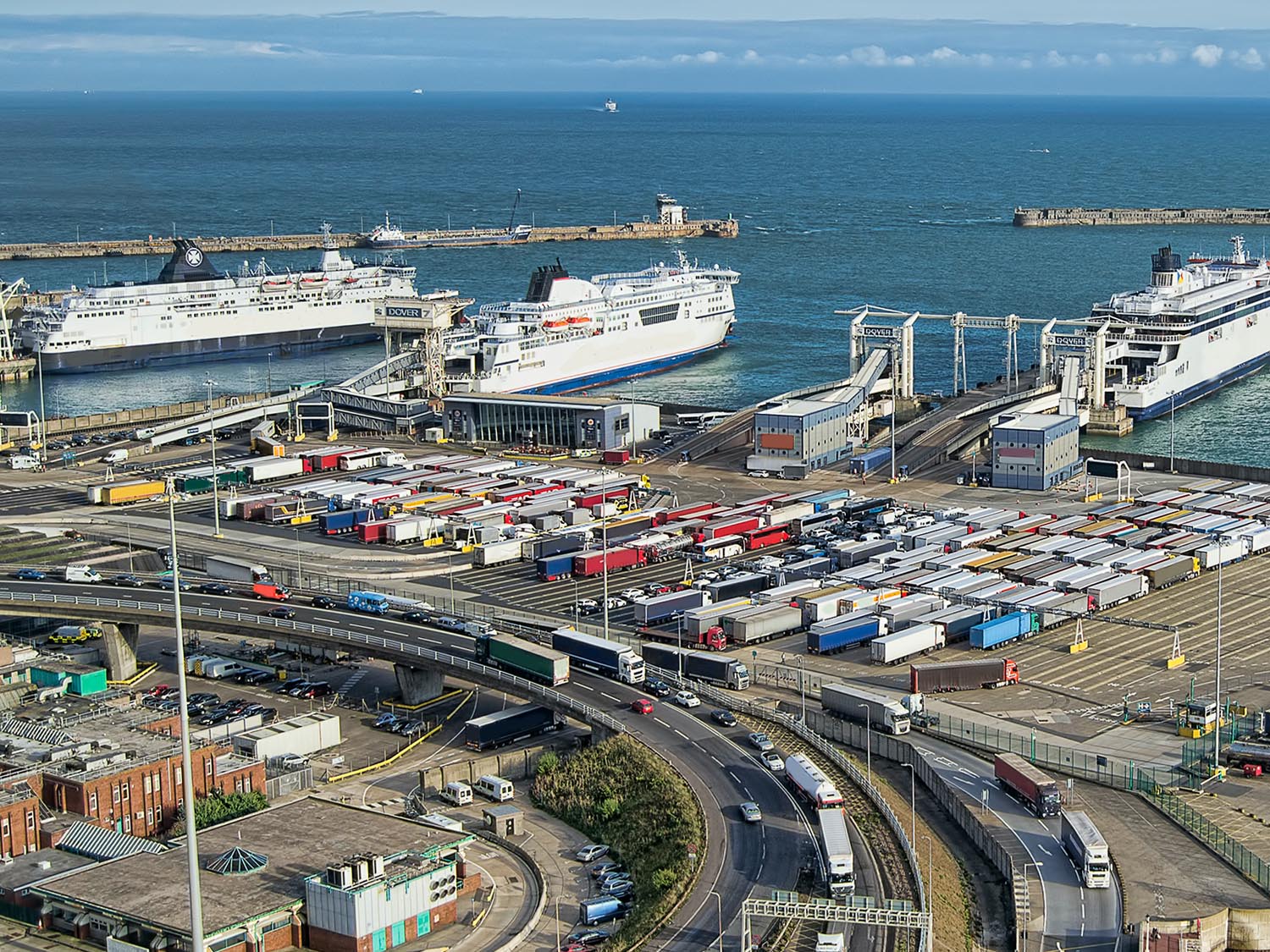
Inland Border Facility

Delayed post-Brexit import checks to launch

Despite being part of its post-Brexit trade agreement the UK government has delayed checks on EU goods four times. It has announced that risk-based checks for EU and non-EU imports will finally be introduced in three parts from October.

The draft Border Target Operating Model (TOM) sets out proposals for a new border surveillance and control system to provide protection from security and biosecurity threats, with risk-based checks across EU and non-EU trade.

The government has delayed putting in place import checks, which are legally required under the Brexit trade deal, four times due to concerns over port disruption, leading to considerable friction with Brussels.

The draft TOM was developed with input from the border industry and affected UK businesses and the government will engage with industry for a further six weeks, before publishing the final version of the model.

New changes for imports from the EU into UK include:
• Trusted traders scheme to avoid trade checks
• Reduced safety and security data requirements
• Introduction of the UK Single Trade Window
• Live animal products and by-products, plants and plant product controls will be determined by risk and country of origin
• Simplified and digitised health certificates
• Checks to take place at Border Control Posts to prevent port traffic

None of the proposed checks or controls in the model will apply to imports into Northern Ireland from the EU, following the Windsor Framework, but there will be further checks for goods arriving directly on the UK mainland from Ireland.

Subject to feedback and review, the TOM will be implemented in three parts:

31st October 2023 

Introduction of health certification on imports of medium-risk animal products, plants, plant products and high-risk food and feed of non-animal origin from the EU.

31st January 2024 

Introduction of documentary and risk-based identity and physical checks on medium-risk animal products, plants, plant products and high-risk food and feed of non-animal origin from the EU.

Imports of animal and plant goods from the rest of the world will start to benefit from the model.

Existing inspections of high-risk plants/plant products from the EU will move from their destination to a border control post within a port or airport

31st October 2024 

Safety and security declarations for EU imports will come into force, as will a reduced need for import data and the use of the UK Single Trade Window, which will remove the need for duplicated pre-arrival data.

Businesses in Northern Ireland will be able to import goods from the EU with none of the additional checks or controls set out in the new Border Target Operating Model.

Metro are at the forefront of UK/EU/RoW customs brokerage solutions, with our automated CuDoS declaration platform and a dedicated team of customs experts, reacting swiftly to any changes in the UK’s trading regimes.

To learn how we can simplify and automate customs declarations for your businesses, please EMAIL Andy Fitchett, Brokerage Manager, to review the options.

Dover istock

Export declarations start CDS migration

HMRC data showed that more than a quarter of businesses had not signed up to their new Customs Declaration Service (CDS) at the start of the year and with the migration already started  thousands of businesses could potentially find themselves cut adrift and unable to export.

CDS has been in development since before the UK voted to leave the EU in 2016 and was originally intended to launch before Britain left the EU, replacing the ageing Customs Handling of Import and Export Freight (CHIEF) system, but it was delayed till 2018 because the system was not ready and is now being rolled out for importers and exporters, with the transition due for completion by this November.

The migration from paper-based rules on CHIEF, to data processing rules on CDS was scheduled in two stages, with import declarations moving on the 30th September 2022, while exports, which were due to migrate on the 31st March 2023, had their final deadline extended to the 30th November 2023.

At the start of the year data showed that more than a quarter of businesses had not signed up to CDS and could potentially find themselves unable to export, with HMRC now contacting traders to raise awareness of the absolute deadline and the need to register for the service.

Our clients have been migrated onto the CDS platform, which is staging the transition process, so that different groups will start making export declarations through CDS at different times:

March 2023 - Non-inventory linked ports, operating Goods Vehicle Movement Service (GVMS) are accepting CDS declarations. We are switching from CHIEF export customs entry format to the CDS Movement reference number (MRN) for GVMS applications.

September 2023 - Export declarants using inventory-linked ports and Designated Export Place (DEPs) will be contacted with details of how to start making export declarations through CDS from September.

November 2023 - All export declarations will be made through CDS.

CDS EXPLAINER: 

  1. You will note that ports are referred to as inventory linked and non-inventory linked. 
  2. The Metro Customs Team have links to sea ports around the UK, which are used for inventory and non-inventory linked UK customs clearances.
  3. Dover and Eurotunnel, like most RoRo ports are not inventory linked, which means we submit entries to customs and inform the driver/port of the entry’s details.
  4. For inventory linked ports like Liverpool, Purfleet and Sheerness the customs declaration we submit is linked to the port inventory system, which means the customs release status on the port system is automatically updated by customs.
  5. Ports including Felixstowe, Harwich, Portsmouth and Tilbury use a hybrid mix of non inventory-linked and inventory linked, depending on the berth the vessel is going to.
  6. For exports using GVMS there are specific declaration requirements, that depend on the port of export and ferry operator.

It is critical to note that some of the export declaration changes are complex, requiring specific actions and CDS requires far more data and specific information than CHIEF, which may involve changes to your commercial documentation. 

Our team can outline how your exports are affected and what actions are necessary to protect your outbound traffic flows.

Metro clients have been migrated onto the CDS platform and are supported by our customs brokerage team, but you must hold a valid GB EORI and be registered on the Government Gateway to use CDS. 

If you have not registered for CDS, or are uncertain how it applies to you, we can guide you through the changes and actions required. 

EMAIL Andy Fitchett, Brokerage Manager, for further information, or to discuss your situation.

Award 1

<strong>Award recognition for CuDoS customs platform</strong>

We are delighted to win Gold at the ‘Stevie' Sales and Customer Service Awards 2023, with our key technology partner, WNS, for their ground-breaking contribution to our CuDoS customs platform, in digitising customs declarations, enhancing customer experience and ensuring a smooth transition into the post-Brexit environment. 

For over twenty years Metro has been investing in technology, software developers, system analysts and data scientists that have conceived, designed, created and supported four generations of our supply chain management and visibility platform MVT.

MVT is multi-award winning technology that connects shippers to their entire supply chain; providing real-time visibility, milestone event management, control and intelligence, in a secure cloud based environment.

The platform embraces new and emerging technology, including artificial intelligence (AI) and machine learning (ML) to support existing core and new modular functionalities, like our ECO and Customs (CuDoS) solutions, with the latter recently winning a prestigious award for a key-partner, WNS.

WNS is a leading Business Process Management (BPM) provider that combine technology, analytics and process expertise to co-create innovative, digitally led solutions. 

For Metro’s CuDoS solution this meant the automation of cognitive data extraction and contextualisation, using the latest AI/ML and automation capabilities to overhaul and optimise the data capture and customs declaration processes.

The ‘Stevie Awards’ are the world's premier business awards, honouring and generating public recognition of the achievements and positive contributions that organisations make. WNS have won the customer service category for the work they have done with Metro, to accelerate CuDoS’ customer experience through hybrid learning in reduced dependency on multiple systems for data extraction and verification.

With WNS’ digitisation support, Metro’s CuDoS solution is now achieving a SLA of 98% on turnaround times (customer submission/request through to document delivery) of under two hours.

Other CuDoS performance statistics are just as compelling:

 - 20% reduction in headline costs, with 25% increase in volumes

 - 96% of declarations processed and submitted to HMRC within 30 minutes of documents receipt

 - 99% processing accuracy

 - ML/AI contributed to record turnaround speeds under 8 mins

Metro are at the forefront of automated customs brokerage solutions, with our CuDoS declaration platform and dedicated team of customs experts, reacting swiftly to changes in the UK’s trading regime with the EU and rest of world.

To learn how we can simplify and automate customs declarations for your businesses, please EMAIL Elliot Carlile to review the options.

Metro continues to invest in MVT and CuDoS innovation in 2023-2024, which promises to be an exciting period for the business. EMAIL Simon George, Technical Solutions Director, to learn more.

ICC

<strong>Important notice for exporters; Change to Certificate of Origin</strong>

The Certificate of Origin (CoO) is an important international trade document which certifies that goods are wholly obtained, produced, manufactured or processed in a particular country. The current UK Certificates of Origin will be changing from 1st April.

The CoO declare the ‘nationality’ of the cargo and also serves as a declaration by the exporter to satisfy customs or trade requirements.

The British Chamber of Commerce (BCC), as the authorising body in the UK for Certificates of Origin, has decided that plain paper United Kingdom Certificates of Origin will be issued from the 1st April 2023 in the UK.  

Over 40% of Certificates of Origin issued worldwide are already printed on plain paper and the BCC wants the Chambers to be working in step with the Government, who have committed to achieve its digital ambition for a paperless border by 2025.

Step 1 - ICC (International Chamber of Commerce) Logo

The ICC logo has been redesigned and will replace any existing pre-printed COO’s.

From 1st April 2023, any pre-printed COO’s which have the old ICC logo on will be obsolete and if used could be refused at any customs point as an invalid document.   

The ICC will be providing a directive confirming both the deadline and the instructions regarding refusal of old COO’s as of the cut-off date 1st April, which we will publish once we have confirmation of the process.

Step 2 - Plain Paper COO’s 

As part of the transitional move towards the single trade window proposed implementation deadline of 2025, the BCC and ICC have set a deadline of 1st October 2023 for the switch from pre-printed COO’s for any electronically certified COO to plain paper.  

This will mean that although the current process for COO’s completion and submission will remain the same, the development will be on the actual final printing of the certified COO.  

Currently once a COO is approved by the Chamber and the status of the order shows “certified ready to print” you then input the PA number of the supplied COO copy into the system and print your downloaded pdf file onto the supplied COO sheets (top copy and yellow carbon copy).  

The new process will mean that once the COO is showing as certified, you will print the top copy and carbon copy out as a complete file onto plain paper. The ICC directive will require that you print out the top copy in full 4 colour and then carbon copy in one colour black. Any COO’s printed entirely in one colour black (i.e. both top copy and carbon copy in black) will be refused at customs entry point as an invalid document. 

The ICC will be providing a directive confirming this refusal of incorrectly printed COO’s which we will communicate once received.

Important note - Arab Chamber will NOT move to plain paper COO and shall remain as per current process. However, the likelihood is that it will have to adopt the plain paper process in the future.

The Certificate of Origin is one of a variety of documents and certificates that may be needed for import and export shipments, depending on the region, regulatory body and legislative requirements. 

Our Customs Brokerage team ensure that you always have the correct customs documentation in place for your goods, dealing with the application, form-filling and certifications, because mistakes may cost you penalties and delays.

EMAIL Akella Nasir, Head of Automotive Documentation or EMAIL Andy Fitchett, Brokerage Manager, to learn more.