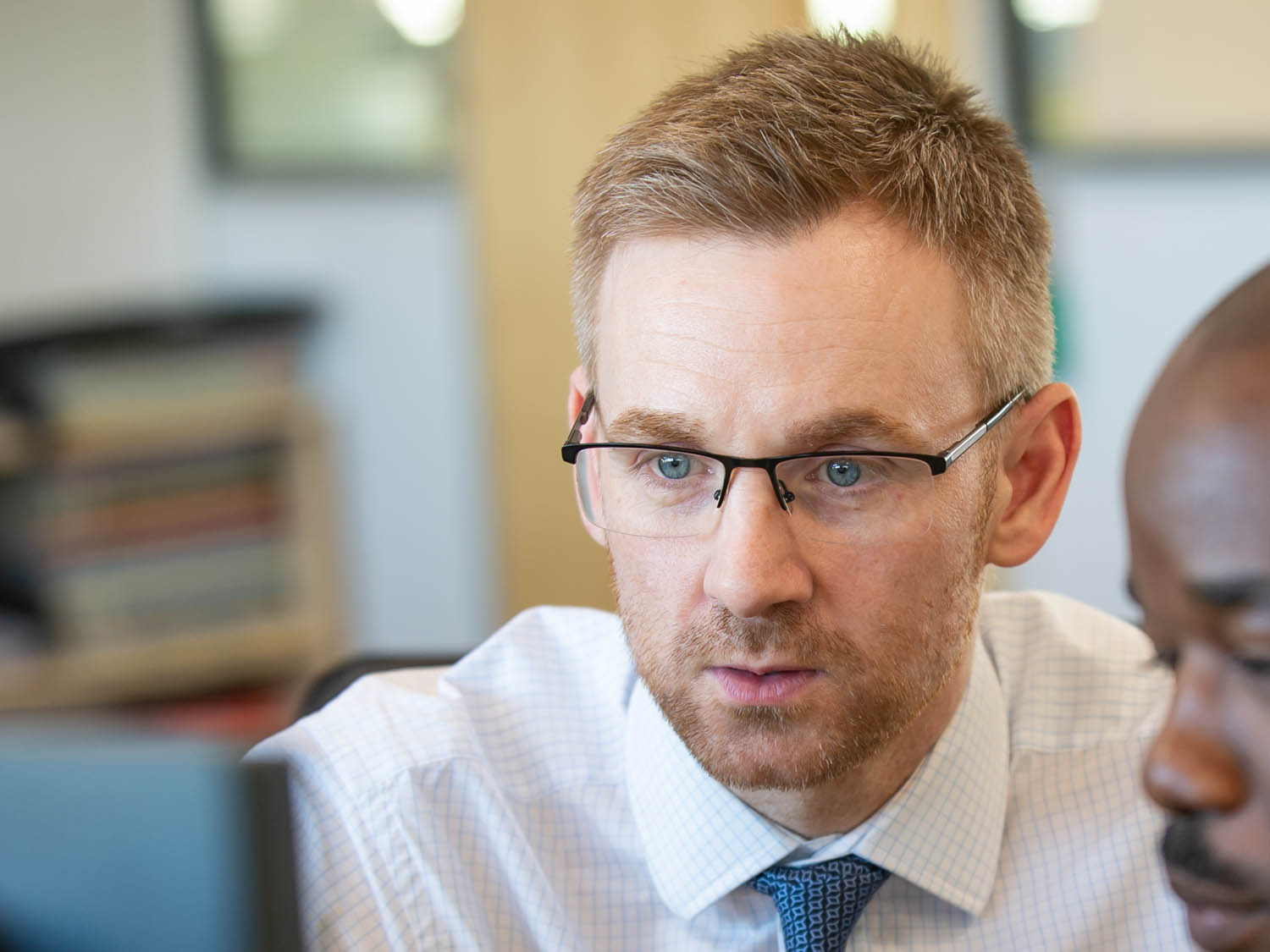
The Metro team talk Simon George

Leading by example

Effective planning for the receipt of inbound ocean cargo, requires accurate arrival dates, but with schedule reliability at all time lows, the effective management of imports has never been more challenging. Metro’s new ‘Vessel Tracking’ tool links directly with transceivers on board, to follow real-time progress and uses AI to detect changes and automatically correct expected arrival dates, so that plans can be updated. 

At Metro shipping, we move over 100,000 containers every year and it's becoming increasingly difficult to solely rely on the arrival data the carriers are providing, we require additional levels of visibility that go way beyond the standard.
According to our systems, less than 20% of container vessels are arriving on time and some trade lanes have reliability of less than 2% on-time schedule reliability. 

The ability of vessels to hit their port berthing window impacts shippers that have goods or equipment tied up on the ocean voyage, with ripple impacts from delays all along the extended supply chain.

The Metro Technical Solutions team have been working closely with Windward, the Predictive Intelligence company, that apply AI to global maritime trade, to integrate their Ocean Freight Visibility solution with the Metro supply chain platform, MVT.

Utilising AI to get predictive ETA data is an important development. To see the impact of vessel behaviour, weather, port congestion all being evaluated is quite exciting for us and Windward's data stacked up incredibly well, in terms of what we found in the predictive data.

The resulting MVT ‘Track Your Vessel’ module improves inbound planning efficiency, with automated data collection and analysis to provide real-time accurate ETA predictions, disruption risk predictions, reasons for delay, and location-based insights for inbound cargo. 

Effective planning for the receipt of inbound ocean cargo, is dependent on knowledge of the vessel’s actual arrival date and even with schedule reliability at all time lows, the automated updating of accurate vessel ETAs by the MVT ‘Track Your Vessel’ module supports the effective management of imports, customs processes and swift delivery to the importer.

In a forthcoming webinar, Metro’s technical solutions director, Simon George, will show how technology can turn transform import challenges into effective operations, that exceed customer expectations.

"We need to provide first-class digital solutions. This last year has been one of the worst in terms of predicting how your supply chain is going to perform. Anything that could’ve gone wrong, has gone wrong. As an example, not only is it costing up to 10x more to move freight, instead of 35 days shipments are taking 45 or 50 days. Technology can’t fix that. But it can help you make decisions within those constraints. You can make data-driven decisions."

Simon, together with former Maersk executive, Lars Jensen and members of the Windward team will discuss how to turn formidable challenges, including supply chain disruption, into promising opportunities. 

The Windward webinar takes place on Thursday 17th March @ 11am. Click HERE to register for this event.

The MVT ‘Track Your Vessel’ module automatically follows all ships carrying containers with our cargo on the water. The module instantly detects an ETA change or an arrival at POD and automatically updates the MVT platform.

Our technical solutions team are constantly innovating and evolving the MVT platforms to ensure that, whatever the challenge, our customers’ products are in the right place, at the right time. 

For further information on our MVT platform and to discuss how we can enhance your supply chains, please get in touch with Eilliot Carlile or Simon George.

AIS

Metro launch enhanced tracking tool as on-time ship arrivals hit six-year low

With global shipping schedule reliability at a six-year low and just 33% of ships arriving on time, during a chaotic year for container shipping, Metro Shipping is enhancing its MVT supply chain platform, with even greater scrutiny of real-time vessel tracking.

The ability of vessels to hit their port berthing window impacts shippers and other carriers that have goods or equipment tied up on the ocean voyage, with ripple impacts along the extended supply chain.

Metro’s new ‘Vessel Tracking’ tool links directly with (AIS) transceivers on ships carrying Metro cargo, to follow real-time progress and detect any ETA change or arrival at POD

The busiest trade lane, the eastbound trans-Pacific to the US West Coast, remained the most under pressure, with on-time performance at 10.4% for November, a slight improvement from October, with an average delay of just over 13 days from Asia in November, which is double the average delay seen a year ago.

Asia–US East Coast services had the seventh-lowest reliability among container trade lanes, Sea-Intelligence data shows, reaching 18.7% in November, up from 15.5% in October. Ships arriving on the US East Coast from Asia were delayed between eight and nine days, also double the level seen in November 2020.

The Asia-North Europe trade lane saw schedule reliability hit 24.5% in November, down from 43.5% in November 2020, while the Asia-Mediterranean lane sat at 22.3% voyage reliability.

On-time performance varies widely across carriers, as ships have faced delayed berth calls and long waits at anchor due to heavy congestion across many ports globally, forcing carriers to make last-minute adjustments to try to return ships to schedule, which has affected reliability.

BBC warn that shipping delays could continue well into 2022 - READ MORE

The 2M Alliance showed the highest schedule reliability, with 46.3% of Maersk vessels hitting their berthing window, Hamburg Süd hit 40.4% and Mediterranean Shipping Co achieving 32.4% on 2,555 voyages during November.

Ocean Alliance members, though, saw generally worsening reliability, with CMA CGM drop 3.7% to 27.9% across 3,352 voyages and Cosco Shipping reliability fall to 20.2% for November on 2,863 voyages.

Don’t forget the statistic of 33% on time arrivals relates to all global container vessel movements – it is not route specific. Deep-sea and, in particular Asia/ Europe/ Asia schedules would actually fall significantly below this figure, with some quoting the majority of vessels arriving off schedule, on the longer haul lanes.

With our enhanced tracking tool, you can ‘see’ the delays and issues, so you can plan and communicate this within your business and to end clients. This is our objective – an early ‘warning system’ that allows you to adjust your supply chain accordingly. It is expected that vessels will continue to be delayed for the foreseeable future and maybe the whole of 2022.

The MVT 'Track Your Vessel' module automatically follows all ships carrying containers with our cargo on the water. The module instantly detects an ETA change or an arrival at POD and automatically updates the MVT platform.

If the ETA change is +- 7 days, the relevant Metro operations team is sent a message by MVT, to advise them that a significant change has occurred and remedial action may be required.

Our technical solutions team are constantly innovating and evolving the MVT platforms to ensure that, whatever the challenge, our customers' products are in the right place, at the right time. 

Creating unique technical and operational supply chain solutions, to address each customer’s unique situation, is what differentiates us and has provided the platform for over four decades of sustained growth.

For further information on our MVT platform and to discuss how we can enhance your supply chains, please get in touch with Eilliot Carlile,  or your usual Metro team account manager, who will advise the options available, to ensure that expectations are met despite market impact.

ECO globe 2021

Metro deliver on ECO promise

Having conceived, created and launched the MVT Eco module in 2021 - to monitor the CO2 equivalent emissions, of each consignment we move - and committed to environmental transparency, Metro has now officially offset our emissions for 2020.

Companies’ response to climate change is arguably the most pressing issue facing society, which is why the UK government joined 38 international partners to welcome the establishment of new international sustainability reporting standards at COP26. 

Metro is among the 13,000 corporations that have committed to environmental transparency, using international sustainability reporting standards, by disclosing our environmental impact and working to reduce greenhouse gas emissions, safeguard water resources and protect forests.

Metro’s MVT Eco module, which is part of our MVT suite of digital solutions and unique supply chain ecosystem management tools, monitors the energy emissions, emission costs and CO2 equivalent emissions, of each consignment we move, by every mode. Metro customers have free access, to monitor the environmental impact of their supply chains and participate in offset projects that will eradicate their CO2 footprint.

Metro partnered with environmental consultancy Comply Direct, to undertake an organisational carbon footprint exercise, to measure, target, reduce and offset our carbon footprint, across all areas under operational control within the UK. Conducted under international sustainability reporting standards, using the internationally recognised GHG Corporate Standard Protocol.

Metro is committed through our ISO 14001 system to reduce our footprint, by fully offsetting current emissions through purchasing verified carbon offsets, which allows Metro to take responsibility for the emissions already released, while taking steps to reduce emissions going forward.

The projects Metro support are aligned with UN Sustainable Development Goals, and include protecting the rainforest in Brazil, providing clean cooking stoves in Kenya and helping to assist the delivery of renewable energy to India, a country currently heavily reliant on coal.

We know that our actions are a small step, but if all companies took similar responsibility and action, we are absolutely convinced it really would make a difference. Many small steps will take you a long way.

In 2022 we will make further progress with additional initiatives, including EV charging points in our office car parks and the adoption of EV company cars as existing cars are replaced. On a larger scale we are working with partners that use the most sustainable methods of fuel and energy and that have adopted, and implemented, their own environmental policies and protocols to ensure that we can create some of the most eco-friendly and green supply chains from and to anywhere, globally.

The MVT ECO module is a cloud-based solution, that is available, free-of-charge, to all our shippers on their MVT dashboard, where they can view key eco statistics related to their movements, to see which areas will benefit most from emissions offsetting and where efforts can have the most impact.

To request a demo or discuss your requirements, please contact Simon George, who leads our technical solution team, or Claus Rasmussen to discuss carbon reduction strategies and the availability of offset projects.

It really does work!

4fold 1

Foldable containers may be cure. Just not yet…

The bulk of the world’s trade is shipped in intermodal shipping containers, which have remained largely unchanged since IMO standardisation 50 years ago, but innovation may be the key to reducing supply chain congestion. Is this a new era of global container shipping?

Few tools of the global economy have survived without major innovations as long as the shipping container and the continuing pandemic-linked supply chain disruption is presenting a significant opportunity to address that.

As ports, terminals and warehouses get congested with containers, both empty and full, the conditions are increasingly favourable for a product innovation that failed to catch on before the pandemic. Shipping containers that collapse to as much as one-fifth their usual size.

The cost of repositioning empty containers to places where they’ll be loaded is about $20 billion, according to the Boston Consulting Group and many will spend days and weeks taking up space in already-jammed holding areas and depots, compounding delays along supply chains.

In 2013, the Dutch container company 4Fold’s 40-foot metal boxes became the first foldable units to get certification from the Container Safety Convention and International Organisation for Standardisation, meeting standards required by shipping lines, terminals and rail companies.

Today more than 15 carriers, shipping via 60 ports worldwide are testing the Delft, Netherlands-based company’s environmentally friendly containers that can be folded into a quarter of their volume, taking up less space on trucks, ships and docks.

The world’s largest shipping line, Maersk, has referred to foldable containers as the “dream of the shipping industry” and leading consumer-goods producers, including Procter & Gamble, are also testing the technology.

Despite sparking hope among carriers and shippers, as the answer to making equipment available more quickly, higher upfront costs and hesitancy to turn to a new business model have so far kept foldable containers from becoming mainstream.

As companies find themselves more pressed to find answers to supply-chain congestion, the trade-offs of investing in a new technology might become smaller. The US-based foldable-container company Staxxon LLC gained full certification for its 20’ product at the height of the pandemic and is planning to put them on the market next year, suggesting it has dozens of potential buyers who’ve indicated interest.

Carriers could save up to 57% in inland transportation costs by relying on foldable containers, according to Singapore University. And despite higher purchase and annual maintenance costs, foldable units would still be a more cost-beneficial option, their research found.

The challenge is defining the optimal mix of foldable and regular containers that carriers should maintain in their inventory.

Too many and the purchase costs could offset the benefits. Too few and you would struggle to find three other foldable containers to create the single unit, that generates efficiency and cost-savings.

Metro are innovators and we will be watching the development of this story with interest. And ready to actively participate in testing, evaluating or investing, in the best interests of our customers. 

We also own many of thousands of containers ourselves within our group of businesses – so know what we are talking about. Please direct any questions or requests for creative solutions to Elliot Carlile who is heading up the programme for Metro clients.

Header image courtesy of HOLLAND CONTAINER INNOVATIONS NEDERLAND B.V.