UK border strategy

Metro’s role in government border strategy

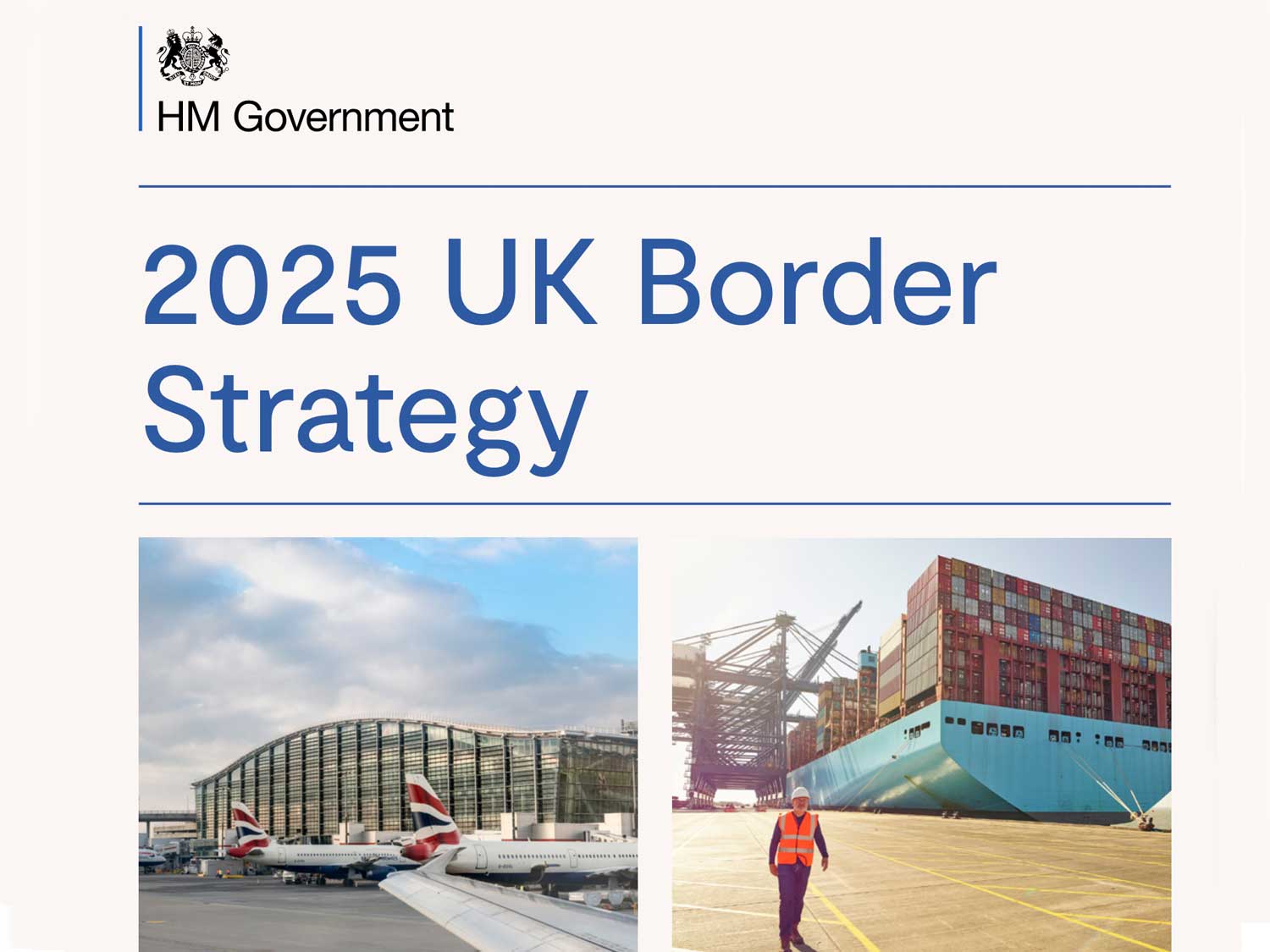
On the 17th December 2020 HM Government (HMG) released its 2025 Border Strategy document, which outlines its intentions for modernising the UK frontier and embraces many technologies and ideas pioneered by Metro.

The 2025 UK Border Strategy sets out the government’s vision for the UK border to be the most effective in the world, with innovations that simplify processes for traders and improves the security and biosecurity of the UK.

This new strategy sets out how the government will work with industry to harness innovative technology to help UK businesses take full advantage of new trading relationships with the rest of the world.

The government is committing to working in partnership with the border industry and users of the border to design, deliver and innovate the border strategy, including the development of upstream compliance, e-documents and a ‘single window’ to avoid duplication of data submission from traders into government.

Metro’s technical team conceive and develop our award-winning MVT supply chain platform and proprietary solutions that keep us at the forefront of our industry, by quantifying and embracing the emerging technologies that add value for our customers.

Metro’s IT experts are actively involved in the development of data exchange standards, including UN/CEFACT projects and were key technical partners in the EU funded CORE project (Consistently Optimised Resilient Secure Global Supply-Chains), to prove the concept and convince the UK Government to adopt a more efficient and modern way of border operation.

It was CORE that ultimately got HMG’s attention and initiate a proof of concept (PoC) to take data from commercial systems for the benefit of government.  

The PoC’s data - including participation by Metro’s MVT platform, involving a number of key clients - was shared across government agencies, who responded positively, recognising the benefits of engaging with commercial systems like MVT, that will play a big role in the future border of 2025.

The UK Border Strategy, 2025 says that new data pipelines (such as those demonstrated by MVT) will enable direct ingestion of industry data from participating traders to automate data submission and that they will leverage existing data pipelines to enable the direct ingestion of industry supply chain data into government systems. 

The Single Trade Window will be at the heart of this approach, ultimately acting as the point of entry for these data pipelines into government. It is critical that we improve and expand the systems and data pipelines that allow us to share information with our international partners. This is essential for keeping the UK secure. 

Successful implementation will smooth trade flows, reduce administrative burden and improve the UK’s position as a global trading nation.

Underpinning this will be a new design authority for the border that will bring together all public sector bodies who design and deliver the border across the UK Government, with expert insight from industry, to take a coordinated approach to border design going forward.

DOWNLOADS

Future Borders - Proof of Concept

2025 UK Border Strategy 

Tariff 2

Tariff code continuity post-transition is good news

The Department for International Trade has confirmed that current commodity codes will continue to be used for trade between Great Britain and the EU, when transition ends on 31st December and the UK has left the Single Market and EU Customs Code.

From the start of 2021, the UK will apply a new tariff to imported goods when the UK Global Tariff (UKGT) replaces the EU’s Common External Tariff (CET).

The government says that the UKGT is simpler, easier to use and lower tariff regime than the EU’s Common External Tariff (EU’s CET) and will be in pounds, not euros. It will scrap red tape and other unnecessary barriers to trade, reduce cost pressures and increase choice for consumers.

Commodity codes are 10-digit numbers allocated to goods to classify them for import and export purposes and to identify the correct duties payable.

On the 1st January the current commodity codes will continue to be used for trade between Great Britain and the EU and the Rest of the World, for trade between GB and Northern Ireland, and from NI to the Rest of the World.

The UK government’s commodity look-up tool on gov.uk has also been updated, with more information about commodity codes post-31st December here. https://www.gov.uk/government/collections/exporting-and-importing-businesses-prepare-for-1-january-2021

Changing the commodity code structure would have been hugely problematic as there would have been insufficient time for traders to reclassify thousands of products.

We think that UK importers will have enough changes to deal with after the end of the EU transition period and welcome the news that the UK’s commodity codes will remain the same from the 1st January onwards.

The government ran a consultation, that generated 1,394 responses from businesses, business representatives, consumers, civil society groups, associations and other interested individuals and organisations, to inform development of the UKGT.

UKGT will apply to all goods imported into the UK – unless the country from which the imports originate has a trade agreement with the UK.

Other exceptions include tariff suspensions or goods that originate in countries that are part of the Generalised Scheme of Preferences.

The UKGT simplifies and liberalises many tariffs on goods imported into the UK.

For more information see the government's guide

Metro’s post Brexit Task Team are working tirelessly to ensure we minimise disruptions. 

Please contact Jade Barrow or Andrew White for further information. 

EU exit 2

Brexit politics round-up 10th December

As Boris’ dinner with Ursula von der Leyen, the European Commission President, fails to end Brexit trade deadlock, the deadline for the end of the transition period is looming, and it’s looking likely that any deal needs to be struck by Sunday, or the UK is leaving the EU without one.

Despite the Prime Minister sending his Brexit negotiator, Lord Frost, to Brussels on Sunday for 48 hours of "intensive" discussions with Michel Barnier and concessions from both sides, sticking points remained, which Johnson and von der Leyen failed to overcome last night.

Failure to agree on new trading arrangements by Sunday will mean the UK leaving without a deal and trading on WTO terms, which would introduce tariffs and quotas.

Medicines are not subject to tariffs under WTO rules, but agricultural and manufactured goods such as cars would become more expensive. The price of cars could increase by 10% while some foodstuffs such as cheese and beef could see a 50% price hike.

‘Yellowhammer’, the leaked Whitehall document outlining the possible worst-case no deal scenarios, predicts a three-month "meltdown" at UK ports and significant tariffs on manufactured and agriculture exports after the UK leaves the EU.

There is some hope that the European Commission may implement contingency plans to smooth out significant disruption albeit on a temporary, unilateral basis. But even this is unlikely, unless it is in the EU’s interest. 

For example, the last time no-deal appeared to be a possibility the commission made plans for bare bones transport connectivity, which gave UK aircraft temporary but limited permission to land in EU airports.

Government ministers are trying to reassure the public that “extensive plans” are in place to guarantee vaccines will still come in from Europe, even in the result of a no-deal Brexit.

The Office for Budget Responsibility (OBR) warned that no-deal would leave the UK worse off to the tune of 1.75% in terms of real GDP next year and that unemployment could reach 8%, while the Bank of England fears that a no-deal Brexit would do more long-term economic damage to the UK than the coronavirus pandemic.

No deal is not sustainable for the long term and eventually the two sides will need to return to the negotiating table. 

Metro’s post Brexit task team are working tirelessly to ensure we minimise disruptions. 

Please contact Jade Barrow or Andrew White for further information. 

Dubai

Brexit: Trade agreements update

After 31st December 2020, EU trade agreements will not apply to the UK, which is why trade negotiators are seeking to reproduce the effects of existing EU agreements, to ensure continuity of trading arrangements for UK businesses after the transition period ends.

From 1st January 2021, if no trade agreement exists between the UK and another country, trade with that country will take place under World Trade Organisation (WTO) rules.

The UK currently trades with many countries on WTO terms, including China, India, Brazil and Saudi Arabia on an MFN basis.

Some developing countries are eligible to get trade preferences through the UK Generalised Scheme of Preferences (GSP), which reduce or remove rates of duty (tariffs) on imports from 1st January 2021.

The UK GSP will initially provide trade preferences to the same countries as the EU GSP, across number of frameworks with differing membership criteria and requirements.

The UK will keep the same rules of origin qualifying operations as the EU GSP product-specific rules and importers will have to pay import duty at the full (non-GSP) rate, if checks carried out by HMRC reveal that the goods do not satisfy the GSP rules of origin.

Follow this LINK for Government guidance on trading with developing nations.

While it was an EU member, the UK was automatically part of around 40 trade deals, with more than 70 countries. The UK has so far signed 23 trade agreements, covering 50 countries, to take effect when existing EU trade agreements no longer apply to the UK, from 1st January 2021.

Since leaving the EU the UK has been working not only on a trade agreement with the EU, but also agreements with the United States, Canada, Australia, Japan and New Zealand. 

In October the government signed a new trade agreement with Japan, which means that 99% of UK exports there will be free of tariffs, though there has been controversy about the value of the deal.

The Department for International Trade (DIT) estimated the 2019 EU-Japan trade deal would add £2 billion to the UK’s annual GDP, which is around £1.1 billion higher than the GDP increase estimated as a result of the new deal.

The new deal goes beyond the EU’s in areas such as e-commerce and financial services, but it has some drawbacks, particularly for agricultural products, which could put UK exporters at a disadvantage.

Prime Minister Justin Trudeau says he thinks Canada and the U.K. can conclude a free trade deal before the UK officially exits the European Union, but his trade minister was unable to offer MPs a firm guarantee that they will see a bill to ratify the trade agreement before the Canadian Parliament breaks for Christmas on the 11th December.

Whatever trade deals are agreed before the 31st December, they will not negate the need for customs formalities and processes, relating to the movement of goods between the UK and EU. 

Our Brexit Task Team recommend that you should now have a fully functioning trade compliance process in place. For further information, contact Andrew White or Jade Barrow.